
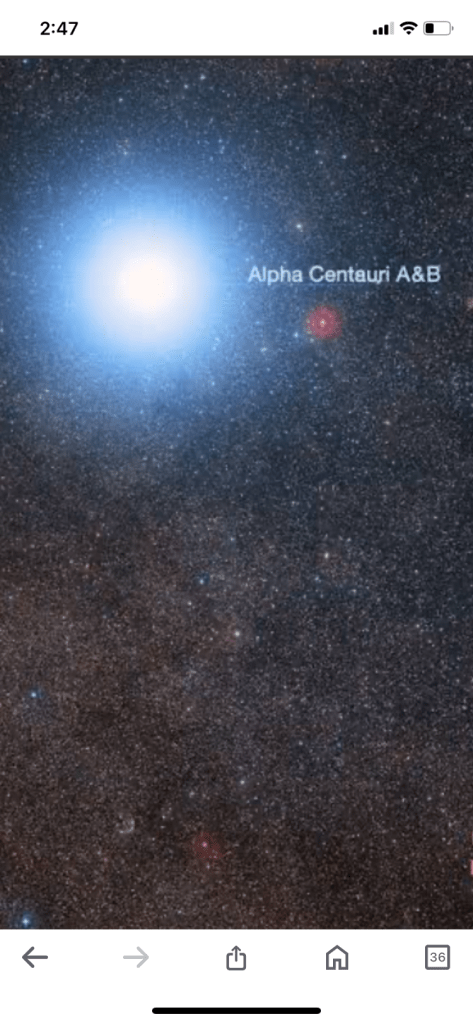
According to ThoughtCo, Alpha Centauri is a gateway to the stars because it’s the closest star system to Earth, located about 4.21 light-years away. The system is made up of three stars:
- Alpha Centauri A: Also known as Rigil Kentaurus, this star is a sun-like G-type star. It’s the brightest of the three stars, and is somewhat larger and brighter than the sun.
- Alpha Centauri B: Also known as Toliman, this star is a bit less massive and half as bright as the sun.
- Proxima Centauri: This dim reddish star weighs in at just 12% of the sun’s mass.
The Alpha Centauri system is a target in the search for habitable planets. The three stars form an inner binary system, with Proxima Centauri orbiting around the inner binary.
Alpha Centauri is the third brightest star in the sky, but it’s located too far south to see from most of the Northern Hemisphere. However, it’s circumpolar in Australia and much of the Southern Hemisphere meaning that it never sets
The brightest of the three is Alpha Centauri A, also known more familiarly as Rigel Kent. It’s the third-brightest star in our night sky after Sirius and Canopus. It is somewhat larger and a bit brighter than the Sun, and its stellar classification type is G2 V
Could Alpha Centauri support life
Scientists think it’s possible that Alpha Centauri could support life. The Alpha Centauri system is a top candidate for finding extraterrestrial life, with a 75% chance of finding a potentially habitable planet
Proxima b is the most likely habitable planet in the system, with a size and distance from its star similar to Earth. However, research suggests it might not have an Earth-like atmosphere. Proxima b is also tidally locked and bombarded by stellar winds, which makes it unlikely to be habitable.
Proxima b is located in the habitable zone of its star, which means its surface could be hot enough to support liquid water. However, Proxima Centauri is a flare star, and Proxima b is subjected to intense stellar winds. These winds are 2,000 times more intense than the winds the sun sends to Earth. This would make it difficult to live there without protective habitats.
The chances of a rocky, potentially habitable planet in our neighboring solar system might therefore be as high as 75 percent. All this puts the Alpha Centauri system high on everyone’s list of places to look for extraterrestrial life
With current technology, it would take about 6,300 years to reach Alpha Centauri, but humans can’t survive the trip. Some say it would take tens of thousands of years to get there, by which point the humans would be long dead
NASA released a mission concept in 2017 that would send a spacecraft to Alpha Centauri in 2069. Even at 10% of the speed of light, it would take a spacecraft 44 years to reach the constellation, and another 4 years for a signal to reach Earth. The concept received no further funding or development.
To design a landing system for Proxima B, one possible option is a descent module, similar to those used in the Apollo missions to the Moon. The Descent module would detach from the main spacecraft, and use its propulsion system to slow down and land on the planet’s surface.
No, my friend, it is not currently possible to travel to Alpha Centauri, and I don’t foresee it happening in our lifetime or the next few centuries, for that matter. You see, Alpha Centauri is a star system located a whopping 4.37 light-years away from our good old planet Earth
As of 2023, the Alpha Centauri system has five detected planets, three of which orbit Proxima Centauri. One of these planets, Proxima Centauri b, is sometimes called Alpha Centauri Cb. It orbits within the habitable zone of a red dwarf star
Alpha Centauri is a star system, not a planet. It’s a group of stars about 4.37 light years from Earth. The system consists of two stars that orbit each other, and their barycenter orbits a third star
Is there intelligent life on Alpha Centauri
According to Universe Today, it’s highly unlikely that an intelligent civilization is located at Alpha Centauri. However, scientists think there could be life at Alpha Centauri. The Alpha Centauri system is high on the list of places to look for extraterrestrial life because there’s a 75% chance of finding a rocky, potentially habitable planet
Proxima Centauri b is the most likely habitable world in the system because of its Earth-like size and distance from its star. However, research suggests it might not have an Earth-like atmosphere. Proxima b is also thought to be tidally locked and inundated by stellar winds, which makes it unlikely to be habitable.
The Alpha Centauri system is about 1.5 to 2 billion years older than our solar system. If life ever began on a planet there, it would have had more time to evolve
Alpha Centauri is special because it’s the closest star system to our solar system. It’s made up of three stars, including Proxima Centauri, which is the closest star to the sun
Alpha Centauri is also the brightest star in the constellation Centaurus, which is named after the mythical half-human, half-horse creature. In mythology, Hercules accidentally wounded the centaur and placed it in the sky after death by Zeus. Alpha Centauri marks the right front hoof of the centaur
How does Alpha Centauri has three stars
Alpha Centauri is a triple star system made up of three stars:
- Alpha Centauri A and Alpha Centauri B A binary pair of yellow dwarf stars that form the inner binary. Alpha Centauri A is about 8% more massive and 50% brighter than the sun, while Alpha Centauri B is about 10% less massive and 50% less bright.
- Proxima Centauri A red dwarf star that orbits around the inner binary. Proxima Centauri is the closest star to the sun, but it’s much smaller and cooler than the sun
The two main stars, Alpha Centauri A and Alpha Centauri B, are designated as Alpha Centauri AB, α Cen AB, or RHD 1 AB. The AB designation denotes the binary system.
The distance between Proxima Centauri and either of Alpha Centauri A or B is similar, so the AB binary system is sometimes treated as a single gravitational object
The Alpha Centauri system, our solar system’s closest neighbor, has become a target in the search for habitable planets. The system is composed of three stars: Alpha Centauri A and Alpha Centauri B, stars forming an inner binary, and Proxima Centauri, an outer star that orbits around the inner binary
Alpha Centauri A is estimated to be between 4.85 and 6.5 billion years old. Some say that the Alpha Centauri star system is slightly older than the sun, which is 4.6 billion years old
Alpha Centauri is a star system, not a galaxy. It’s located in the Milky Way galaxy, which is 100,000 light years in diameter. Alpha Centauri is the closest star system to our Solar System, located 4 light years away
Alpha Centauri is located in the Milky Way galaxy. The Milky Way is a barred spiral galaxy that’s about 100,000 light-years in diameter and contains hundreds of billions of stars. Alpha Centauri is the closest star system to our own, located about 4.37 light-years away in the constellation of Centaurus
Alpha Centauri A and B orbit around a common center with an orbital period of 79 years. To the naked eye, these two main components appear to be a single star with an apparent magnitude of −0.27. Alpha Centauri is the third-brightest star in the sky, outshone by only Sirius and Canopus.
Alpha Centauri is considered one of the relatively few locations in the Milky Way that may offer conditions that are favorable to terrestrial life
Yes, Alpha Centauri is visible from Earth, but only from the Southern Hemisphere. It’s located in the constellation of Centaurus, and can only be seen from south of about 40° north latitude
Alpha Centauri is a close binary star, and appears as a single bright star to the naked eye. However, the third star in the system, Proxima Centauri, is too faint to be seen without a telescope
As seen from Earth, the system is the third brightest star (after Sirius and Canopus); the red dwarf Proxima is invisible to the unaided eye. Alpha Centauri lies in the southern constellation Centaurus and can be seen only from south of about 40° north latitude
Science of the Alpha Centauri system
The two sunlike stars that make up Alpha Centauri are Rigil Kentaurus and Toliman. Rigil Kentaurus, also known as Alpha Centauri A, is a yellowish star, slightly more massive than the sun and about 1.5 times brighter. Toliman, or Alpha Centauri B, has an orangish hue; it’s a bit less massive and half as bright as the sun. Studies of their mass and spectroscopic features indicate that both these stars are about 5 billion years old, slightly older than our sun
The mythology of Alpha Centauri
Alpha Centauri has played a prominent role in the mythology of cultures across the Southern Hemisphere. For the Ngarrindjeri indigenous people of South Australia, Alpha and Beta Centauri were two sharks pursuing a sting ray represented by stars of the Southern Cross. Some Australian aboriginal cultures also associated stars with family relationships and marriage traditions; for instance, two stars of the Southern Cross were through to be the parents of Alpha Centauri
How it got its name
Alpha Centauri is the brightest star in the constellation Centaurus, named after the mythical half human, half horse creature. It represented an uncharacteristically wise centaur that figured in the mythology of Heracles and Jason. Hercules accidentally wounded the centaur and placed it in the sky after death by Zeus. Alpha Centauri marked the right front hoof of the centaur, although little is known of its mythological significance, if any.
In December 1689, while observing a passing comet, French Jesuit priest Father Jean Richaud discovered that Alpha Centauri contained the individual stars Alpha Centauri A (or Rigil Kentaurus) and Alpha Centauri B (or Toliman). This was only the second binary star system to be discovered
Most habitable planet in Alpha Centauri
Proxima Centauri b is a planet in the Alpha Centauri star system that is considered to be the most habitable planet known to the public. It is located about four light-years from Earth, making it the closest known exoplanet to our planet
Proxima Centauri b is slightly larger than Earth, with a mass 1.27 times that of our planet. It orbits a red dwarf star, Proxima Centauri, which is known for producing frequent large stellar flares. The planet’s close orbit to its star means that its year is only 11.185 Earth days long.
Proxima Centauri b is in its star’s habitable zone, which means that its surface may be hot enough to support liquid water. However, the planet is exposed to extreme ultraviolet radiation due to its close proximity to its star
If we travel with the speed of light to Alpha Centauri
If you travel at the speed of light, it would take 4.37 years to reach Alpha Centauri, which is about 4.37 light years away from Earth. Light travels at 300,000 kilometers per second, so if you travel at 186,000 miles per second, it would take 4 years to reach Alpha Centauri. If you travel at half the speed of light, it would take 8 years, and if you travel at 46,000 miles per second, it would take 12 years
Light years
A light year is a unit of distance, not time, and is equal to the distance light travels in a vacuum in one year. One light year is about 5,878,625,370,000 miles (9.5 trillion km). To convert a light year to Earth years, you can divide the distance of a light year by the speed of light, and then divide the result by the number of seconds in a year. This gives a light year as approximately 4.925 billion Earth years long
Light years are used to express astronomical distances because the universe is so huge. For example, the known universe is estimated to be 28 billion light-years in diameter
According to Albert Einstein’s theory of special relativity, nothing can travel faster than the speed of light. Only massless particles, like photons, can travel at the speed of light. It would take an infinite amount of energy to accelerate any material object to the speed of light
However, some say that it’s possible to travel thousands of light years in a few seconds. For example, if you were traveling at almost the speed of light, the journey would seem instantaneous to you. However, thousands of years would have passed for people on Earth.
According to NASA, sending humans to the edge of interstellar space is still science fiction. However, scientists and engineers are developing technologies that might help us get there one day
Please like subscribe comment your precious thoughts on universe discoveries
Full article source google
https://www.amazon.in/b?_encoding=UTF8&tag=555101-21&linkCode=ur2&linkId=80fb4c3470b5df5903dc59fd3da06150&camp=3638&creative=24630&node=1983518031 Universe discoveries
Nice information.
LikeLiked by 1 person
Very nice article with sharing information ℹ️
LikeLike