
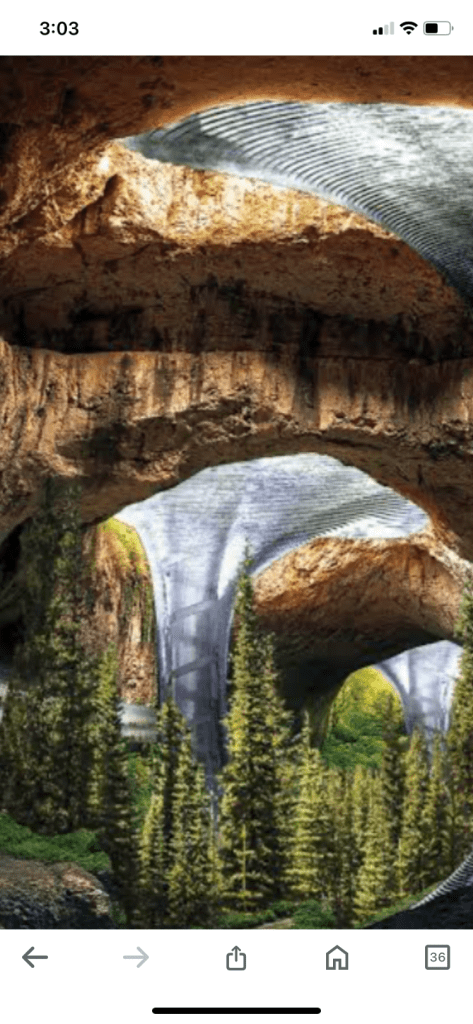
It has been claimed that evidence of ancient human habitation has been found in a huge lava tube in Saudi Arabia. Scientists have said that 10 thousand old evidence has been found. Many important secrets related to the lifestyle of ancient humans have been found in it.
Australia: Matthew Stewart and Michael Petraglia of Griffith University and Hugh Groucutt of the University of Malta, on the Gold Coast in Australia, have made a major and mysterious claim about the ancient human history in Saudi Arabia. Scientists reported that thousands of stone formations can be seen across the landscape of the Arabian Peninsula. On land, you can find plenty of stone tools and ancient fireplaces scattered along the shores of ancient lakes, as well as rock art filled with hunting and shepherding scenes in the surrounding mountains. Scientists have claimed to have found the first evidence of ancient human habitation in a huge lava tube cave in Saudi Arabia.
Scientists said that despite the sites being within sight, archaeologists have only taken dedicated interest in them in the last decade or so. Some structures are now said to be 10,000 years old. However, the dry climate, hot days and cold nights, and strong wind erosion make some of the remains less useful to archaeologists. To date, little has been known about fossils or deeply buried, layered deposits that can open a window into the history of a place. Until recently, no archaeologist had surveyed any of the hundreds of caves and lava tubes recorded in northern Arabia. In 2019 the team began looking at these underground spaces – and a new study published in PLOS One revealed the first documented occupation of lava tubes in the Arabian Peninsula.
How was the lava tube made?
The Umm Jirsan Lava Tube is located in the Harat Khaybar lava field, about 125 kilometers north of the city of Medina. This tube was formed long ago by the cooling of lava. Its length is 1.5 kilometers, and in some parts the height reaches 12 meters and width 45 meters. The first thing you notice when entering the dark and twisting tunnels of the Tube is the huge number of animal remains. Scattered across the floor were piles of bones containing thousands – if not hundreds of thousands – of exceptionally preserved fossils. These bone piles are the work of striped hyenas, which drag the bones underground to eat, hide them in times of food shortage, or process them to feed to cubs. This process, repeated over millennia, has produced some of the most incredible accumulations of fossils seen anywhere in the world. But it’s not all just bones. When the entrances to Umm Jirsan were surveyed, essentially areas where the roof had collapsed, providing access to the lava tube, hundreds of stone artefacts made of obsidian, chert and basalt were uncovered.
10 thousand years of evidence
Radiocarbon dating of charcoal found in the cave, and dating of sediments using a method called optically stimulated luminescence dating, showed that this main occupation phase probably occurred between 7,000 and 10,000 years ago. We also found some interesting objects in the surrounding landscape. These included more stone artefacts and circular structures, as well as a so-called “I-type” structure. These constructions are believed to date back about 7,000 years, based on their association with large rectangular structures called mustatils, which are believed to have been used for ritual animal sacrifice. We also found the first rock art discovered in the area.
It includes scenes of herding cattle, sheep and goats and even hunting scenes involving dogs. The art has similarities with other rock art from the Neolithic and later Bronze Age in Arabia. Archaeologists have made remarkable discoveries in recent years at sites such as ancient lake beds in Arabia. This discovery at Umm Jirsan adds another important element to the story of Arab societies over time. (The Conversatio
How does lava tubes on earth human evidence can relate to mars lava tubes and habitability
Lava tubes are well-known on Earth, and space missions have observed similar features on Mars and the Moon. This has led to a debate among planetary geologists about whether similar processes on Earth could have created similar features on other planets
Lava tubes are underground networks of tunnels that can extend up to 65 kilometers. They are formed when lava flows through the ground, leaving behind empty tunnels with hardened walls, floors, and ceilings.
On Earth, lava tubes are found in many volcanic areas, including Hawaii, Iceland, Lanzarote, and Sicily. Space missions have observed chains of collapsed pits and “skylights” on the moon and Mars that have been interpreted as evidence of lava tubes.
Lava tubes could provide natural shelters or serve as essential spaces for human-built habitats on other planets. They could also be good places to pressurize and build habitats with less material than what would be needed on the surface.
Lava tubes can provide evidence of:
- Dissolution activity Speleothems like gypsum and halite form in lava tubes due to evaporation of marine spray.
- Geological history Lava tubes form when molten rock flows from the ground, cools, and solidifies to create a protective layer.
- Environmental conditions Lava tubes offer relatively stable environmental conditions that are more hospitable than those found on a planet’s surface.
- Microbial life Caves are unique environments where secondary mineral precipitation and microbial growth are enhanced by stable physico-chemical conditions. This means that caves may contain a record of secondary mineralization that would inform us on past aqueous activity.
- Daily life Middens within lava tubes have contained ʻopihi shells, stone tools, and other evidence of daily life.
Why are lava tubes important
Lava tubes are important for a number of reasons:
- Geological history The walls of lava tubes can provide evidence of lava flow and meteor impacts, which can help us understand Earth’s history.
- Astronauts Lava tubes on the moon and Mars could provide natural shelter for astronauts from radiation, micrometeorites, and unstable temperatures.
- Humans Lava tubes are used by humans for shelter and storage. They are thermally stable, so they can keep food cool and last longer. Lava tubes are also a source of fresh water, as saltwater filters through the volcanic rock and drips into the lava tunnels.
- Biodiversity Lava tubes are home to many small, unusual animals, including bats, bears, and ring-tailed cats. In Hawaiian lava tubes, whole ecosystems have developed on the roots of trees that penetrate into the caves.
- Recreation Lava tubes are the second most common type of cave used for recreational purposes
What is the cultural significance of lava tubes
Lava tubes have cultural significance in many ways, including:
- Shelter In ancient times, lava tubes were used for shelter from the elements and during times of war.
- Ceremonies and burials Lava tubes have been central in some ceremonies and burials, such as the placement of the bones of important individuals in the caves.
- Rock art The artifacts and rock art found in lava tubes can serve as vibrant cultural expressions, shedding light on the beliefs, values, and social structures of the people who created them. For example, the rock art in Saudi Arabia’s lava tubes shows a society that was deeply connected to its surrounding environment and the animals that inhabited it.
- Archaeological abundance Research has highlighted an area in Arabia that once acted as a key point for cultural exchanges and trades amongst ancient people, and it all takes place in vast caves and lava tubes.
- Visual impact The Geomunoreum lava tube system in Jeju has multi-colored carbonate decorations adorning the roofs and floors, and dark-colored lava walls, partially covered by a mural of carbonate deposits.
What does the term lava tubes refer to
लावा ट्यूब एक प्राकृतिक नाली है जो तब बनती है जब लावा ज्वालामुखी के छिद्र से बहता है और लावा प्रवाह की कठोर सतह के नीचे चला जाता है। लावा ट्यूब मंगल, शुक्र, बुध और चंद्रमा के साथ-साथ स्थलीय पाहोहो लावा प्रवाह पर भी पाए जा सकते हैं। लावा ट्यूब प्रवाह के भीतर घुमावदार चैनल हैं जहां लावा सबसे गर्म और सबसे अधिक तरल होता है। जब प्रवाह बढ़ना बंद हो जाता है, तो लावा जम सकता है और ट्यूब में भर सकता है, जिससे एक गुफा निकल जाती है।
लावा ट्यूब तब बनती हैं जब लावा चैनलों और पाहोहो के ऊपर की परत बहती है। जैसे ही लावा ठंडा होता है, यह जम कर काले पत्थर में बदल जाता है, और लावा के ऊपर की चट्टान मोटी और चौड़ी हो जाती है, जिससे नीचे पिघली हुई चट्टान पर एक छत बन जाती है। अंततः, लावा ट्यूब पिघली हुई चट्टान को निकालती है, और पीछे एक गुफा सुरंग छोड़ जाती है।
एक विस्तृत लावा-प्रवाह क्षेत्र में अक्सर एक मुख्य लावा ट्यूब और छोटी ट्यूबों की एक श्रृंखला होती है जो एक या अधिक अलग-अलग प्रवाह के सामने लावा की आपूर्ति करती है।
सबसे लंबी ज्ञात लावा ट्यूब हवाई में काजुमुरा गुफा है, जिसमें 65 किमी का मार्ग और 101 प्रवेश द्वार हैं।
Collapsed lava tubes on the Moon are also known as pyroducts
The most recognizable features of collapsed lava tubes are known as “sinuous rilles”. These features are often interpreted as collapsed lava tubes.
Lava tubes on the Moon are also sometimes called air holes or ice caves
Martian lava tubes are volcanic caverns that form when basaltic lava flows are fast-moving. The external surface of the lava channels cools quickly, forming a hardened crust over the subsurface lava flows. When the lava has drained, parts of the roof of the tube will collapse under its own weight. These collapse pits will only be as deep as the bottom of the original lava tube
Here are some examples of lava tubes on Mars:
- Hephaestus Fossae: A system of channels and troughs in the Utopia Planitia region
- Pavonis Mons: The central volcano of the three “shield” volcanoes that comprise Tharsis Montes
Martian lava tubes are volcanic caverns on Mars that are believed to form as a result of fast-moving, basaltic lava flows associated with shield volcanism. Lava tubes usually form when the external surface of the lava channels cools more quickly and forms a hardened crust over subsurface lava flows
Can humans live in Martian lava tubes
According to NASA, lava tubes are the most practical places to install the first human bases on Mars
Lava tubes are underground caves formed by volcanic activity. They could provide protected habitats large enough to house streets on Mars or even towns on the Moon.
Lava tubes can naturally protect humans from: deadly radiations, extreme temperature variations, dust storms, and micrometeorite impacts.
Lava tubes would also allow mission durations to be largely unrestricted by radiation exposure. They would also allow the use of a wider range of sensitive equipment that would otherwise be unworkable or difficult to maintain.
However, one Quora user thinks that living in lava tubes is a terrible idea. They say that you will not extract water from a stone, meaning that basalt will not be water-bearing. You must have water to survive on Mars
Extrapolating their results to Mars, they calculated that living in a Hellas lava tube, people might experience just about 61.64 μSv/day. That’s still high, but closer to what you could expect if you got your teeth X-rayed several times a day than what you could expect living in a habitat on the surface of Mars
Please like subscribe comment your precious thoughts on universe discoveries
Full article source google
Best pet supplies on discount on Amazon
https://www.amazon.in/b?_encoding=UTF8&tag=555101-21&linkCode=ur2&linkId=ff74c1040ede9fe5a6888ed894d0e4b2&camp=3638&creative=24630&node=2917484031 Universe discoveries
I recently read that archaeologists have found the oldest bread in the Black Desert (Jordan). It is 14,400 years old.
LikeLiked by 1 person
In 2018, archaeologists discovered the remains of a flatbread baked 14,400 years ago in the Black Desert of northeastern Jordan
LikeLike
Yes it’s true
LikeLike