
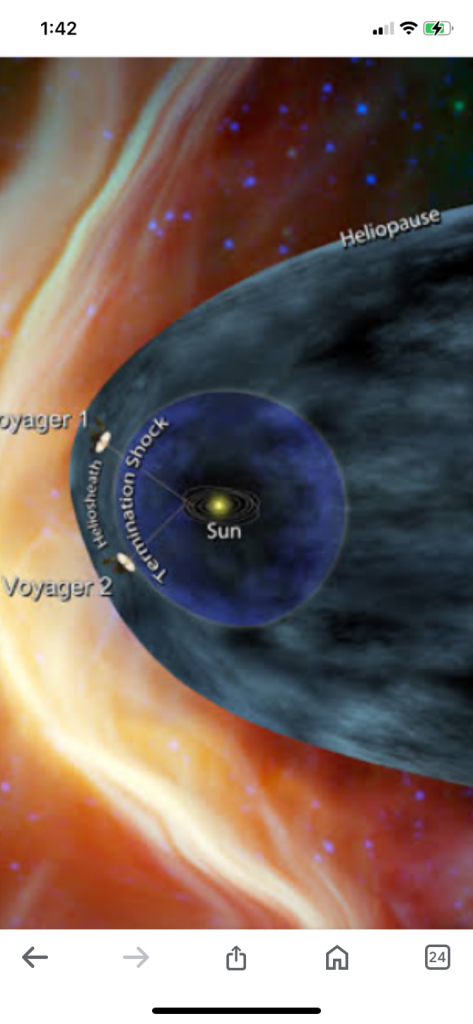
The edge of the solar system depends on the criteria used to define it. For example, the edge of the solar system could be where the planets end, which is at Neptune and the Kuiper Belt. However, the Sun’s magnetic fields extend beyond Neptune and the Kuiper Belt, so the edge could also be defined by the heliosphere, which is the limit of the Sun’s magnetic fields. The heliopause, which is the limit of the heliosphere, is estimated to be about 9 billion miles (15 billion km) from the Sun.
The edge of the solar system could also be defined by the stopping point of the Sun’s gravitational influence, which is at the Oort Cloud. The Oort Cloud is the furthest and most expansive potential solar system boundary, extending up to around 100,000 astronomical units (AU) from the Sun. One AU is about 150 million kilometers.
NASA’s Voyager 1 spacecraft is around 125 AU from Earth and is believed to have entered interstellar space in 2012
Where is the end of solar system
The solar system doesn’t have a clear boundary. However, the Oort Cloud is thought to be a giant spherical bubble that surrounds the solar system, planets, and Kuiper belt. The Oort Cloud is made of icy space debris the size of mountains and sometimes even larger. It’s thought to contain billions of small cometary nuclei and reach almost halfway to the nearest star
Based on where the planets end, you could say it’s Neptune and the Kuiper Belt. If you measure by edge of the Sun’s magnetic fields, the end is the heliosphere. If you judge by the stopping point of Sun’s gravitational influence, the solar system would end at the Oort Cloud
Distance from earth to the edge of solar system
The edge of the solar system is about 15 trillion kilometers (9.3 trillion miles) away from Earth. The Oort Cloud, which is thought to be the edge of the solar system, starts 1,000 to 5,000 astronomical units (AU) from the Sun and extends to around 100,000 AU. One AU is the average distance between Earth and the Sun, which is about 150 million kilometers.
The heliopause is another boundary region that some consider the edge of the solar system. It’s the area where the Sun’s solar wind meets the solar winds of other stars. The heliopause is estimated to be about 17.6 billion miles (120 AU) away
Our solar system is so big it is almost impossible to imagine its size if you use ordinary units like feet or miles. The distance from Earth to the Sun is 93 million miles (149 million kilometers), but the distance to the farthest planet Neptune is nearly 3 billion miles (4.5 billion kilometers
The solar system has a diameter of 287.46 billion kilometers, and is 143.73 billion kilometers from the Sun. Astronomers use astronomical units (AU) to describe the distance between objects in space, and one AU is roughly the average distance between the Earth and the Sun
The distance to the farthest planet, Neptune, is almost 4.5 billion kilometers. For comparison, the farthest distance a person can walk in one day is 70 miles, and the International Space Station travels 400,000 miles in 24 hours
Size of the solar system in light years
The solar system is roughly 0.5 to 1 light year in diameter, though the exact size is debated. This is because the Oort Cloud, a collection of asteroids that surrounds the solar system, extends up to 1 light year away from the Sun. Some experts consider the Oort Cloud to be part of the solar system, making the diameter 1 light year. Others say the solar system extends to the Oort Cloud, which is about 100,000 astronomical units away, or roughly 1.5 light years
If we consider it to be a part of the solar system then the diameter is measured to be equal to 1.5 light years. However, if we do not take the Oort cloud to be inside the solar system, then its diameter is equal to only 0.5 light years in length
According to NASA, it would take about 1.87 years to travel to the edge of the solar system at light speed. The edge of the solar system is the Oort Cloud, which is about 2 light years from the Sun. However, light takes about 40 times longer to leave the solar system than to reach Earth from the Sun, which takes just over 8 minutes. This means it would take about 5 hours for light to leave the solar system
Earth is about eight light minutes from the Sun. A trip at light-speed to the very edge of our solar system – the farthest reaches of the Oort Cloud, a collection of dormant comets way, way out there – would take about 1.87 years
Heliosphere
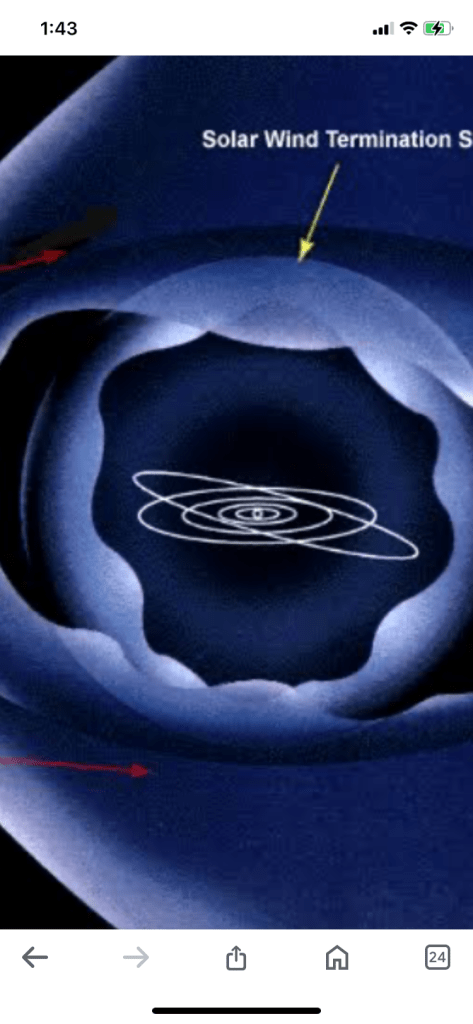
The heliosphere is a vast, bubble-like region of space that surrounds the Sun and its planets, and is made up of the Sun’s outermost atmospheric layer, magnetosphere, and astrosphere. It’s shaped like a bubble with a tail and is formed by the Sun’s constant flow of charged particles, known as the solar wind, which travels past the planets and into the interstellar medium. The heliosphere protects the planets from interstellar radiation
The heliosphere is influenced by the Sun’s magnetic field and the solar wind. The heliosheath is the area where the solar wind slows down and starts to interact with the interstellar medium. The heliosphere separates the solar system from the Milky Way galaxy, which is made up of more than 100 billion stars and contains harsh space radiation
What is beyond heliosphere
Interstellar space is the region that lies beyond the heliosphere, where the Sun’s magnetic field and material no longer affect their surroundings. This region is also known as the space between stars, but it’s not empty. It contains a sparse distribution of atoms, molecules, neutrinos, charged particles, dark matter, and photons, ranging from cosmic microwave background light to high-energy radiation
The heliosphere’s edge is about 120 astronomical units (AU) from the Sun, which is four times farther than Neptune, the farthest major planet from the Sun. The Sun’s gravity also extends beyond the heliosphere, keeping the Oort Cloud in place, which is a sphere of dust, ice, and space debris
The heliopause is the final known boundary between the heliosphere and the interstellar space that is filled with material, especially plasma, not from the Earth’s own star, the Sun, but from other stars
What happens outside the heliosphere
Outside the heliosphere, the solar wind slows down and mixes with the interstellar medium (ISM). The heliopause is the boundary where the solar wind’s pressure equals that of the ISM, and the Sun’s magnetic influence weakens. The heliopause is about 11 billion miles (18 billion km) from the Sun.
The heliosphere protects the Solar System from most cosmic rays, which are deadly high-energy particles that come from supernovae and other energetic events. However, uncharged gamma rays aren’t affected. If the heliosphere disappeared, Earth would be exposed to these rays, which could harm any remaining life
Outside the heliosphere, this solar plasma gives way to the interstellar plasma permeating the Milky Way. As part of the interplanetary magnetic field, the heliosphere shields the Solar System from significant amounts of cosmic ionizing radiation; uncharged gamma rays are, however, not affected
The heliosphere protects the Solar System from most cosmic rays, which are energetic particles that would otherwise bombard the Earth and damage living cells. The heliosphere also plays a role in the interaction between the solar wind and interstellar neutral atoms. The interaction of the heliosphere with the local interstellar medium (LISM) is believed to generate energetic neutral atoms (ENAs). Global images of the heliosphere in ENA fluxes are a powerful tool to study the solar wind interaction with the surrounding LISM.
The heliosphere is also an ideal laboratory to test the behavior of a diluting and cooling plasma. Understanding the heliosphere is important for studying plasma dynamics, magnetospheric systems, and space weather prediction. The scientific study of the heliosphere is heliophysics, which includes space weather and space climate.
The heliosphere acts as a shield that protects the planets from interstellar radiation
What is the difference between heliosphere and interstellar space
The heliosphere is a bubble created by the Sun that protects the planets from interstellar radiation.Interstellar space is the space between stars, also known as the interstellar medium. The heliopause is the boundary between the heliosphere and interstellar space, where the Sun’s magnetic field and material stop affecting their surroundings
The heliosphere is filled with plasma, or charged particles, that flow out from the Sun in every direction. The interstellar medium is made up of gas, dust, and cosmic rays that move between star systems. The heliosphere is hotter than the interstellar medium, which is about 10,000 degrees Fahrenheit (6,000 Kelvin).
The heliosphere’s size and shape change as it moves through different parts of the interstellar medium
Scientists define the beginning of interstellar space as the place where the Sun’s constant flow of material and magnetic field stop affecting its surroundings. This place is called the heliopause. It marks the end of a region created by our Sun that is called the heliosphere
The heliopause
The heliopause is the boundary between the solar wind and the interstellar medium, where the pressure from both equals out and the solar wind can’t go any further. It’s located about 123 astronomical units (AU) from the Sun, or 18 billion kilometers (11 billion miles). The heliopause’s shape changes due to the interstellar gas wind caused by the Sun’s movement through space. The orbits of all the major planets, including Earth’s, are located within the heliopause.
The heliopause is the outermost part of the heliosheath, which is the area where the solar wind slows down and interacts with the interstellar medium. The heliosheath has three parts: the termination shock, the heliopause, and the area between the inner and outer boundaries.
The Voyager 1 spacecraft has already passed beyond the solar bubble and into interstellar space, while Voyager 2 is still exploring the solar bubble’s outer layer.
Yes, Voyager 2 left the heliopause and entered interstellar space on November 5, 2018. Voyager 2 is the second spacecraft to leave the heliosphere, after its twin Voyager 1 in 2012. Voyager 2’s exit occurred in the heliosphere’s southern hemisphere, while Voyager 1’s was in the northern hemisphere
The Oort clouds
The Oort cloud is a spherical shell of icy debris that surrounds the Sun, planets, and Kuiper Belt Objects. It’s the furthest region of our solar system, extending from one-quarter to halfway from the Sun to the next star. The Oort cloud is thought to contain billions or trillions of icy planetesimals, which are objects in space that are too small to be considered planets but came into existence during the formation of planets. The planetesimals are made of frozen water, frozen methane, and frozen ammonia, and are sometimes the size of mountains or larger
The Oort cloud is home to most long-period comets, which take more than 200 years to orbit the Sun. Scientists believe that the Oort cloud is the source of these comets, and that sometimes something disturbs the orbit of one of these icy worlds, causing it to fall toward the Sun. Two recent examples of this are comets C/2012 S1 (ISON) and C/2013 A1 Siding Spring.
Dutch astronomer Jan Oort proposed the concept of the Oort cloud in 1950, and it’s named after him. He theorized that comets have long periods of time between their orbits and come from many different directions, so they must be coming from some sort of cloud on the outer edge of the solar system
What is interstellar space?
Interstellar space – the space between the stars – isn’t just empty space. There’s a lot of “stuff” out there, including hydrogen (70%) and helium (28%), formed in the Big Bang that set our universe into motion. The other 2% of “stuff” in interstellar space is heavier gases and dust, consisting of the other elements made inside stars and spewed into space by supernovae. The material in interstellar space is very spread out. It’s denser in some places than in others, but a typical density is about one atom per cubic centimeter. Still, even the most dense regions of interstellar space count as vacuum, compared with our earthly air
How was the solar system formed
The solar system formed about 4.6 billion years ago when a dense cloud of gas and dust collapsed due to the shockwave of a nearby exploding star, called a supernova. The collapse created a spinning disk of material called a solar nebula, with gravity pulling more material into the center. Eventually, the pressure in the core became so great that hydrogen atoms began to combine and form helium, releasing a large amount of energy and creating the Sun. The Sun then amassed more than 99% of the available matter.
As the Sun formed, small condensations in the disk formed the planets and their satellites. The energy from the young Sun blew away the remaining gas and dust, leaving the solar system as we see it today. The planets’ orbits are nearly circular and range from one-third to 30 times the size of Earth’s orbit. Mercury, the closest planet to the Sun, orbits in about three months, while Neptune takes 165 years
Please like subscribe comment your precious thoughts on universe discoveries
Full article source google
Best kitchen items on heavy discount on Amazon
Best health books on discount on Amazon

Fascinating! I just can’t fathom the size of our solar system.
LikeLike
Fascinanting!
LikeLike
Very good post with sharing 💥
LikeLike