
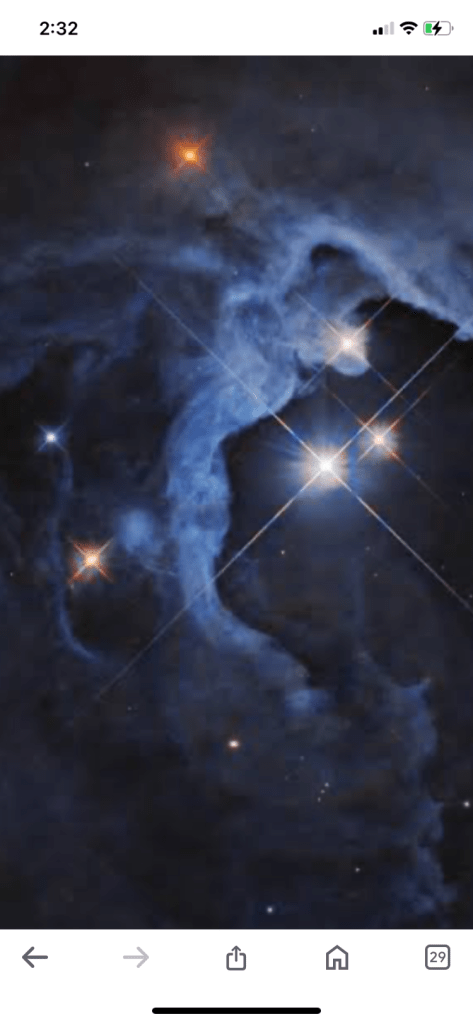
In a world that seems to be switching focus from the Hubble Space Telescope to the James Webb Space Telescope, Hubble still reminds us it’s there. Another amazing image has been released that shows the triple star system HP Tau, HP Tau G2, and HP Tau G3
The stars in this wonderful system are young, HP Tau for example is so young that it hasn’t started to fuse hydrogen yet and is only 10 million years old!
Hubble was launched in 1990 and since then, has revolutionised our understanding of the Universe. It orbits Earth at an altitude of around 547 kilometres and from that position has provided us stunning views of objects across the cosmos. It is about the size of a classic British double decker bus and at its core, a 2.4m mirror. The mirror collects incoming light from distant objects before directing it to one of a number of instruments that record and analyse it.
Another amazing image has been released that shows the triple star system HP Tau, HP Tau G2, and HP Tau G3. The stars in this wonderful system are young, HP Tau for example is so young that it hasn’t started to fuse hydrogen yet and is only 10 million years old!
NASA explained that the triple-star system is made up of the variable star HP Tau, HP Tau G2, and HP Tau G3. “These three stars blaze from the hollowed-out cavity of a reflection nebula, illuminating the surrounding clouds,” it said
Explaining the HP Tau star, NASA said that HP Tau is classified as a T Tauri star, which is a young variable star that hasn’t begun nuclear fusion yet, but is starting to evolve into a hydrogen-fueled star similar to the Sun. T Tauri stars are typically younger than 10 million years old and are often found still swaddled in the clouds of gas and dust from which they formed
NASA added, “A variable star’s brightness changes over time, but T Tauri stars have both periodic and random fluctuations in brightness,” adding that the random changes could be caused by things like flares on the star’s surface, whereas periodic changes might be due to giant sunspots rotating in and out of view
HP Tau, the brightest star in the trio, is a stellar infant. Unlike our Sun, a seasoned 4.6 billion years old, HP Tau is a mere 10 million years old. Classified as a T Tauri star, it hasn’t ignited nuclear fusion yet, but it’s on its way to becoming a Sun-like star. These youngsters are often found cloaked in the leftover dust and gas from their birth, which explains the swirling nebula surrounding HP Tau, NASA said in a news release.
True to its variable star nature, HP Tau’s brightness fluctuates. These changes can be erratic, influenced by the chaotic environment of a developing star. The swirling disk feeding the star, material falling onto its surface, and even giant sunspots on its surface can all contribute to the star’s unpredictable shine.
Sharing the picture on Instagram, the space agency wrote, “HP Tau, 550 light-years from Earth, is the youngest star in a three-star system. (It’s the one at the top of the triangle.) HP Tau is in the process of turning into a star like our Sun, but it’s likely less than 10 million years old-for comparison, the Sun is around 4.6 billion years old.”
What are triple star systems
A triple star system, also known as a tertiary star system, is a hierarchical structure of three stars that orbit a common center of mass. In this arrangement, two stars form a close binary system, and the third star orbits the binary at a much greater distance
According to NASA, up to 10% of star systems in the universe could be triple star systems. The closest triple star system to Earth is Alpha Centauri, which is about 4.37 light-years away
What is meant by triple star system?
A hierarchical triple stellar system consists of three bodies organized in two nested orbits – one central binary and a third star orbiting the center of mass of this binary at a larger distance. We shall call the two bodies constituting the binary stars 1 and 2, and the outer body star 3
What are the 3 star systems?
Triple star systems
In a physical triple star system, each star orbits the center of mass of the system. Usually, two of the stars form a close binary system, and the third orbits this pair at a distance much larger than that of the binary orbit. This arrangement is called hierarchical
Are triple star systems stable?
As far as is known, all observed stable triple stars are hierarchical systems, although theoretically other types of stable systems exist
What is the nearest 3 star system?
Alpha Centauri
Aside from the sun, Alpha Centauri is a group of three stars that are the closest stars to Earth. The distance of this nearest star system is about 4 light-years away. The system is composed of Rigil Kentaurus (Alpha Centauri A), Toliman (Alpha Centauri B), and Proxima Centauri (Alpha Centauri C)
Sirius a triple star system?
That Sirius is a binary star was first reported by the German astronomer Friedrich Wilhelm Bessel in 1844. He had observed that the bright star was pursuing a slightly wavy course among its neighbours in the sky and concluded that it had a companion star, with which it revolved in a period of about 50 years
What is a star system example?
Examples. Some star systems are: Our own solar system, with the Sun at its centre (one star) Sirius (two stars
Can a planet orbit three stars?
Scientists have observed abnormalities in the behavior patterns of the three stars and have speculated that an unseen planet may be orbiting all three stars simultaneously
Is Alpha Centauri A triple star system?
The Alpha Centauri system, our solar system’s closest neighbor, has become a target in the search for habitable planets. The system is composed of three stars: Alpha Centauri A and Alpha Centauri B, stars forming an inner binary, and Proxima Centauri, an outer star that orbits around the inner binary
Dynamics of the Triple-Star System Alpha Centauri and its Impact on Habitable Planets
The Alpha Centauri system, our solar system’s closest neighbor, has become a target in the search for habitable planets. The system is composed of three stars: Alpha Centauri A and Alpha Centauri B, stars forming an inner binary, and Proxima Centauri, an outer star that orbits around the inner binary. We computed 3-body models to follow the dynamics for the main-sequence lifetimes of the stars that are based on 100 realizations of the observed orbits. In the majority of cases, Proxima only modestly torques the A-B binary orbit, and so previous studies of planet formation and dynamics, which find the habitable zones to be stable, are somewhat justified in ignoring this effect. On the other hand, in ~16% of the observationally allowed orbits, fluctuations in the orbital eccentricity of the A-B orbit destabilize the middle of the habitable zone of both stars. This result calls for further theoretical work to quantify the effect of galactic tides, passing stars, and massive planets in the triple-system dynamics.
Are there any 7 star systems?
It is thought to be a member of a septuple star system, one of only two known star systems with a multiplicity of 7, the other being Nu Scorpii
Is Orion a triple star system?
Orion’s Belt is a line of three stars located around the middle of the constellation Orion. The belt is perhaps the most recognizable feature of Orion. Visible around the world, the constellation is named after the eponymous hunter in Greek mythology
HP Tau is known as a T Tauri star, a type of young variable star that hasn’t begun nuclear fusion yet but is beginning to evolve into a hydrogen-fueled star similar to our Sun
HP Tau is part of a triple star system — the three separate stars are visible at the center of this image — surrounded by a large arcing reflection nebula. These nebulae, as the name suggests, reflect the light from nearby stars rather than glowing like emission nebulae elsewhere in the Universe
Difference between single star system and triple star systems
Triple star systems are less stable than single-star systems and have more complex dynamics. The stability of planets orbiting a star depends on the configuration of the stars and the planets’ orbits
Triple-star systems make up about 10% of all star systems, but far fewer planets have been observed in them than in single-star systems. This could be due to observational bias, or because planet formation is less common in multiple-star systems.
The presence of a third star in a binary system can significantly alter the evolution of the stars and the binary system. The rich dynamical behavior in three-body systems can give rise to Lidov-Kozai cycles, in which the eccentricity of the inner orbit and the inclination between the inner and outer orbit vary periodically
Are triple star systems habitable
Planets in triple star systems can be habitable if the main star isn’t too large and the stars are not too equal in size. However, multiple stars can make it difficult for life to survive on these planets because they can disrupt a planet’s orbit and cause habitable zones to change dramatically
According to NASA, up to 10% of star systems in the universe could be triple star systems, also known as tertiary systems. In September 2021, astronomers detected an exoplanet orbiting a tertiary system for the first time, suggesting that life could exist in these systems.
The Alpha Centauri system, which includes three stars, is our nearest stellar neighbor. The outermost star, Proxima Centauri, is known to host at least one planet
Please like subscribe comment your precious thoughts on universe discoveries
Full article source google
Best history books on discount on Amazon Universe discoveries
Hubble is amazing. I sent a link to your website to a woman seeking science blogs. I have one that is not updated, but how she found me.
LikeLike