
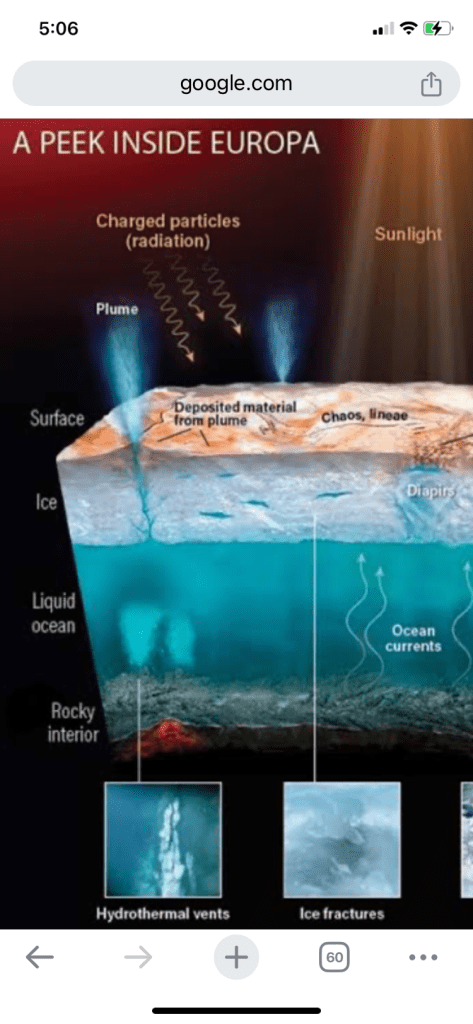
Planetary scientists have theorized that hydrothermal vents at the bottom of the oceans beneath the ice on moons of Jupiter like Europa and Ganymede, and the Saturn satellite Enceladus, could help warm those oceans and kickstart the biochemistry of life
What are the hydrothermal vents in Europa?
Previous studies indicated that the waters on Europa are salty; they are also likely heated by hydrothermal vents, which could provide a source of energy and nutrients
Where can hydrothermal vents be found?
Hot springs on the ocean floor are called hydrothermal vents. The most numerous and spectacular hydrothermal vents are found along world’s mid-ocean ridges. The heat source for these springs is the magma (molten rock) beneath the volcanic ridge system
What organisms live in hydrothermal vents?
Animals such as scaly-foot gastropods (Chrysomallon squamiferum) and yeti crabs (Kiwa species) have only been recorded at hydrothermal vents. Large colonies of vent mussels and tube worms can also be found living there. In 1980, the Pompeii worm (Alvinella pompejana) was identified living on the sides of vent chimneys.
Low-temperature hydrothermal vents could survive on the dark ocean floors of moons like Jupiter’s Europa for potentially billions of years, new computer simulations have shown, as astrobiologists strive to figure out whether these alien oceans could be habitable
Hydrothermal vents are both a source of chemical energy and heat, and are one of the possible locations for the origin of life on Earth. Planetary scientists have theorized that hydrothermal vents at the bottom of the oceans beneath the ice on moons of Jupiter like Europa and Ganymede, and the Saturn satellite Enceladus, could help warm those oceans and kickstart the biochemistry of life.
The problem is that modeling of these vents has focused on the extremely high-temperature ones — the “black smokers” powered by volcanic activity. While these super-hot vents can siphon energy from Earth’s hot core, the icy moons do not have hot cores, meaning there’s been a question mark over whether such vents could survive long enough to create the long-term conditions for life.
Life is abundant on Earth, but we haven’t yet found it anywhere else in the universe. How do we search for life beyond our home planet? Scientists say we should look for three key ingredients that make life possible: liquid water, chemistry, and energy. Also, life takes time to develop. We should look for life on worlds where sufficient time has passed for life to get started.
Jupiter’s icy moon Europa may have these essential ingredients and is as old as Earth. NASA is sending the Europa Clipper spacecraft to conduct a detailed exploration of Europa and investigate whether the icy moon, with its subsurface ocean, has the capability to support life. Understanding Europa’s habitability will help scientists better understand the potential for finding life beyond our planet and guide us in our search
Water
Liquid water tops the list of ingredients for life, and Europa has lots of it. Scientists think Europa has a salty ocean beneath its icy crust with about twice as much water than all of Earth’s oceans combined. Water dissolves nutrients for organisms to eat, transports important chemicals within living cells, supports metabolism, and allows those cells to get rid of waste. Scientists are confident there’s a rocky seafloor at the bottom of Europa’s ocean. Hydrothermal activity could possibly supply chemical nutrients that could support living organisms.
Chemistry
Along with water, life as we know it also needs certain chemical elements – the building blocks of life – including carbon, hydrogen, nitrogen, oxygen, phosphorus, and sulfur. These elements are common in the universe and make up 98% of living matter on Earth by combining to form organic molecules essential to life. Scientists think these elements were likely incorporated into Europa as the moon formed. Later, asteroids and comets collided with the moon and may have left more organic materials.
Energy
The third ingredient for life is energy. All lifeforms need energy to survive. On Earth, most of that energy comes from the Sun. For example, plants grow and thrive through photosynthesis, a process that converts sunlight into energy. The energy is transferred to humans, animals, and other organisms when the plants are eaten.
But the type of life that might inhabit Europa likely would be powered purely by chemical reactions instead of by photosynthesis, because any life at Europa would exist beneath the ice, where there is no sunlight.
For centuries humankind have wondered whether life exists elsewhere in the universe. But only since the mid-20th century, with great advances in technology, have scientists been able to research extraterrestrial life
However, scientists may not need to go too far to find life as there are places off Earth in our solar system which may have the correct conditions for life to evolve. The most famous hunt is for life on Mars, but our best chance might be Jupiter’s moon Europa.
EUROPA, THE ICE COVERED MOON
Europa was discovered in 1610 by the astronomer Galileo Galilei and it is one of the 79 moons of Jupiterand one of the four bright Galilean moons so easy to see with a telescope.
POTENTIAL FOR LIFE ON EUROPA
Life as we know it has three main requirements: an energy source, the right organic compounds and liquid water, and it is possible that Europa has all three of these
Europa’s surface is blasted by radiation from Jupiter.That’s a bad thing for life on the surface – it couldn’t survive. But the radiation may create fuel for life in an ocean below the surface. The radiation splits apart water molecules (H2O, made of oxygen and hydrogen) in Europa’s extremely tenuous atmosphere
Europa’s ocean is also probably in direct contact with warm rock at the seafloor. As Europa revolves around the gas giant, the icy moon’s interior flexes. The flexing forces energy into the moon’s interior, which then seeps out as heat (think of how repeatedly bending a paperclip generates heat). The more the moon’s interior flexes, the more heat is generated.
The interaction with warm rock could supply hydrogen and other chemicals to the ocean. While the energy input for life on Earth comes primarily from the Sun, Europa’s energy input might come from surface chemistry and water-rock interactions on the seafloor.
Decades ago, science fiction offered a hypothetical scenario: What if alien life were thriving in an ocean beneath the icy surface of Jupiter’s moon Europa? The notion pulled Europa out of obscurity and into the limelight where it has remained, stoking the imaginations of people both within and outside the science community who fantasize about humans discovering life beyond Earth. That fantasy, however, may be grounded in reality.
In 1972, scientists using a telescope at Kitt Peak National Observatory in Tucson, Arizona, made spectroscopic observations that showed that Europa’s surface composition is mostly water ice. Thermal models dating back to 1971 also suggested that the interior of Europa could contain a layer of liquid water.
NASA’s Pioneer 10 and 11 spacecraft flew by Jupiter in the early 1970s, but the first spacecraft to image the surfaces of Jupiter’s moons in significant detail were the Voyager 1 and 2 spacecraft.
Europa is named for a woman who, in Greek mythology, was abducted by the god Zeus – Jupiter in Roman mythology.
Atmosphere
Europa has only a tenuous atmosphere of oxygen, but in 2013, NASA announced that researchers using the Hubble Space Telescope found evidence that Europa might be actively venting water into space. This would mean the moon is geologically active in the present day.
Please like subscribe comment your precious thoughts on universe discoveries
Full article source google
https://www.amazon.in/b?_encoding=UTF8&tag=555101-21&link Universe discoveries
Very interersting!
LikeLiked by 2 people
Yes 👍
LikeLiked by 1 person