
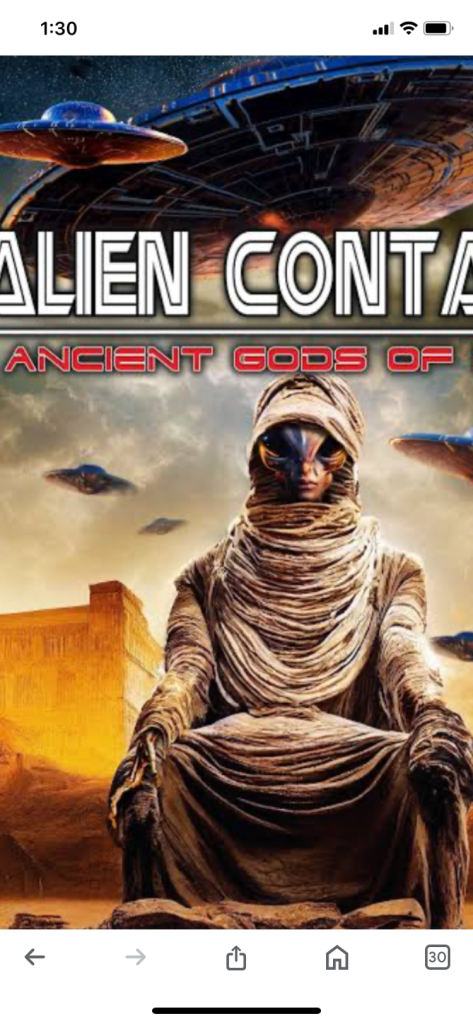
The idea that ancient astronauts or aliens visited Earth and made contact with humans in prehistoric times is a pseudoscientific belief called “ancient astronauts”. Academics and archaeologists consider these claims to be unscientific and pseudoarchaeological
Some say that if Earth-like planets are common, some may have developed intelligent life long ago and may have even developed interstellar travel. However, there is no convincing evidence that extraterrestrial civilizations have visited Earth or their probes have been there
Did ancient humans know about space?
Ancient peoples from across the Earth only knew about five of the planets: Mercury, Venus, Mars, Jupiter, and Saturn. To the people of some ancient civilizations, the planets were thought to be representations of deities, for others they were a means through which gods communicated to humans.
Ancient astronauts (or ancient aliens) refer to a pseudoscientific set of beliefs that hold that intelligentextraterrestrial beings visited Earth and made contact with humans in antiquity and prehistoric times. Proponents suggest that this contact influenced the development of modern cultures, technologies, religions, and human biology. A common position is that deities from most, if not all, religions are extraterrestrial in origin, and that advanced technologies brought to Earth by ancient astronauts were interpreted as evidence of divine status by early humans
The idea that ancient astronauts existed and visited Earth is not taken seriously by academics and archaeologists, who identify such claims as pseudoarchaeological and/or unscientific. It has received no credible attention in peer reviewed studies. When proponents of the idea present evidence in favor of their beliefs, it is often distorted or fabricated. Further, the history of thought surrounding the subject shows that proponents have adopted white supremacist beliefs to argue that indigenous cultures around the world were incapable of the feats of technology and culture that they achieved.
History of ancient aliens beliefs and their proponents
Paleocontact or “ancient astronaut” narratives first appeared in the early science fiction of the late 19th and early 20th centuries, including the 1898 novel Edison’s Conquest of Mars and the works of H.P. Lovecraft. The idea was proposed in earnest by journalist Harold T. Wilkins in 1954. It grew in popularity in the 1960s, mainly due to the Space Race and the success of Erich von Däniken’s works, although it also received limited consideration as a serious hypothesis. Critics emerged throughout the 1970s, discrediting Von Däniken’s claims. Ufologists separated the idea from the UFO controversy. By the early 1980s little remaining support could be found.
Carl Sagan co-authored a widely popular book Intelligent Life in the Universe, with Soviet astrophysicist Iosif Shklovsky and published in 1966. In his 1979 book Broca’s Brain, Sagan suggested that he and Shklovsky might have inspired the wave of 1970s ancient astronaut books, expressing disapproval of “von Däniken and other uncritical writers” who seemingly built on these ideas not as guarded speculations but as “valid evidence of extraterrestrial contact.” Sagan pointed out that while many legends, artifacts, and purported out-of-place artifacts were cited in support of ancient astronaut hypotheses, “very few require more than passing mention” and could be easily explained with more conventional hypotheses. Sagan also reiterated his earlier conclusion that extraterrestrial visits to Earth were possible but unproven and improbable
There are multiple matches for Prometheus, including a Titan and god in Greek mythology, a monitoring system, and a 2012 film:
- Greek mythology Prometheus is a Titan, god of fire, and trickster in Greek mythology. His name may mean “forethought”, and he symbolizes planning and thinking ahead. In some versions of the myth, Prometheus is credited with creating humans from clay and teaching humans technology and useful arts. He is also associated with fire and the creation of mortals, and is often depicted with fire in ancient art. Prometheus’s love for humans often put him in conflict with Zeus, the chief of the Olympian gods, and he was punished for stealing fire from Olympus and giving it to humans.
- Monitoring system Prometheus is an open-source monitoring system that uses a dimensional data model to identify time series. It can store time series in memory and on local disk, and offers multiple ways to visualize data, including a built-in expression browser, Grafana integration, and console template language. Prometheus also includes PromQL, which allows users to slice and dice time series data to generate graphs, tables, and alerts.
- 2012 film Prometheus is a 2012 film directed by Ridley Scott and starring Noomi Rapace, Michael Fassbender, Charlize Theron, and Idris Elba. The film follows clues to the origin of mankind and received generally positive reviews, though some criticized its script and unresolved plot points. It grossed over $403 million worldwide and has a sequel, Alien: Covenant, which was released in 2017
The possibility of alien life, or extraterrestrial life, beyond Earth has been speculated about since ancient times. However, some say that the harsh conditions and different chemical compositions of other planets’ atmospheres make it more likely that alien life is a speculation than a reality
Some rough estimates suggest that there are around 5 billion Earth-like planets in the habitable zone around sunlight stars. However, these planets may not have liquid water on their surfaces
It’s no secret that far more people watch TV shows like the History Channel’s ‘Ancient Aliens’ than attend lectures by professional archaeologists and historians. Millions of people tune in to watch TV series and docu-dramas with a questionable grip on facts about the past. The stories spun by producers and writers may have some basis in truth, but they’re largely stories — they’re compelling stories, though, and they’re aimed at a general audience the way that most academic output isn’t.
People are also reading books about ancient aliens and other forms of pseudoarchaeology, according to archaeologist Donald Holly. He starts a recent open-access book review section in the journal American Antiquity by asking archaeologists to entertain the idea of pseudoarchaeology — just for a little bit — so that we can create better teachable moments, whether we’re talking to students or to anyone interested in our jobs. People who read these books are not ignorant or obstinate, he points out, but rather undecided about alternative archaeological explanations and clearly interested in understanding the past. ”It’s time we talk to the guy sitting next to us on the airplane,” Holly asserts. In collecting nine reviews of popular-on-Amazon pseudo-archaeology books by professional archaeologists, Holly hopes that this will both “offer the silent and curious majority that is interested in these works a professional perspective on them” and give archaeologists unfamiliar with the books a pseudoarchaeology primer
For beings that are supposedly alien to human culture, extraterrestrials are pretty darn common. You can find them in all sorts of cultural contexts, from comic books, sci-fi novels and conspiracy theories to Hollywood films and old television reruns. There’s Superman and Doctor Who, E.T. and Mindy’s friend Mork, Mr. Spock, Alf, Kang and Kodos and My Favorite Martian. Of course, there’s just one hitch: They’re all fictional. So far, real aliens from other worlds have refused to show their faces on the real-world Earth — or even telephone, text or tweet. As the Italian physicist Enrico Fermi so quotably inquired during a discussion about aliens more than six decades ago, “Where is everybody?”
Scientific inquiry into the existence of extraterrestrial intelligence still often begins by pondering Fermi’s paradox: The universe is vast and old, so advanced civilizations should have matured enough by now to send emissaries to Earth. Yet none have. Fermi suspected that it wasn’t feasible or that aliens didn’t think visiting Earth was worth the trouble. Others concluded that they simply don’t exist. Recent investigations indicate that harsh environments may snuff out nascent life long before it evolves the intelligence necessary for sending messages or traveling through space
But now everybody does. In the space of the last two decades, conclusive evidence of exoplanets, now numbering in the thousands, has reconfigured the debate and sharpened Fermi’s original paradox. No one any longer doubts that planets are plentiful. But still there’s been not a peep from anyone living on them, despite years of aiming radio telescopes at the heavens in hope of detecting a signal in the static of interstellar space.
Maybe such signals are just too rare or too weak for human instruments to detect. Or possibly some cosmic conspiracy is at work to prevent civilizations from communicating — or arising in the first place. Or perhaps civilizations that do arise are eradicated before they have a chance to communicate
Please like subscribe comment your precious thoughts on universe discoveries
Full article source google and Wikipedia
https://www.amazon.in/b?_encoding=UTF8&tag=555101-21&link Universe discoveries
Ancient astronauts are a fun idea to explore. Thanks for sharing.
LikeLike