
A Massive Water Reservoir in Space
Yes, it’s true! Astronomers have discovered a protoplanetary disk around a young star that contains an astonishing amount of water vapor. This reservoir is estimated to hold three times the volume of Earth’s oceans.
The discovery was made using the Atacama Large Millimeter/submillimeter Array (ALMA) telescope. The water vapor is located in a region of the disk where planets are likely to form, suggesting that water could be a common ingredient in the formation of planets throughout the universe.
This finding has significant implications for our understanding of the origin of life. Water is essential for life as we know it, and the abundance of water in space increases the chances of finding habitable planets.
The recent discovery of a massive water reservoir in space was made around a young star, located in a protoplanetary disk. This disk is a region of gas and dust where planets are forming. The specific location of the star and its protoplanetary disk is not publicly available at this time.
However, astronomers are constantly searching for water in other parts of space, including:
- Comets: Comets are known to contain large amounts of water ice.
- Exoplanets: Some exoplanets have been found to have atmospheres that contain water vapor.
- Interstellar space: Water molecules have been detected in interstellar space.
As technology continues to advance, astronomers will likely discover even more water-rich regions of space in the future.
Water Vapor Detected in SpaceScientists have discovered a massive amount of water vapor in space, surrounding a young star named HL Tauri, located 450 light-years away
There’s been a big development in the search for life in the universe, after scientists discovered an enormous presence of water vapour.
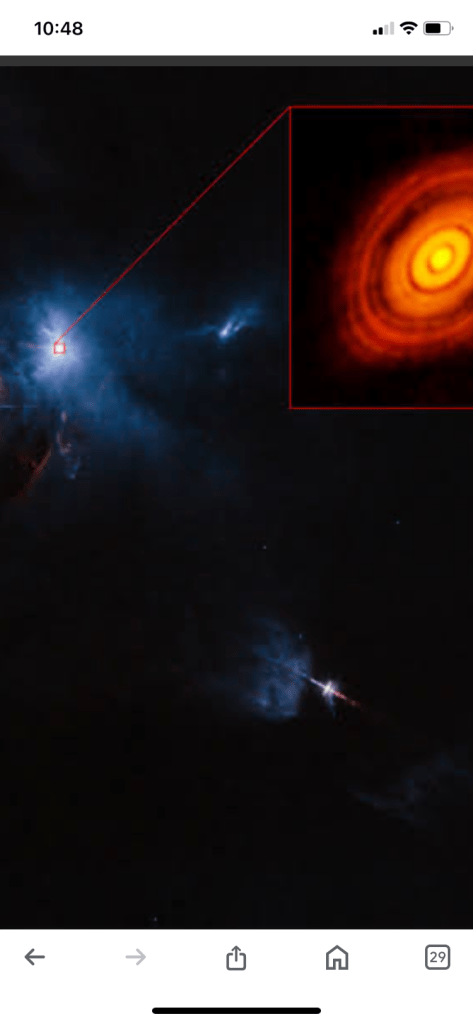
The new research focuses on a gas and dust disk surrounding a young star, which was observed using the Atacama Large Millimeter/submillimeter Array (ALMA).
The star, named HL Tauri, is found 450 light-years away and surrounded by a staggering amount of vapour
In fact, it adds up to three times the volume of all the oceans on Earth, and it could mark the birthplace of planets
Stefano Facchini from the University of Milan is the lead author on the project and shared his excitement at seeing “an image of oceans of water vapour in the same region where a planet is likely forming.”
Water, as ever, has been fundamental to a number of new scientific developments over recent times
Water is essential for sustaining life on any planet, and there has been much speculation about how Earth came to have water. Some believe that comets and asteroids delivered water to Earth, while others think the planet came with water when it was born
No one can be sure yet, but examining planetary systems like HL Tauri can provide insights into this mystery.The Taurus Molecular Cloud, of which HL Tauri is a part, is the largest and closest star-forming region to Earth. The stars born here are known as T Tauri stars. Looking at the observations by ALMA, one can see concentric gaps in the disk. The team believes that these gaps are carved by the forming planets. As they form, the planets sweep up material in the disk as they orbit the star
The star’s proximity and the clear view of the disk provided the scientists with a great opportunity to take a more detailed look at the water vapor and its contribution to the formation of planets. ALMA’s discovery is quite an achievement, as distinguishing water from such a vast distance would not have been possible for ground-based telescopes earlier, due to the vapors in Earth’s atmosphere obscuring the view
The story of oceans is the story of life. Life as we know it requires three ingredients: energy, organic molecules, and liquid water. Our search for life beyond Earth is, in part, a search for planets and moons that harbor substantial liquid water. We call these places “ocean worlds,” and we’re learning that they could be ubiquitous in the galaxy.
Oceans define our home planet, covering the majority of Earth’s surface and driving the water cycle that dominates our land and atmosphere. But more profound still, the story of our oceans places our home in a far larger context that reaches deep into the universe and places us in a rich family of ocean worlds that span our solar system and beyond.
Water molecules exist in the Orion Nebula and are still forming today. The nebula is composed mostly of hydrogen gas; other molecules are comparatively rare. Even so, the nebula is so vast that it creates enough water every day to fill Earth’s oceans 60 times over. Water, along with every other molecule created in these stellar nurseries, becomes raw material for the formation of new planetary systems
Oceans of Our Solar System
Which planets and moons in our solar system are considered ocean worlds?
Earth isn’t the only ocean world in our solar system. Water on other worlds exists in diverse forms on moons, dwarf planets, and even comets. Ice, water vapor in the atmosphere, and oceans on other worlds offer clues in the quest to discover life beyond our home planet.
Jupiter’s Moon Europa
Scientists strongly suspect that a salty, subsurface ocean lies beneath Europa’s icy crust. Tidal heating from its parent planet, Jupiter, maintains this ocean’s liquid state and could also create partially melted pockets, or lakes, throughout the moon’s outer shell. The Hubble Space Telescope has spotted possible water plumes erupting from the moon’s surface, which may be excellent targets for NASA’s upcoming Europa Clipper mission.
How far is HL Tauri from Earth?
456.6 light yearsHL Tauri/Distance to Earth
HL Tauri (abbreviated HL Tau) is a young T Tauri star in the constellation Taurus, approximately 450 light-years (140 pc) from Earth in the Taurus Molecular Cloud
Which telescope was used to see HL Tauri?
the Hubble Space Telescope
This is a composite image of the young star HL Tauri and its surroundings using data from ALMA and the Hubble Space Telescope
Astronomers using the Atacama Large Millimeter Array (ALMA) radio telescope in Chile have detected water vapor in the disk of HL Tauri, a young, Sun-like star in the Taurus constellation
- Water quantity The inner disk of HL Tauri contains at least three times as much water as all of Earth’s oceans.
- Water location The water vapor is found in a ring-like gap where scientists suspect a planet is forming.
Distance
The water vapor was detected at a distance of 450 light-years from Earth
Significance
The study’s authors say that the discovery reveals a new link between water and planet formation
The observations reveal at least three times as much water as in all of Earth’s oceans in the inner disc of the young Sun-like star HL Tauri, located 450 light-years away from Earth in the constellation Taurus
Please like subscribe comment your precious thoughts on universe discoveries
sk-mania-blogs.in
Full article source google
https://www.buymeacoffee.com/Satyam55
Buy me a coffee!” (your opportunity to say thanks for the free stuff and to encourage me to do even more)
<!– /wp:heading https://www.amazon.in/b?_encoding=UTF8&tag=555101-21&link
“If you like my work or the free stuff on this website and want to say thanks, or encourage me to do more, you can buy me a coffee!
Contribute to my coffee fund with any amount you are comfortable to pay.
The coffee will give me the ‘kick’ to work even harder to empower creative entrepreneurs
 Universe discoveries
🙏🌹
Aum Shanti
LikeLiked by 1 person
🌺🌺
LikeLiked by 1 person