

The Sun’s galactic orbit plays a significant role in shaping our cosmic environment and the evolution of life on Earth. Here are some key effects:
- Galactic tides: The Sun’s orbit around the Milky Way galaxy creates gravitational tides similar to those caused by the Moon on Earth. These tides can influence the formation and evolution of stars and planets within the galaxy.
- Exposure to interstellar material: As the Sun orbits the galaxy, it encounters various interstellar clouds and materials. These encounters can affect the Sun’s activity, such as solar flares and sunspots, which in turn can impact Earth’s climate and space weather.
- Orbital stability: The Sun’s orbit is relatively stable, which is essential for the long-term survival of our solar system. If the Sun’s orbit were to become significantly perturbed, it could lead to catastrophic consequences for Earth and the other planets.
- Galactic environment: The Sun’s position within the Milky Way galaxy also influences the overall galactic environment. For example, the Sun’s location in a relatively quiet region of the galaxy has likely contributed to the development of complex life on Earth.
- Cosmic rays: The Sun’s orbit exposes it to cosmic rays, high-energy particles that originate from distant galaxies. These cosmic rays can interact with Earth’s atmosphere and create secondary particles that can affect climate and biological processes.
Overall, the Sun’s galactic orbit is a complex and interconnected phenomenon that has far-reaching implications for our understanding of the universe and our place within it.
The galactic year, also known as a cosmic year, is the duration of time required for the Sun to orbit once around the center of the Milky Way Galaxy.1] One galactic year is approximately 225 million Earth years. The Solar System is traveling at an average speed of 230 km/s (828,000 km/h) or 143 mi/s (514,000 mph) within its trajectory around the Galactic Center, a speed at which an object could circumnavigate the Earth’s equator in 2 minutes and 54 seconds; that speed corresponds to approximately 1/1300 of the speed of light.
The galactic year provides a conveniently usable unit for depicting cosmic and geological time periods together. By contrast, a “billion-year” scale does not allow for useful discrimination between geologic events, and a “million-year” scale requires some rather large numbers
The following list assumes that 1 galactic year is 225 million years.TimeEventGalactic
years
(gal)Millions
of years
(Ma)Past (years ago)About 61.32 galBig Bang. 54 galBirth of the Milky Way20.44 galBirth of the Sun17–18 gal3937 MaOceans appear on Earth16.889 gal3800 MaLife begins on Earth15.555 gal3500 MaProkaryotes appear12 gal2700 MaBacteria appear10 gal2250 MaEukaryian period. first appearance of eukaryotes[Stable continents appear6.8 gal1530 MaMulticellular organisms appear2.4 gal540 MaCambrian explosion occurs2 gal500 MaThe first brain structure appears in worms1.11 gal250 MaPermian–Triassic extinction event0.2933 galCretaceous–Paleogene extinction event0.0013 galEmergence of anatomically modern humans
How many times has the Sun orbited the galaxy?
In reality, the Sun is dragging us around the galaxy at around 800,000km/h, taking around 250 million years to complete a single orbit. That means our Solar System has made around 18 complete circuits since it was formed around 4.5 billion years ago
What is the time it takes the Sun to orbit the galactic center?
approximately 225 million Earth years
The galactic year, also known as a cosmic year, is the duration of time required for the Sun to orbit once around the center of the Milky Way Galaxy. One galactic year is approximately 225 million Earth years
Is the Sun orbiting a black hole?
Just like the moon orbits Earth and our planet orbits the sun, our home star is also circling the Milky Way — or, more accurately, orbiting the supermassive black hole at the center of our galaxy. The entire Milky Way is actually constantly spinning around our galaxy’s black hole heart
How many suns are in Milky Way?
The sun is an ordinary star, one of about 100 billion in our galaxy, the Milky Way.
The next galactic year, also known as a cosmic year, will occur in 225 million years. A galactic year is the time it takes for the Sun to complete one orbit around the center of the Milky Way Galaxy
How many galactic years has Earth had?
About 19.566 ‘galactic’ years. The Sun takes about 230 million years to complete a revolution around the center of the galaxy, so that is a galactic ‘year
Is Milky Way moving?
We could measure the motion of the Milky Way relative to a neighbor galaxy, but this galaxy is also moving. The universe is filled with great islands of stars (just like the Milky Way) and each of them is moving in its own way. No galaxy is sitting still
How long is a galactic cycle?
about 200 to 250 million years
A long cycle involves the revolution of the solar system around the center of the disk-shaped Galaxy. This revolution is estimated to take about 200 to 250 million years (Rampino and Stothers, 1986)
How old is the sun now in 2024?
Our Sun is 4,500,000,000 years old. That’s a lot of zeroes. That’s four and a half billion.
What is the 42 galactic years?
42 is the number of galactic years that the Sun-Earth system will survive before it’s destroyed. And 42 is the expansion rate of the entire Universe, in miles-per-second-per-megaparsec. It really could be the answer to the ultimate question about life, the Universe, and everything
Will our sun go supernova?
Our sun isn’t massive enough to trigger a stellar explosion, called a supernova, when it dies, and it will never become a black hole either
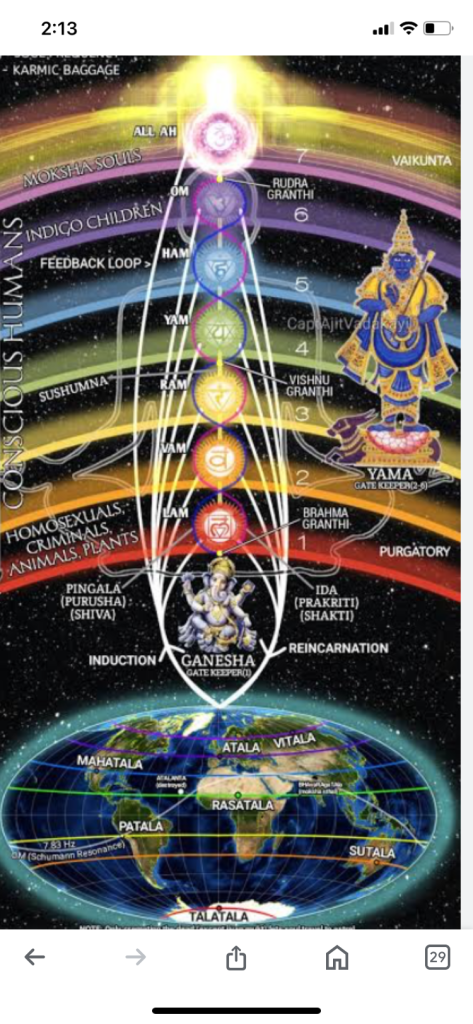
The yugas cycle in Hinduism and sun journey in the Milky Way
Hinduism states that the world, through Brahma, evolved from the Navel of Lord Vishnu.
Brahma , with the blessings of Lord Vishnu created the world by producing Daksha Prajapathi , the first Man.
Then the entire Humanity evolved.
This is creation part elaborated.
Now to Astronomy.
The Sun ascends and descends from the navel of Lord Vishnu,.
Sun takes 12, 000 years for ascension, moving towards the navel, and 12’000 years for descending, moving away from Lord Vishnu’s Navel.
( in Earth Years and the distance from the navel of Lord Vishnu to the center of the earth)
These 24,000 year of Ascending and Descending cycle approximates the 25,765 Precessional Years when the sun moves backwards in the 12 zodiacal constellations.
This is from the Surya Siddhanta.
1.Lord Vishnu’s Nabhi as the center of our Milky way Galaxy verified.
“The Galactic Center cannot be observed at visible, ultraviolet, or x-ray wavelengths because interstellar dust obscures the line of sight. All scientific information about it comes from observations of gamma ray, hard X-ray, infrared, and radio wavelengths. The precise astronomical location of the Galactic Center at approximately 3 degrees Sagittarius (sidereal) was first verified in 1918 by Harlow Shapley. However its energetic connection to the earth was not realized until 1932 when Karl G. Jansky, an engineer working for Bell Telephone, was investigating the source of the static interference with overseas telephone lines. He discovered that the interference was due to radio waves being emitted from the center of the galaxy. The source of the radio waves appears to be located almost exactly at the Galactic Center, and may coincide with a super massive black hole. This black hole has the equivalent mass of 4 million suns and is the source of most of the gravitational energy in our galaxy. Thus the Galactic Center is the Sun around which our Sun rotates. Hinduism understood this connection between Sun and the Galaxy, and used it as a marker for the ascending and descending yuga cycles that are measured by our Earth/Sun relationship to it (ie the pole star alignments at the solstices).
Please like subscribe comment your precious thoughts on universe discoveries
sk-mania-blogs.in
Full article source google and Wikipedia
https://www.buymeacoffee.com/Satyam55
Buy me a coffee!” (your opportunity to say thanks for the free stuff and to encourage me to do even more)
<!– /wp:heading https://www.amazon.in/b?_encoding=UTF8&tag=555101-21&link
“If you like my work or the free stuff on this website and want to say thanks, or encourage me to do more, you can buy me a coffee!
Contribute to my coffee fund with any amount you are comfortable to pay.
The coffee will give me the ‘kick’ to work even harder to empower creative entrepreneurs
 Universe discoveries
🙏🌹
Aum Shanti
LikeLike
🌺🌺
LikeLiked by 1 person
wow! Interesting!
LikeLike
Very Interesting
LikeLike