
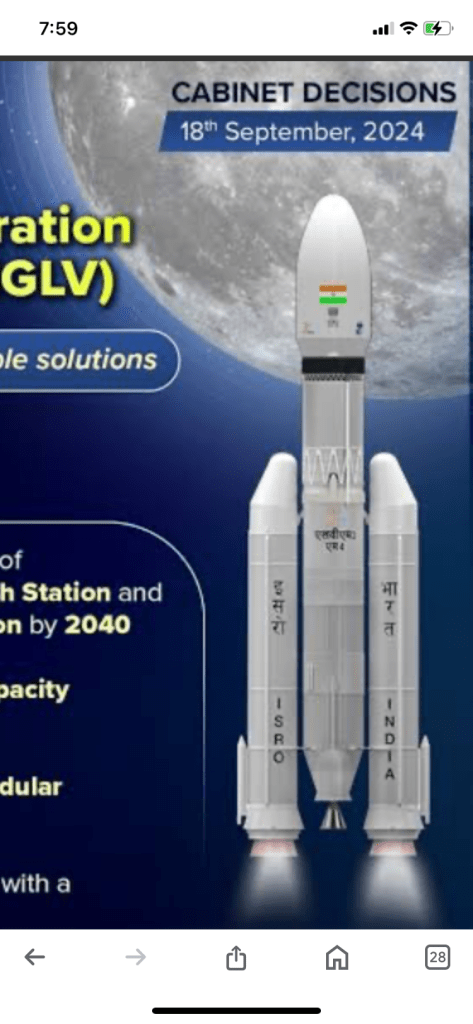
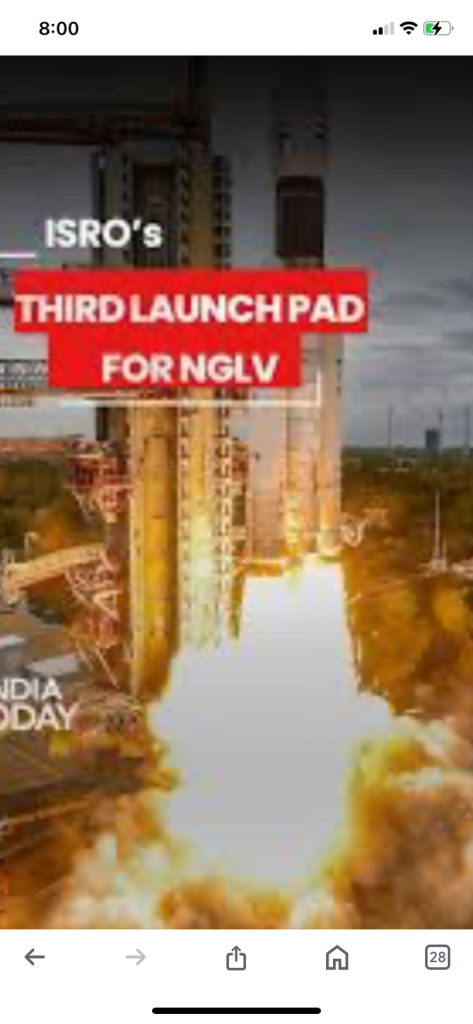
ISRO currently has two launch pads at Sriharikota Spaceport. But he has already made preparations to build the third launch pad. Those rockets which will be necessary for other planets and human spaceflight will be launched from this launch pad. Like- NGLV rocket. This will lead to many types of missions. This rocket will be assembled by lying on the launch pad itself.
India’s space technology, size, vision everything is increasing. Indian Space Research Organization i.e. ISRO has made complete preparations for this. Preparations have been made to build a third launch pad at the Satish Dhawan Space Center in Sriharikota. In an interview given to an English newspaper, ISRO Chairman Dr. S. Somnath made this disclosure.
Dr. Somnath said that at present we have only the second launch pad. The first launch pad was built only for the PSLV rocket. With that we cannot release the GSLV rocket. Because it is not a launch pad worthy of a cryogenic stage. When we got the LVM-3 rocket. Then we re-engineered the second launch pad
LVM-3 now has a semi-cryo stage. The initial human spaceflight will take place from this launch pad. That means the initial launch of Gaganyaan will take place from the second launch pad only. We have been continuously upgrading and updating this launch pad for the last 20 years. The danger is that if, say, there is an explosion on this launch pad, then we do not have any other launch pad to launch the GSLV. Due to this, all the missions of ISRO will be stopped.
Why the need for a third launch pad?
ISRO Chief said that the third launch pad is being built as a new, modern and backup plan. Because we are moving towards the new rocket NGLV i.e. Next Generation Launch Vehicle. This rocket will be assembled by laying it down. Then it will be made to stand at an angle. Like SpaceX’s rockets.
It will not assemble vertically. Therefore, we need such a launch pad, where we can lay down the rocket, assemble it and straighten it back up. Can launch again from here. Therefore, a launch pad is needed which can support this technology. NGLV will have more liquid engine boosters. Jet deflector design will also change
जेट डिफ्लेक्टर यानी लॉन्च पैड के नीचे लॉन्च के समय जो धुआं, आग निकलता है, उसे सुरक्षित निकालने का रास्ता. सभी स्टेज की टेस्टिंग भी यहीं होगी. इसके लिए महेंद्रगिरी सेंटर की जरूरत नहीं पड़ेगी. इसलिए इस लॉन्च पैड का ज्यादा एडवांस होना जरूरी है. एक ही लॉन्च पैड से कई सारी चीजें पूरी जाएंगी.
क्या होगा NGLV रॉकेट में…
NGLV will be a three stage rocket. The first stage of which will be reusable. Like the first stage of SpaceX’s Falcon rocket comes back. Just like that. This rocket will be very economical. This is also the need of the future. Currently LVM3 can carry a payload weighing 9.2 tonnes to LEO.
It has to be increased to 20 tonne payload capacity. Currently we can deliver 4.3 tonnes of payload to GTO. It has to be increased to 9 tonnes. NGLV will complete both these tasks. Also, we will recover it from anywhere on land and sea. It will have technology exactly like SpaceX’s Falcon rocket.
The Next Generation Launch Vehicle or NGLV or “Soorya” (previously referred to as Unified Launch Vehicle or ULV) is a three-stage partially reusableHeavy-lift launch vehicle, currently under development by the Indian Space Research Organisation (ISRO). This vehicle is designed to replace currently operational systems like PSLV, GSLV and LVM3
This family of three launchers was previously being designed for replacing the different core propulsion modules of PSLV, GSLV, and LVM3 respectively with a common semi-cryogenic engine and hence it was named as Unified Launch Vehicle (ULV). Unlike the latest proposal of the launcher, the initial proposals were planned to be expendable. But the new proposals under the name of Next Generation Launch Vehicle (NGLV) suggests launchers having partial reusability
History
Development
The launch system has been in development since 2010s and has gone through various design changes with time. As ISRO’s launch vehicles were ageing, the need for a new generation of launchers with interchangeable modular parts was realised. There have been several design changes since the first proposal
Initial proposals
More than a decade after starting the Cryogenic Upper Stage Project in 1994, ISRO began developing a new semi-cryogenic engine that would be used on its next generation of vehicles of Unified Launch Vehicle (now NGLV), Reusable Launch Vehicle (RLV) and a heavy-lift launcher for future inter-planetary missions. On 22 December 2008, the government approved the development of semi-cryogenic engine technology at an estimated cost of ₹1,798 crore (US$215 million), with a foreign exchange component of ₹588 crore(US$70 million), for the completion of the project by 2014, the engine was then named SCE-200.
In May 2013, the configurations of the launchers were revealed for the first time. They had a common core and upper stage, with four different booster sizes. The core, known as the SC160 (Semi-Cryogenic stage with 160 tonnes of propellant, in the ISRO nomenclature), would have 160,000 kg (350,000 lb) of Kerosene / LOX propellant and be powered by a single SCE-200 engine. The upper stage, known as the C30 (Cryogenic stage with 30 tonnes of propellant) would have 30,000 kg (66,000 lb) of LH2 / LOX propellant and be powered by a single CE-20 engine.
Design
NGLV will have a simple, robust architecture that enables bulk production and modularity in stages, subsystems, and systems for quick turnaround times.[28] It’s possible that the NGLV will be a three-stage rocket that runs on green fuel mixes, such as liquid oxygen and kerosene or methane and liquid oxygen for the SCE-200 engine, which runs on an oxidizer-rich closed combustion engine cycle. The first launch is slated for 2034–2035.
What is the capacity of NGLV?
The first launch is slated for 2034–2035. According to ISRO Chairman S. Somanath, the new rocket has a load capacity of between 20 and 1,215 tonnes. Industry players will handle the production and launches from the outset, with ISRO contributing to the development process.
Please like subscribe comment your precious thoughts on universe discoveries
sk-mania-blogs.in
Full article source google and Wikipedia
https://www.buymeacoffee.com/Satyam55
Buy me a coffee!” (your opportunity to say thanks for the free stuff and to encourage me to do even more)
<!– /wp:heading https://www.amazon.in/b?_encoding=UTF8&tag=555101-21&link
“If you like my work or the free stuff on this website and want to say thanks, or encourage me to do more, you can buy me a coffee!
Contribute to my coffee fund with any amount you are comfortable to pay.
The coffee will give me the ‘kick’ to work even harder to empower creative entrepreneurs


🙏
Aum Shanti
LikeLike
Interesting article
LikeLike
Thanks dear friend 🌺🌺
LikeLike
interesting read
LikeLike
Thanks 🌺
LikeLike