
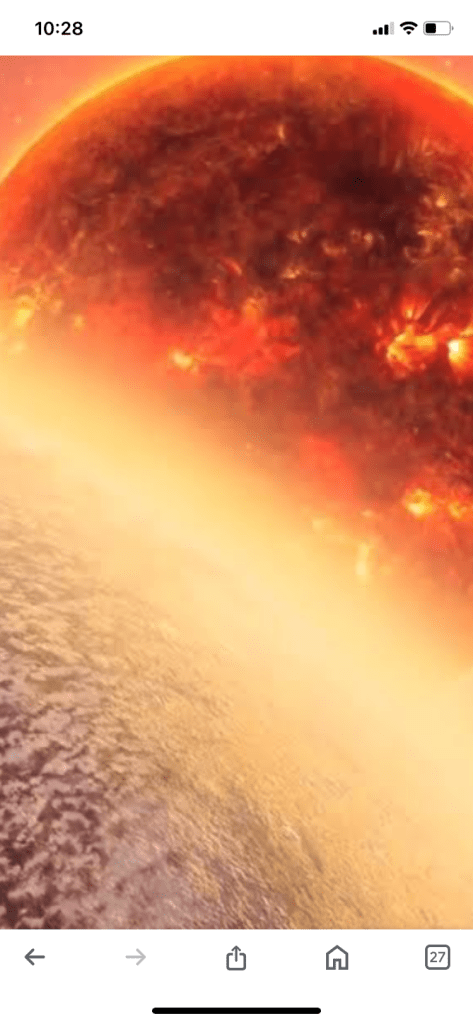
This is the fourth exoplanet discovery by PRL scientists, showcasing India’s growing contributions to global space exploration. TOI-6651b is a unique exoplanet, weighing around 60 times the mass of Earth and having a radius approximately five times larger than Earth’s
Researchers from the Physical Research Laboratory (PRL) in India have announced a remarkable discovery in the field of exoplanet science. Using the advanced PARAS-2 spectrograph, scientists have identified TOI-6651b, a dense, Saturn-sized exoplanet orbiting a Sun-like star.
Located at the edge of what astronomers call the “Neptunian desert” — a region where planets of this size are seldom found — the discovery of TOI-6651b sheds new light on planetary formation and evolution.
The Neptunian desert is a mysterious area where few planets of this mass exist, so this discovery offers a rare opportunity to investigate why such planets are usually absent there
This distant planet orbits its Sun-like host star, TOI-6651, in a close, 5.06-day cycle, meaning its “year” lasts only a fraction of an Earth month.
Its orbit is slightly oval in shape, or eccentric, further distinguishing it from typical gas giants like Saturn in our solar system. The star, TOI-6651, is a G-type sub-giant that’s slightly larger and hotter than our Sun, with a surface temperature of about 5940 K
Yes, Indian scientists from the Physical Research Laboratory (PRL) in Ahmedabad have recently discovered a new planet named TOI-6651b. This exoplanet is approximately five times larger than Earth and orbits a Sun-like star. It is considered a unique discovery as it is located in the “Neptunian Desert,” a region where planets of this size are rarely found.
This discovery showcases India’s growing contributions to global space exploration and highlights the capabilities of Indian scientists in the field of astronomy and astrophysics.
TOI-6651b is a unique exoplanet discovered by Indian scientists from the Physical Research Laboratory (PRL) in Ahmedabad. Here’s a summary of its key features:
Size and Mass:
- Size: Approximately 5 times larger than Earth
- Mass: Around 60 times the mass of Earth
Location: - Neptunian Desert: TOI-6651b is located in a region of space known as the Neptunian Desert. This region is characterized by a scarcity of planets with sizes between Neptune and Saturn. The existence of TOI-6651b in this region challenges traditional theories of planet formation.
Orbit: - Orbital Period: It orbits its Sun-like star in just 5.06 days.
- Eccentric Orbit: Its orbit is slightly elliptical, unlike the nearly circular orbits of gas giants in our solar system.
Composition: - Dense and Rocky: Its high density suggests that it is primarily composed of rocky and iron-rich materials, with a relatively thin atmosphere of hydrogen and helium.
Significance: - Unique Discovery: The discovery of TOI-6651b is significant because it provides valuable insights into the formation and evolution of planets, particularly those in the Neptunian Desert.
- Indian Contribution to Space Exploration: This discovery highlights India’s growing contributions to global space exploration and the capabilities of Indian scientists in the field of astronomy and astrophysics.
For more detailed information, you can refer to the following resources: - India Today: https://www.indiatoday.in/science/story/indian-scientists-prl-ahmedabad-discover-new-planet-it-is-five-times-bigger-than-earth-2624404-2024-10-28
- arXiv: https://arxiv.org/abs/2408.17179
- Zee News: https://zeenews.india.com/hindi/science/toi-6651b-indian-scientists-discover-planet-5-times-bigger-than-earth/2492939
India contribution to universe new discoveries

India has made significant contributions to the field of astronomy and astrophysics, both historically and in recent times.
Historical Contributions:
- Ancient India: Ancient Indian astronomers made remarkable observations and calculations. They developed sophisticated instruments like the gnomon (sundial) and the dhanur yantra (astrolabe) to measure time, track celestial movements, and predict astronomical events.
- Aryabhata and Brahmagupta: These mathematicians and astronomers proposed a heliocentric model of the solar system, calculated the Earth’s circumference, and made significant contributions to the understanding of planetary motion and eclipses.
Modern Contributions: - Indian Space Research Organisation (ISRO): ISRO has launched numerous successful space missions, including Chandrayaan-1 and Chandrayaan-2, which have provided valuable data about the Moon’s surface and composition. The Mars Orbiter Mission (Mangalyaan) successfully reached Mars orbit, making India the first country to achieve this feat in its maiden attempt.
- AstroSat: India’s first dedicated astronomy satellite, AstroSat, has made significant observations of black holes, neutron stars, star clusters, and distant galaxies, contributing to our understanding of the universe’s evolution.
- Recent Exoplanet Discovery: Indian scientists from the Physical Research Laboratory (PRL) in Ahmedabad recently discovered a new planet named TOI-6651b, a dense, Saturn-sized exoplanet orbiting a Sun-like star. This discovery showcases India’s growing contributions to global space exploration.
These are just a few examples of India’s contributions to the field of astronomy and astrophysics. India continues to play a vital role in space exploration and research, and its scientists are making significant contributions to our understanding of the universe. - https://gyanvihar.school/2024/04/03/space-exploration-indias-contributions-to-astrophysics/
India moon missions
India has launched three major lunar missions so far:
- Chandrayaan-1: Launched in 2008, this was India’s first lunar mission. It was an orbiter that mapped the Moon’s surface and discovered water molecules on the lunar surface.
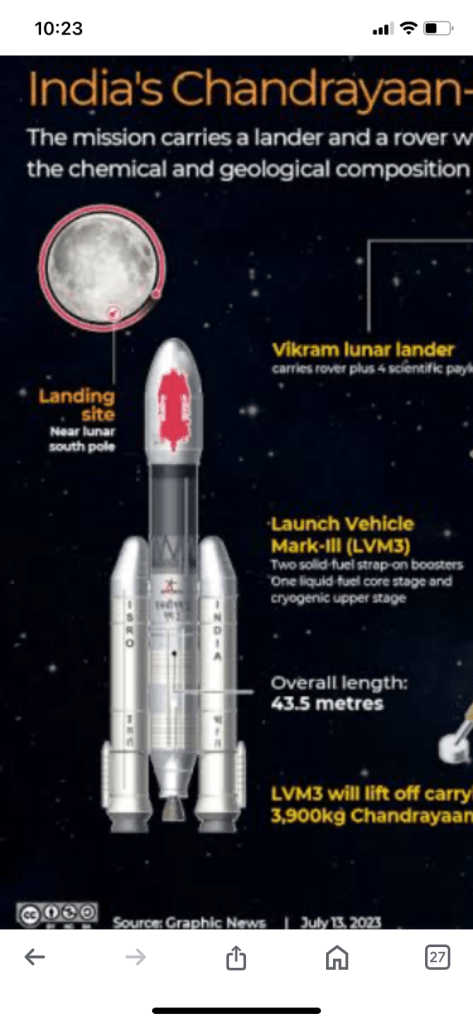
- Chandrayaan-2: Launched in 2019, this mission consisted of an orbiter, a lander (Vikram), and a rover (Pragyan). The orbiter successfully entered lunar orbit, but the lander crashed during its descent.
- Chandrayaan-3: Launched in 2023, this mission successfully landed the Vikram lander and deployed the Pragyan rover on the Moon’s south pole. This made India the fourth country to achieve a soft landing on the Moon and the first to land near the lunar south pole.
These missions have significantly contributed to our understanding of the Moon and have demonstrated India’s growing capabilities in space exploration.
- India mars missions
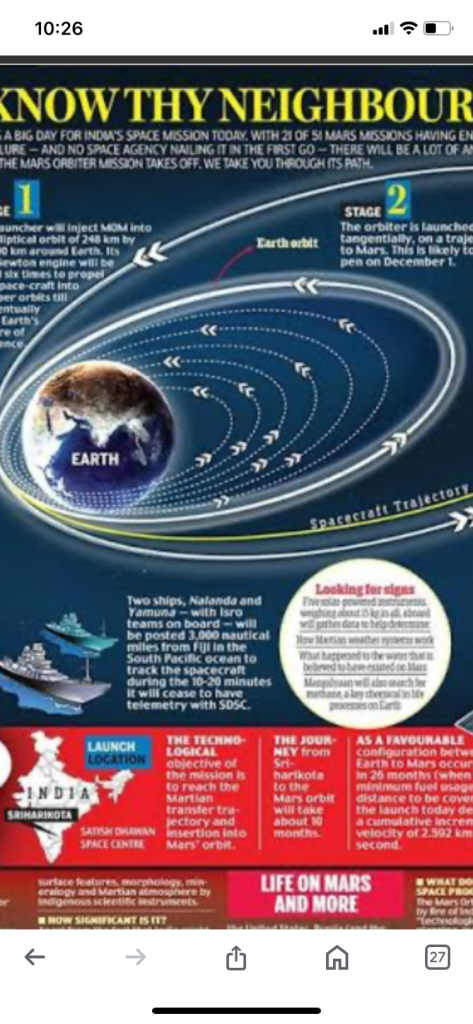
- India has undertaken a significant step in its space exploration journey with the Mars Orbiter Mission (MOM), also known as Mangalyaan. This mission marked India’s first interplanetary venture and successfully placed a spacecraft in Mars orbit in 2014.
Key Points about India’s Mars Mission:
Launch: November 5, 2013
Orbit Insertion: September 24, 2014
Objectives:
Technological demonstration: Testing capabilities for interplanetary missions
Scientific exploration: Studying Mars’ atmosphere, minerals, and surface features
Achievements:
Successfully reached Mars orbit on the first attempt
Made India the fourth country to achieve Mars orbit (after the Soviet Union, USA, and ESA)
Demonstrated India’s technological prowess in space exploration
Collected valuable scientific data about Mars
Significance of the Mission:
Technological Advancement: The mission showcased India’s ability to design, build, and operate a complex interplanetary spacecraft.
Scientific Contribution: The data collected by Mangalyaan has provided valuable insights into Mars’ atmosphere and surface features.
Inspiration: The success of the mission has inspired young scientists and engineers in India and around the world.
Global Recognition: India’s achievement in reaching Mars has elevated its status as a major player in the global space community.
Future Plans:
While India currently has no active Mars missions, there are discussions and plans for future missions to Mars, possibly involving rovers or landers to explore the Martian surface in more detail.
India’s Mars mission is a testament to the country’s growing capabilities in space exploration and its commitment to scientific discovery. It has opened new avenues for future missions and collaborations with other space agencies, contributing to our understanding of the Red Planet and the broader universe.
Please like subscribe comment your precious thoughts on universe discoveries
sk-mania-blogs.in
https://www.buymeacoffee.com/Satyam55
Buy me a coffee!” (your opportunity to say thanks for the free stuff and to encourage me to do even more)
<!– /wp:heading https://www.amazon.in/b?_encoding=UTF8&tag=555101-21&link
“If you like my work or the free stuff on this website and want to say thanks, or encourage me to do more, you can buy me a coffee!
Contribute to my coffee fund with any amount you are comfortable to pay.
The coffee will give me the ‘kick’ to work even harder to empower creative entrepreneurs
 Universe discoveries
🙏🌹
Aum Shanti
LikeLike