
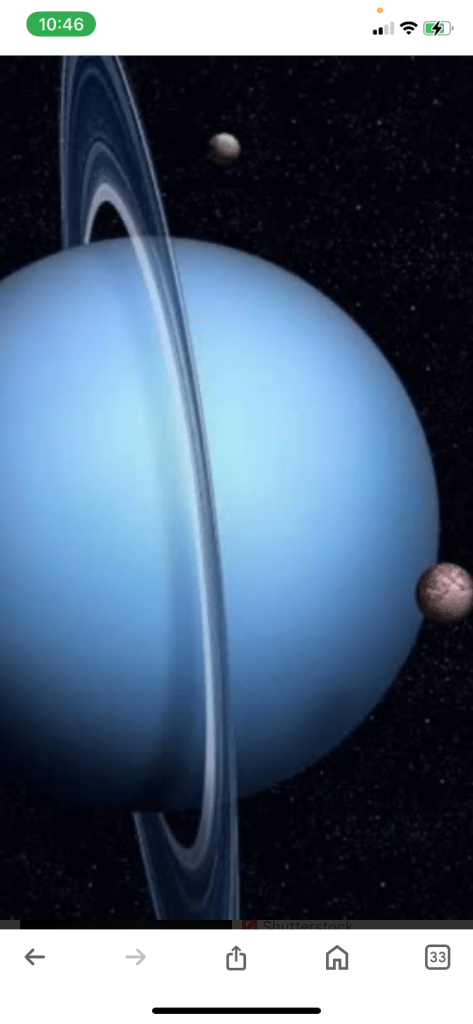
a new research, it has been discovered that there may be enough natural resources on the moon of Uranus which may support alien life. According to scientists from Johns Hopkins and the University of North Dakota, the sophomoric-sounding planet’s moon Miranda has sources of water hidden underneath its surface
According to scientists from Johns Hopkins and the University of North Dakota, the sophomoric-sounding planet’s moon Miranda has sources of water hidden underneath its surface
The discovery can prove to be a breakthrough in mankind’s ongoing search for aliens.
To find evidence of an ocean inside a small object like Miranda is incredibly surprising,” explained planetary scientist and researcher Tom Nordheim. The discovery was published in The Planetary Science Journal.
“It helps build on the story that some of these moons at Uranus may be really interesting — that there may be several ocean worlds around one of the most distant planets in our solar system, which is both exciting and bizarre,” he said about the “remarkable” potential.
“It helps build on the story that some of these moons at Uranus may be really interesting — that there may be several ocean worlds around one of the most distant planets in our solar system, which is both exciting and bizarre,” he added of the “remarkable” potential.
The new data builds on NASA research from last year that probed Uranus moons Ariel, Umbriel, Titania, and Oberon for evidence of similar deep, water-filled gorges that could show signs of biological extraterrestrial life
Using images taken by the deep space probe Voyager 2 in 1986, the “Frankenstein-like hodgepodge of grooved terrain” on Miranda’s southern hemisphere was reanalyzed to see if the rugged ground is the result of tidal forces interacting with the heating — or lack thereof — on the moon.
“This research helps us understand what the requirements are for an icy moon to be an ocean world, which is relevant to assessing the habitability of icy outer solar system satellites,” researcher Caleb Strom said of studying the cracks of Uranus’ moon
No, there is no scientific evidence to suggest that little green men or any other form of extraterrestrial life exist on the moons of Uranus or anywhere else in our solar system. While some of Uranus’s moons, such as Miranda, have intriguing geological features and may harbor subsurface oceans, there is no indication of life of any kind.
The idea of little green men is a popular cultural trope, often used in science fiction and other media. However, it is important to remember that it is based on imagination and speculation, not on scientific fact.
While some of Uranus’s moons, like Titania and Oberon, show potential for subsurface oceans, the extreme cold temperatures and harsh conditions on the surface make them inhospitable for life as we know it. These moons are incredibly cold, with temperatures well below freezing, and they lack a significant atmosphere.
However, the possibility of subsurface oceans raises intriguing questions about the potential for life in these extreme environments. Some scientists speculate that these oceans could harbor simple forms of life, similar to extremophiles found on Earth.
While the idea of life on Uranus’s moons is fascinating, it’s important to note that this is still a subject of ongoing research and speculation. More data and exploration are needed to determine the true nature of these distant worlds and their potential to support life.
“Little green men” is a popular term used to describe stereotypical extraterrestrial beings, often depicted as small, humanoid creatures with green skin and sometimes large eyes or antennae. This image became popular in the mid-20th century, particularly during the UFO craze of the 1950s.
It’s important to note that this is a fictional representation and there is no scientific evidence to support the existence of such creatures.
Miranda, one of Uranus’s five major moons, is a fascinating celestial body with a unique and intriguing surface.
Key features and characteristics:
- Size: It’s the smallest of Uranus’s major moons, with a diameter of about 470 kilometers (290 miles).
- Surface: Miranda’s surface is incredibly diverse, featuring a patchwork of different terrains, including:
- Craters: Impact craters from past collisions with other objects.
- Ridges and valleys: Long, winding ridges and deep valleys that crisscross the surface.
- Fault scarps: Steep cliffs that mark the boundaries between different geological regions.
- Coronae: Large, oval-shaped features with concentric rings and troughs, thought to be formed by tectonic activity.
- Composition: Miranda is primarily composed of water ice, with a significant amount of rocky material.
- Internal structure: Some scientists believe that Miranda may have a subsurface ocean of liquid water, which could have played a role in shaping its complex surface features.
Formation and geological history:
Miranda’s formation is still not fully understood, but it is believed to have formed through a process called accretion, where particles of dust and ice gradually came together to form a larger body. Its complex surface features suggest a history of significant geological activity, possibly driven by tidal forces from Uranus and other moons.
Exploration:
The only spacecraft to visit Uranus and its moons is Voyager 2, which flew by Miranda in 1986. Voyager 2’s images of Miranda revealed its astonishingly varied surface, leading to much scientific interest and speculation about its geological history.
Future exploration:
While there are currently no specific plans for future missions to Uranus or its moons, some scientists have proposed potential missions that could provide more detailed information about Miranda and its geological processes.
Miranda’s unique and complex surface makes it a fascinating object of study, and further exploration could help us better understand the formation and evolution of this enigmatic moon.
Recent scientific research suggests that Uranus’s moon Miranda may harbor a subsurface ocean, which could potentially support life. This discovery is quite exciting as it opens up the possibility of life existing in one of the most unexpected places in our solar system.
However, it’s important to note that this is still a hypothesis, and more research is needed to confirm the existence of this ocean and assess its habitability. The extreme conditions on Miranda, such as its frigid temperatures and high radiation levels, would make it a challenging environment for life as we know it.
Even if life does exist on Miranda, it’s likely to be in the form of simple, microbial organisms. The chances of finding complex life forms like animals or plants are extremely low.
Despite these challenges, the possibility of life on Miranda is a fascinating prospect that continues to inspire scientists and the public alike. Further exploration of Uranus and its moons could reveal more about the potential for life beyond Earth.
Please like subscribe comment your precious thoughts on universe discoveries
sk-mania-blogs.in
https://www.buymeacoffee.com/Satyam55
Buy me a coffee!” (your opportunity to say thanks for the free stuff and to encourage me to do even more)
<!– /wp:heading https://www.amazon.in/b?_encoding=UTF8&tag=555101-21&link
“If you like my work or the free stuff on this website and want to say thanks, or encourage me to do more, you can buy me a coffee!
Contribute to my coffee fund with any amount you are comfortable to pay.
The coffee will give me the ‘kick’ to work even harder to empower creative entrepreneurs
 Universe discoveries
This is interesting, and I like that this moon is called Maranda.
LikeLike
Thanks a lot Mary 🌺🌺
LikeLike
🙏🌹
Aum Shanti
LikeLike
Wow
LikeLike
Who knows what lies beneath Miranda, very interesting article, greetings from Italy
LikeLiked by 1 person
Thanks dear friend 🌺you are right
LikeLiked by 1 person
Fascinating!
LikeLike