
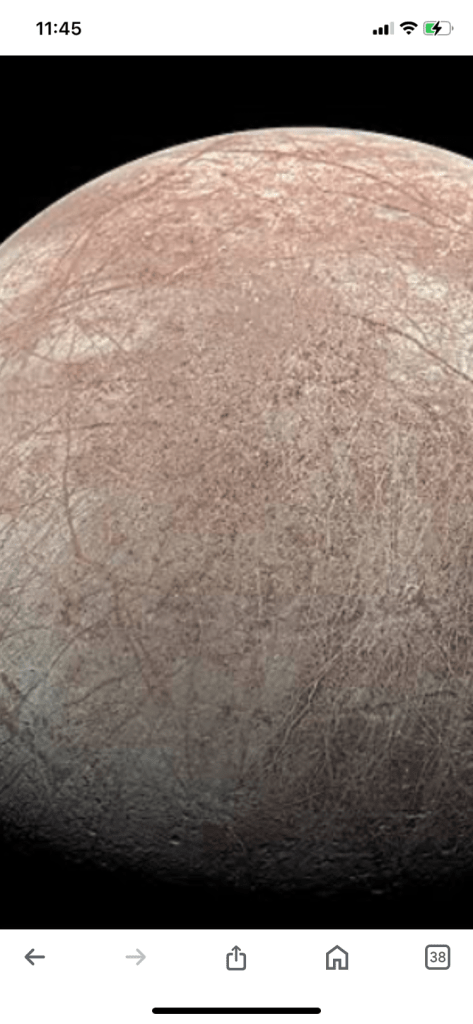
Astrobiologists around the world were thinking that there might be life beneath the thick icy layer of Jupiter’s icy moon Europa. Because there is an ocean of salty water beneath it. There may be a possibility of life. But his perception has changed in recent revelations. Because there is so much thick snow here, which is much more than expected
The layer of ice on the surface of Europa is 35 km deep. This investigation was done by NASA’s spacecraft Juno. It has been continuously orbiting Jupiter and its moons since 2016. He tried to measure the thickness of the surface through a microwave radiometer (MWR). It turned out that there was only a layer of ice 35 kilometers de
Juno’s project scientist Steven Levin said that this is the average thickness. At some places it is many times more than this. This height is equal to the height of four Mount Everests. The ice is three times deeper than the deepest drilling that humans have done on Earth. This is much more than the expectations of all of us scientists and is surprising.
Planetary scientist Brandon Johnson of Purdue University says that if these figures are true then they are surprising. Europa’s ice layer is many times bigger, deeper and higher than many things present on our Earth. This 35 km thick layer is also divided into many layers. The first 7 km hard layer. Second mobile layer of 13 km.
American space agency NASA has seen craters formed by the collision of space debris on Europa. There are ancient pits, valleys, cracks etc. at many places here. Along with all these things, there is also very intense radiation on Europa. But some dark colored shapes have also been seen amidst its upper rugged icy surface
There are many small impact craters on Europa. Scientists believed that there was a possibility of life coming out from under the thick layer of water. The system of water coming out is being disrupted due to a process called impact gardening. There are millions of small craters on the surface of Europa, which are about 12 inches deep.
If any kind of chemical biosignature is found on these small craters, it means that chemical evidence of the origin of life is being found here. These can give rise to life in the depths. The current situation is such that things break down due to radiation. The particles necessary for the origin of life are being divided
There is hope for life to exist even in objects coming from space and hitting Europa. But at present, due to the destructive radiation going on Europa, chemical biosignatures are not able to flourish in the form of life. As radiation decreases in future, the possibility of origin of life will increase
Cynthia Phillips, Europa Scientist of NASA’s Jet Propulsion Laboratory, said that we are continuously deepening our study. We are studying all the impacts on Europa due to the solar system. If we want to study the origin of a planet and the signs of life on it.
Recent research suggests that Jupiter’s moon Europa may have plumes of water vapor erupting from its surface, offering a potential way to study the subsurface ocean without drilling through the thick ice. While a daunting challenge, the possibility of life in Europa’s ocean remains an exciting area of research.
Europa is one of Jupiter’s moons, and it’s considered one of the most promising places in our solar system to find extraterrestrial life. Here’s why:
- Buried Ocean: Scientists believe that beneath Europa’s icy surface lies a vast global ocean of liquid water, potentially containing more water than all of Earth’s oceans combined.
- Potential for Life: This subsurface ocean could provide the necessary conditions for life, including liquid water, chemical energy sources, and organic molecules.
- Tidal Heating: Europa’s elliptical orbit around Jupiter creates tidal forces that heat the moon’s interior, potentially providing the energy needed to sustain a habitable environment.
- Cryovolcanism: Europa’s surface is crisscrossed by a network of cracks and ridges, suggesting that water from the subsurface ocean may be erupting onto the surface in the form of cryovolcanic plumes.
These factors make Europa a compelling target for future exploration missions, such as the upcoming Europa Clipper, which will conduct detailed observations of the moon to investigate its potential for habitability. While the search for life on Europa is a daunting challenge, the possibility of finding life beyond Earth is an exciting prospect that continues to drive scientific exploration.
Please like subscribe comment your precious thoughts on universe discoveries
Sk-mania-blogs.in
Full article source google
https://www.buymeacoffee.com/Satyam55
Any freinds who love my article can have drink 🍸 me coffee to encourage me I will be obliged that they love my work and I am successful in spreading universe discoveries knowledge and educate new kid’s going in school and become future scientists and contribute in our species become interstellar
 Universe discoveries
🙏🌹
Aum Shanti
LikeLike