
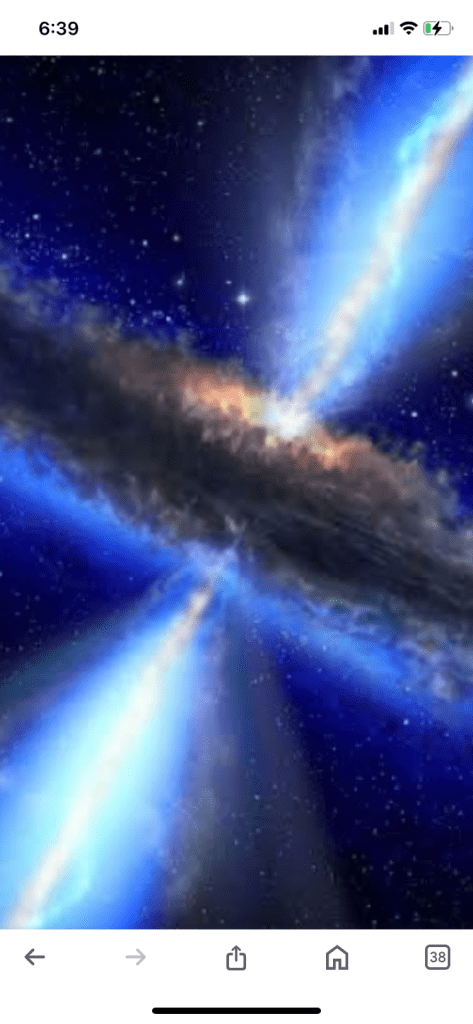
A colossal water reservoir has been discovered by astronomers in a remote corner of the universe, orbiting a quasar over 12 billion light-years away. This staggering distance means the light we observe today embarked on its journey shortly after the universe’s birth
Massive ocean circling a quasar found in deep space
The quasar, named APM 08279 5255, contains water vapour equating to 140 trillion times the volume of Earth’s
Astronomers have uncovered a colossal water reservoir circling a quasar over 12 billion light-years away, a discovery that sheds light on the universe’s distant past. This quasar, named APM 08279 5255, surrounds a supermassive black hole that’s 20 billion times more massive than our Sun and emits energy equivalent to a thousand trillion suns. This extraordinary system contains water vapour equating to 140 trillion times the volume of Earth’s oceans, making it the largest and farthest known water source in the universe.
The quasar’s environment is unique, emitting hydrogen-rich gases like water vapour and carbon monoxide, and creating a region hundreds of light-years wide. Despite the gas being sparse by Earth’s standards, it is surprisingly warm and dense compared to typical galactic conditions. This suggests intense radiation from the quasar keeps the surrounding gas active and primed for star formation or feeding the black hole, potentially increasing its mass sixfold.
The magnitude of this distant water supply is immense, containing an estimated 140 trillion times the volume of all Earth’s oceans combined. This vast reservoir resides near a supermassive black hole, approximately 20 billion times more massive than our sun.
Bradford’s team, along with a separate group of astronomers, investigated APM 08279+5255 and its central black hole, which pulls in surrounding matter.
As the black hole draws in material, it heats the surrounding gas and dust, creating a region filled with molecules never before detected at such an extreme distance
Quasars were first discovered over 50 years ago when telescopes revealed mysterious sources of intense brightness in distant parts of space.
These objects are not ordinary stars. They shine brightly from the centres of distant galaxies, outshining all the stars within those galaxies
At their core lie supermassive black holes, millions or even billions of times the mass of our sun. As gas and dust spiral toward these black holes, the material heats up and releases energy.
This energy radiates across all wavelengths, making quasars some of the brightest and most energetic phenomena ever observed.
Studying quasars allows astronomers to learn about the early universe, as the light we observe today has travelled billions of years to reach us.
Surprising Discovery of Water
Astronomers discovered water vapour in the environment surrounding this particular quasar. The vapour spans a region hundreds of light-years across, with one light-year equaling roughly six trillion miles
Although the gas is thin by Earth standards, it is unusually warm and dense compared to similar regions in our Milky Way.
With temperatures around minus 63 degrees Fahrenheit, the gas is about 300 trillion times less dense than Earth’s atmosphere. Despite this, it is five times hotter and up to hundreds of times denser than gas found in typical galaxies. These exceptional conditions make this region a unique find.
Why Does This Matter?
Water vapour is more than just a molecule; its presence indicates that the quasar is emitting radiation that keeps the surrounding gas relatively warm.
Astronomers also detected other molecules, such as carbon monoxide, suggesting an abundance of material that could feed the black hole as it continues to grow.
They estimate that there is enough gas for the black hole to increase its mass by roughly six times, though the outcome remains uncertain.
Some of this gas could form new stars, while other portions may be expelled into space. Regardless, these observations provide a glimpse into the conditions of the early universe.
Quasars, Water, and the Building Blocks of Life
The detection of water vapour in such a distant quasar expands our understanding of how life’s essential building blocks appear over vast expanses of time and space.
Water is vital for life as we know it, and its presence billions of years ago suggests that the elements necessary for life have been available for a long time.
Please like subscribe comment your precious comment on universe discoveries
Sk-mania-blogs.in
Full article source google
 Universe discoveries
Nice information.
LikeLike
🙏🎅
Aum Shanti
LikeLike
The discovery of such a massive water reservoir orbiting a quasar is astounding. It not only reveals a vast amount of water in deep space but also provides a glimpse into the early universe.
LikeLike