
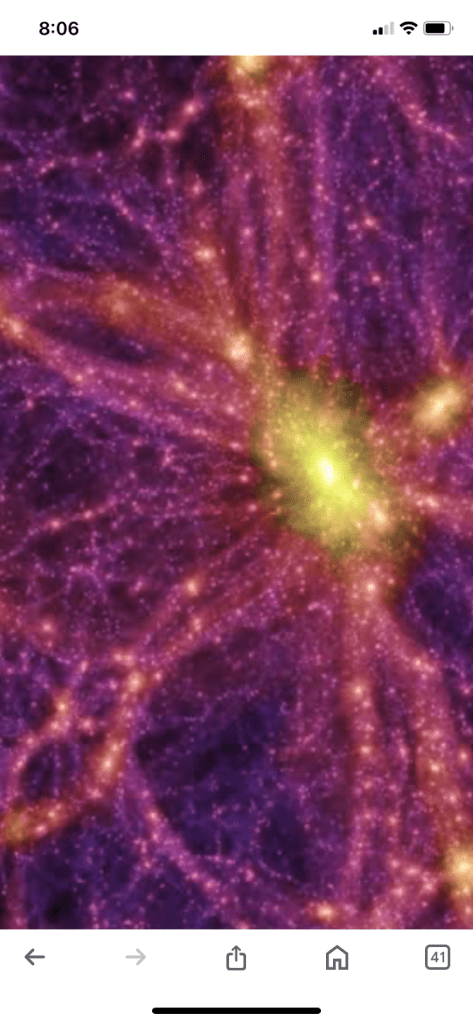
Dark Matter Discovery: Dark matter is that mysterious part of the universe, which, despite being invisible, makes its presence felt through gravity. But till now dark matter could not be observed directly. According to scientists at the University of California, Berkeley, dark matter can be discovered in just 10 seconds! They say that within the first 10 seconds of the next nearby supernova explosion, we can detect possible particles of dark matter, called ‘axions’.
A supernova occurs when a massive star explodes in a spectacular explosion at the end of its life. This releases a lot of energy and particles. Scientists believe that during this process, a large number of axons may be generated. If we have the right instruments and are looking in the right direction, we can detect these axions
Axions were proposed in the 1970s as a solution to a physics problem called the ‘strong CP problem’. Later, it was understood that these particles could be good candidates for dark matter, because they are extremely light, have no electrical charge, and can be found in abundance in the universe.
A special feature of axions is that they can convert into photons (light particles) in strong magnetic fields, making them possible to detect.
We have something like the ‘Fermi Space Telescope’, which catches gamma-rays (high-energy light), but its vision is limited. Because of this, the probability of detecting axions at the time of a nearby supernova is only 10%.
That is why scientists are proposing to launch a group of gamma-ray satellites named ‘GALAXIS’, so that the entire sky can be continuously monitored. With this we may be able to detect axons produced during supernovae.
If we are successful in detecting axions, this discovery will prove to be a milestone in astronomy. Such a discovery will play an important role in understanding the nature of dark matter. This discovery will not only help in solving the mystery of dark matter, but will also be helpful in understanding other problems of physics, such as ‘Strong CP Problem’, ‘String Theory’, and ‘Matter/Antimatter Imbalance
This historic discovery is possible only if we have the right equipment, in the right direction, at the time of the next supernova. Scientists are worried that the next supernova might happen before our instruments are ready, because such events are rare. Once the opportunity is missed, we may have to wait for decades
Recent research suggests that we might be closer than ever to understanding dark matter. While we haven’t directly detected it yet, new experiments and theories are offering promising insights.
Here are some key developments:
- XENONnT experiment: This experiment, located in Italy, has been searching for dark matter particles called WIMPs. While it hasn’t made a definitive detection yet, it has set new limits on the properties of WIMPs, helping to narrow down the search.
- Axion searches: Axions are another theoretical candidate for dark matter. Several experiments, including the Axion Dark Matter Experiment (ADMX) in the United States, are actively searching for axions.
- Gravitational lensing: By observing how the gravity of dark matter bends light from distant objects, scientists can indirectly map its distribution in the universe. New observations from telescopes like the Hubble Space Telescope and the James Webb Space Telescope are providing more detailed maps of dark matter.
- Cosmological simulations: Scientists are using powerful computers to simulate the evolution of the universe, including the effects of dark matter. These simulations are helping to refine our understanding of dark matter’s role in the formation of galaxies and other structures.
While we haven’t made a direct detection of dark matter yet, these developments are bringing us closer to understanding this elusive substance. It’s an exciting time for dark matter research, and we may be on the verge of a major breakthrough.
Please like subscribe comment your precious comments on universe discoveries
SK-mania-blogs.in
Full article source google
If you love my work and think i am contributing in giving education to young kids please give me a coffee
 Universe discoveries
🙏🎅
Aum Shanti
LikeLike
Nice post
LikeLike
This is fascinating. The idea of detecting dark matter through axions during a supernova explosion is groundbreaking.
LikeLike
Yes willie my dear freind it’s very fascinating and interesting 🌅
LikeLiked by 1 person
🤗🤗
LikeLike
I know that in astronomy, dark matter is a hypothetical form of matter that does not interact with light or other electromagnetic radiation.
LikeLike
Yes you are Right but dark matter is very mysterious 😊
LikeLike