
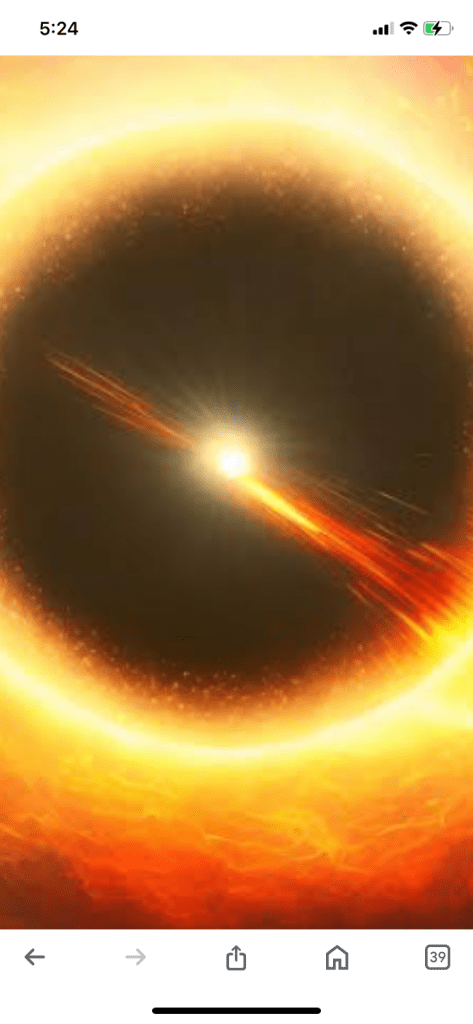
The idea that black holes could hide the end of space and time is a fascinating one, and it’s been explored in various scientific theories. One of the most prominent concepts is the Penrose conjecture, which suggests that the singularity at the center of a black hole could be a point of infinite density and curvature, effectively marking the end of space and time as we know it.
However, this is just a theoretical possibility, and there are many other theories about the nature of black holes and their potential connection to the end of space and time. Some scientists believe that black holes could be wormholes leading to other universes, while others suggest that they could be portals to a higher dimension.
Ultimately, we don’t know for sure what happens at the center of a black hole, and it’s possible that we may never know. But the idea that these mysterious objects could hold the key to understanding the ultimate fate of the universe is certainly a tantalizing one.
Einstein’s theory of general relativity describes the inevitability of singularities, which are obscured by black holes according to Penrose’s cosmic censorship conjecture.
Recent studies indicate that quantum mechanics might reinforce this idea, proposing a quantum Penrose inequality that relates entropy to space-time metrics in the vicinity of black holes.
General Relativity and Singularities
Albert Einstein’s theory of gravity, known as general relativity, is incomplete. Physics Nobel laureate Roger Penrose, showed that when matter collapses under its own gravity, it forms a “singularity” – a point where density and space-time curvature become infinite
At a singularity, space, time, and matter are compressed to the point of nonexistence, causing the known laws of physics to break down entirely. If singularities were observable, scientists would lose the ability to predict future events based on past conditions. In other words, science would become an impossibility.
Black Holes and Cosmic Censorship
Penrose also realized nature may hold a remedy for this fate – black holes. A defining feature of a black hole is its event horizon, a one-way membrane in space-time. Objects – including light – that cross the event horizon can never leave due to the black hole’s incredibly strong gravitational pull
Quantum Mechanics and Black Holes
In recent work, published in Physical Review Letters, we showed that quantum mechanics, which rules the microcosmos of particles and atoms, supports cosmic censorship.
Black holes are influenced by quantum mechanics to some extent, but such influence is normally ignored by physicists. For example, Penrose excluded these effects in his work, as did the theory that enabled scientists to measure ripples in space-time called gravitational waves from black hole
Challenges and Advances in Quantum Cosmic Censorship
It is widely expected that any viable theory of quantum gravity should resolve the singularities present in the classical theory – potentially showing they are simply an artifact of an incomplete description. So it’s reasonable to expect quantum effects should not make the problem of whether we could ever observe a singularity worse
Guardians of the Universe: How Quantum Black Holes Hide the End of Space and Time. Quantum research supports Penrose’s theory that black holes obscure singularities, with the quantum Penrose inequality linking black hole entropy to space-time structure
How do time and space reverse in a black hole?
From the outside, the black hole is infinitely extended in time, but has only a finite size in space. Inside, the tables are turned: Time is only of finite extent (it starts at the horizon and ends abruptly at the singularity-axis), but instead one space direction, the axis direction, is now infinitely long.
What happens to space and time near a black hole?
In addition to gravity stretching and squashing objects, another strange phenomenon that a traveler would observe close to a black hole is something called time dilation, in which time passes slower closer to the black hole than further away
Does time exist inside of a black hole?
Time does stop at the event horizon of a black hole, but only as seen by someone outside the black hole
Who was the first person to discover black holes?
British astronomers Louise Webster and Paul Murdin at the Royal Greenwich Observatory and Thomas Bolton, a student at the University of Toronto, independently announced the discovery of a massive but invisible object in orbit around a blue star over 6,000 light-years away
How long is 1 year in a black hole?
One year near a black hole could mean 80 years on Earth, as you may have seen illustrated in the movie Interstellar
What is the mystery of the black hole?
Black holes are regions in space where an enormous amount of mass is packed into a tiny volume. This creates a gravitational pull so strong that not even light can escape. They are created when giant stars collapse, and perhaps by other methods that are still unknown
What are 5 facts about black holes?
5 black hole facts to blow your mind
- There are likely millions of black holes in our galaxy, and we will probably never know where they are. …
- If you fell into a black hole, you would never escape. …
- If you fell into a stellar-size black hole, you could turn into human spaghetti. …
- A black hole could fit in your pocket.
What is the theory that black holes are universes?
A black hole cosmology (also called Schwarzschild cosmology or black hole cosmological model) is a cosmological model in which the observable universe is the interior of a black hole. Such models were originally proposed by theoretical physicist Raj Kumar Pathria, and concurrently by mathematician I. J. Good
What is the paradox of quantum black holes?
The black hole information paradox is a conflict between two apparently incontrovertible facts: first, that semiclassical gravity is valid on scales where gravitational and quantum effects are more or less separate; second, that quantum mechanics is “unitary” and thus all quantum processes are in principle, though not .
Who is the father of black hole theory?
But the true “father” of the black hole concept was a humble 18th century English rector named John Michell–a man so far ahead of his scientific
What did Einstein believe about black holes?
Einstein denied several times that black holes could form. In 1939 he published a paper that argues that a star collapsing would spin faster and faster, spinning at the speed of light with infinite energy well before the point where it is about to collapse into a Schwarzchild singularity, or black hole
Please like subscribe comment your precious thoughts on universe discoveries
Sk-mania-blogs.in
Full article source google
https://www.buymeacoffee.com/Satyam55
If you love my work and think i am contributing in giving education to young kids please give me a coffee
 Universe discoveries
🙏🎅
Aum Shanti
LikeLiked by 1 person
Very interesting post!
LikeLike
Very interesting! Thank you 😊
LikeLike