
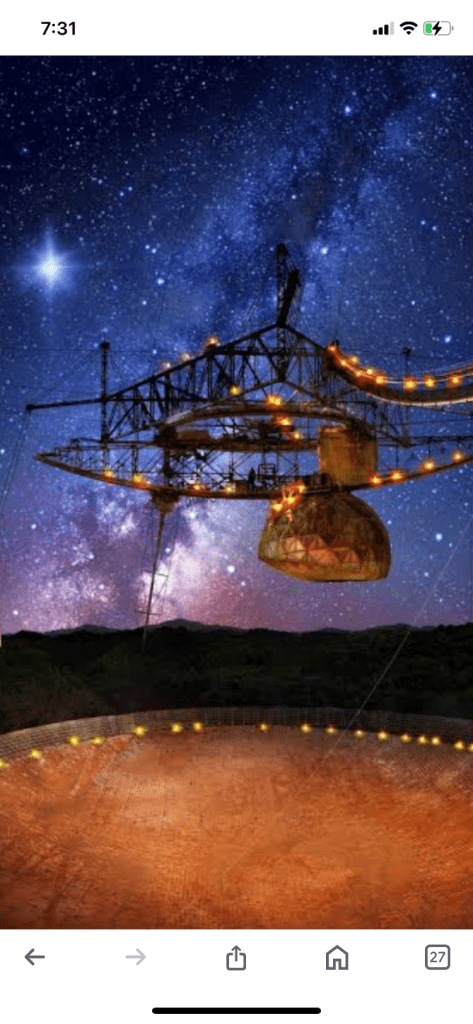
Recent groundbreaking research has revealed the origin of a powerful radio wave burst, FRB 20220610A, to an ancient, dead galaxy located 8 billion light-years away. This discovery challenges existing theories about the sources of such cosmic phenomena and offers a glimpse into the universe’s distant past.
Key Points:
- Fast Radio Bursts (FRBs): These are intense bursts of radio waves lasting only a few milliseconds, originating from distant galaxies.
- FRB 20220610A: This particular FRB is one of the most distant and energetic ever observed.
- Origin: A Dead Galaxy: Scientists traced the signal to an ancient, elliptical galaxy, a type typically associated with older, less active star formation. This finding is significant as most FRBs are linked to younger, star-forming galaxies.
- Implications: The discovery suggests that the origins of FRBs might be more diverse than previously thought, potentially involving different cosmic processes and events. It also opens up new avenues for studying the evolution of galaxies and the universe’s missing matter.
Additional Insights: - Research Teams: The findings were published in two complementary studies led by Northwestern University and McGill University.
- Previous FRB Discoveries: Prior to this, only one other FRB had been traced to the outskirts of a galaxy, highlighting the rarity and significance of this discovery.
This remarkable discovery sheds light on the enigmatic nature of fast radio bursts and expands our understanding of the universe’s vast and complex history.
Astronomers have traced a mysterious fast radio burst to an unexpected place — an ancient, massive galaxy far removed from active star formation.
This revelation shakes up the conventional wisdom that such cosmic phenomena exclusively arise from younger, star-rich regions, hinting at the unknown complexities of the universe and sparking a fresh wave of scientific inquiry into the origins and environments of FRBs.
Unprecedented Discovery in the Cosmos
For the first time, astronomers have traced a fast radio burst (FRB) to the outskirts of an ancient, dead, elliptical galaxy — an unprecedented home for a phenomenon previously associated with much younger galaxies.
This new FRB shows us that just when you think you understand an astrophysical phenomenon, the universe turns around and surprises us,” said Northwestern’s Wen-fai Fong, a senior author on both studies. “This ‘dialogue’ with the universe is what makes our field of time-domain astronomy so incredibly thrilling.”
Eftekhari is a NASA Einstein Fellow at Northwestern’s Center for Interdisciplinary Exploration and Research in Astrophysics (CIERA). Fong is an associate professor of physics and astronomy at Northwestern’s Weinberg College of Arts and Sciences and a member of CIERA.
Advanced Detection Techniques
Astronomers first detected the new FRB, dubbed FRB 20240209A, in February 2024 with the Canadian Hydrogen Intensity Mapping Experiment (CHIME). Flaring up and disappearing within milliseconds, FRBs are brief, powerful radio blasts that generate more energy in one quick burst than our sun emits in an entire year.
The recent discovery of a fast radio burst (FRB) originating from an ancient, “dead” galaxy is a groundbreaking finding that challenges our understanding of these mysterious cosmic phenomena. Here’s why it’s so significant:
What it Means:
- Challenges Existing Theories:
- Most FRBs have been linked to younger, star-forming galaxies. These galaxies are known for their active star formation, which can lead to the creation of the extreme conditions (like magnetars) thought to be responsible for FRBs.
- A dead galaxy, by definition, has ceased significant star formation. This suggests that the mechanisms behind FRBs might be more diverse than previously thought, potentially involving different cosmic processes and events.
- New Possibilities for FRB Origins:
- The discovery opens up new avenues of research into the possible sources of FRBs. It raises questions about whether other types of celestial objects or events within dead galaxies could be responsible for these powerful radio bursts.
- This could include phenomena related to the remnants of past stellar activity, such as the interactions of neutron stars or black holes.
- Implications for Understanding the Universe:
- Studying FRBs provides valuable insights into the evolution of galaxies and the universe as a whole.
- By understanding the different environments where FRBs originate, scientists can gain a better understanding of the processes that shape galaxies and the distribution of matter throughout the cosmos.
In Summary:
The detection of an FRB in a dead galaxy is a significant discovery that challenges our current understanding of these enigmatic phenomena. It highlights the need for further research to unravel the mysteries of FRBs and their diverse origins across the universe.
Please like subscribe comment your precious comment on universe discoveries
sk-mania-blogs.in
Full article source google
https://www.buymeacoffee.com/Satyam55
If you like my website universe discoveries please donate me a coffee freinds
 Universe discoveries
🙏🌹
Aum Shanti
LikeLiked by 1 person
I found this post really fascinating ❣️
LikeLike