

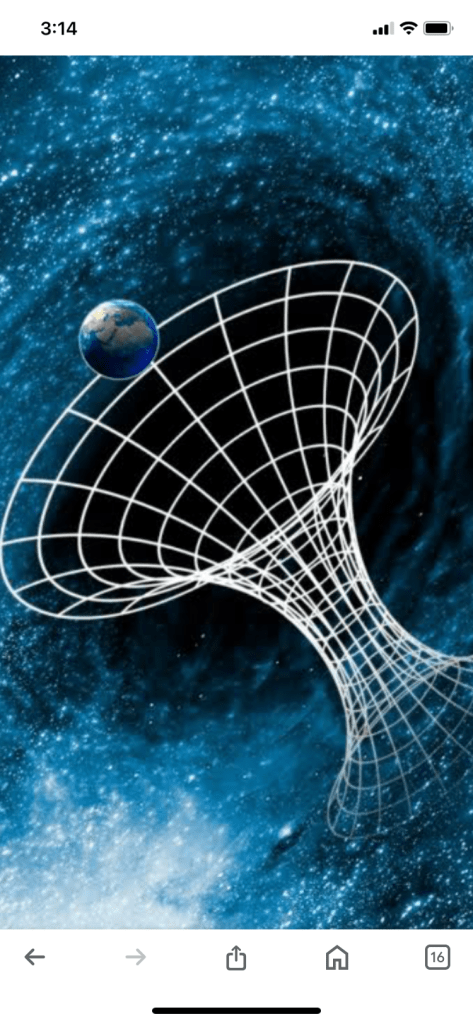
Wormholes are a fascinating concept, but they are still theoretical. Scientists have not yet found any evidence that wormholes exist. However, if they do exist, they could potentially allow us to travel to other worlds or even other times.
Here are some of the things we know about wormholes:
- Wormholes are tunnels that connect two different points in spacetime.
- They could allow us to travel vast distances in a very short amount of time.
- Some scientists believe that wormholes could even allow us to travel through time.
Of course, there are also many unknowns about wormholes. For example, we don’t know if they are stable enough for us to travel through. We also don’t know what would happen if we entered a wormhole.
Despite the unknowns, wormholes are a very exciting possibility. If they do exist, they could revolutionize our understanding of the universe and our place in it.
A wormhole is a theoretical shortcut through spacetime. It’s like a tunnel connecting two distant points, allowing for potentially faster travel than moving through normal space.
Key points to remember:
- Theoretical: Wormholes are predicted by Einstein’s theory of general relativity, but haven’t been observed yet.
- Shortcut: They could connect points separated by vast distances, even in different galaxies or times.
- Unstable: Current theories suggest wormholes would likely collapse quickly, making travel challenging.
- Exotic matter: Some theories propose that exotic matter with negative mass-energy would be needed to keep a wormhole open.
While wormholes remain in the realm of science fiction for now, they continue to fascinate scientists and the public alike, inspiring imaginative stories and fueling ongoing research into the nature of space and time.
While the idea of wormholes is incredibly exciting, the short answer is: we don’t know if they exist.
Here’s a breakdown of what we do know:
- Predicted by Einstein’s theory: Wormholes are theoretically possible according to Einstein’s theory of general relativity. This theory describes gravity as the curvature of spacetime, and under certain conditions, it suggests that spacetime could be bent in such a way to create shortcuts.
- No observational evidence: Despite the theoretical possibility, no wormhole has ever been observed. This doesn’t necessarily mean they don’t exist, but it does mean we have no direct proof of their existence.
- Challenges for existence: Even if wormholes exist, there are significant challenges to overcome:
- Stability: Most theoretical models suggest wormholes would be extremely unstable, collapsing almost instantly.
- Exotic matter: Some theories propose that “exotic matter” with negative mass-energy would be needed to keep a wormhole open. This type of matter has never been observed.
Ongoing research: Scientists are actively researching wormholes, both theoretically and through observation. They are looking for ways to potentially detect wormholes indirectly, such as by their gravitational effects on light or other objects.
In conclusion: Wormholes remain a fascinating and open question in physics. While their existence is not confirmed, they continue to be a source of inspiration for scientists and science fiction writers alike.
While the idea of creating a wormhole in a lab sounds like something out of science fiction, recent advancements in physics suggest it might not be entirely impossible!
Here’s what we know:
- Theoretical possibility: As mentioned earlier, Einstein’s theory of general relativity allows for the possibility of wormholes.
- Quantum entanglement: Scientists have discovered a connection between wormholes and quantum entanglement, a phenomenon where two particles become linked and share the same fate, even when separated by vast distances.
- Quantum computers: Recent experiments using quantum computers have shown promising results in simulating aspects of wormholes and even transmitting information through them.
However, there are still significant challenges: - Size and stability: Creating a wormhole large enough for anything to pass through and keeping it stable would require an immense amount of energy and control over gravity.
- Exotic matter: As mentioned before, some theories suggest the need for exotic matter with negative mass-energy to stabilize a wormhole, and this type of matter has never been observed.
Recent breakthroughs: - In 2022, a team of physicists used a quantum computer to simulate a tiny wormhole and successfully transmitted information through it. This was a groundbreaking experiment that showed the potential for creating and studying wormholes in a controlled environment.
The future:
While creating a full-fledged, traversable wormhole in a lab is still a long way off, these recent advancements are exciting and suggest that it might be possible in the future. Scientists are continuing to explore the connection between quantum entanglement and wormholes, and quantum computers are becoming more powerful, which could lead to further breakthroughs in this field.
It’s important to remember that this is a cutting-edge area of research, and there are still many unknowns. But the possibility of creating a wormhole in a lab is no longer just a dream of science fiction – it’s a goal that scientists are actively working towards.
Please like subscribe comment your precious thoughts on universe discoveries
Full article source google
https://www.buymeacoffee.com/Satyam55
If you like my website universe discoveries please donate me a coffee freinds
 Universe discoveries
🙏🌹
Aum Shanti
LikeLike
Wow! Very interesting!!!
LikeLike
Very nice
LikeLike
Very good 🤗
LikeLike