
This is for informational purposes only.
Einstein’s theory of special relativity, while incredibly successful, does have some limitations. It doesn’t fully explain gravity or quantum mechanics. However, it hasn’t been “broken” in the sense that it’s been proven wrong. It’s more like a piece of a larger puzzle that we’re still trying to complete.
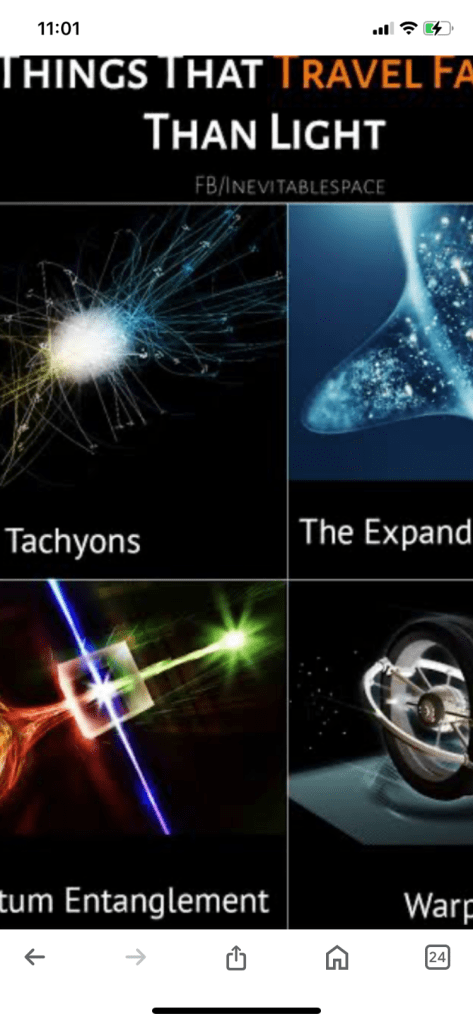
Tachyons are hypothetical particles that are theorized to always travel faster than light. Their existence is purely speculative, and there’s no experimental evidence to support it. If they did exist, they could potentially lead to some mind-bending scenarios, including the possibility of time travel.
However, the idea of time travel raises several paradoxes, like the famous “grandfather paradox,” which creates logical inconsistencies. Because of these paradoxes and the lack of evidence for tachyons, time travel remains firmly in the realm of science fiction for now.
The mass paradox
The mass paradox of tachyons is a theoretical issue that arises if we try to apply our current understanding of physics to these hypothetical faster-than-light particles. Here’s the breakdown:

- Imaginary Mass: Unlike ordinary particles, which have positive mass, tachyons are theorized to possess imaginary mass. This implies that as their energy decreases, their speed increases, leading to a phenomenon where they gain energy as they lose speed, defying the principles of relativity.
- Faster-Than-Light Travel: Tachyons are postulated to travel faster than the speed of light, violating the fundamental tenets of Einstein’s theory of special relativity. If real, this would have profound implications for our understanding of causality and the structure of the universe.
- Paradoxical Behavior: The combination of imaginary mass and faster-than-light speed leads to paradoxical behavior. For instance, if a tachyon were to transfer energy to another particle, it could potentially cause the recipient particle to move backward in time, violating the principle of cause and effect.
- Theoretical Implications: The mass paradox of tachyons challenges our current understanding of physics and raises questions about the validity of applying our known laws to particles that defy the speed limit of the universe.
It’s important to note that tachyons are purely hypothetical, and there’s no experimental evidence to support their existence. However, they serve as a valuable tool for theoretical physicists to explore the boundaries of our understanding of the universe.
The causality clash of tachyons
The causality clash of tachyons is a theoretical paradox that arises if we try to reconcile the existence of these hypothetical faster-than-light particles with our current understanding of cause and effect. Here’s the breakdown:
- Faster-Than-Light Travel: Tachyons are theorized to travel faster than the speed of light, which is a fundamental limit according to Einstein’s theory of special relativity.
- Relativity of Simultaneity: One of the consequences of special relativity is the relativity of simultaneity. This means that two events that appear simultaneous to one observer might not appear simultaneous to another observer moving at a different velocity.
- Paradoxical Scenarios: If tachyons exist, it becomes possible to construct scenarios where an observer in one frame of reference sees a tachyon signal arrive before it was sent in another frame of reference. This leads to a violation of causality, as the effect (the arrival of the signal) precedes the cause (the sending of the signal).
- Implications for Causality: The causality clash of tachyons challenges our fundamental understanding of cause and effect. If causality can be violated, it raises questions about the nature of time and the possibility of time travel paradoxes.
It’s important to note that tachyons are purely hypothetical, and there’s no experimental evidence to support their existence. However, they serve as a valuable tool for theoretical physicists to explore the boundaries of our understanding of the universe and the limits of causality.
Time reversal by tachyons
The concept of time reversal by tachyons is a theoretical consequence of their hypothetical faster-than-light speed. Here’s how it works:
- Relativity of Simultaneity: According to Einstein’s theory of special relativity, the order of events can appear different to observers in different frames of reference, especially when speeds approach the speed of light.
- Tachyon Behavior: If tachyons exist, their faster-than-light speed could lead to scenarios where an observer in one frame of reference sees a tachyon signal arrive before it was sent in another frame of reference.
- Time Reversal: This reversal of the order of events implies that, under certain conditions, tachyons could appear to travel backward in time.
- Theoretical Implications: The possibility of time reversal by tachyons raises questions about the nature of time itself and the fundamental principles of cause and effect. It challenges our understanding of causality and could potentially lead to paradoxes.
It’s important to remember that tachyons are purely hypothetical particles, and there’s no experimental evidence to support their existence. However, they serve as a valuable tool for theoretical physicists to explore the boundaries of our understanding of the universe and the limits of causality.
Quantum echo by tachyons
The concept of quantum echo by tachyons is a theoretical idea that combines the hypothetical properties of tachyons with the principles of quantum mechanics. Here’s a breakdown:
- Tachyons: Tachyons are hypothetical particles that are theorized to travel faster than the speed of light. Their existence is purely speculative, and there’s no experimental evidence to support it.
- Quantum Echo: In quantum mechanics, a quantum echo is a phenomenon where a quantum system, after being disturbed, returns to its original state after a certain period of time. This is analogous to an echo in acoustics, where a sound wave is reflected back to its source.
- Theoretical Possibility: Some theoretical physicists have speculated that if tachyons exist, they could potentially interact with quantum systems in a way that leads to a quantum echo effect. This is based on the idea that tachyons, due to their faster-than-light speed, could potentially influence the past states of quantum systems.
- Speculative Nature: It’s important to emphasize that the concept of quantum echo by tachyons is highly speculative. It relies on the existence of tachyons, which is itself uncertain, and involves complex theoretical frameworks that are still being explored.
- Implications: If quantum echo by tachyons were to exist, it could have profound implications for our understanding of quantum mechanics, causality, and the nature of time itself. However, it’s crucial to remember that this is a theoretical concept with no experimental evidence to support it.
In conclusion, quantum echo by tachyons is a fascinating theoretical idea that combines the hypothetical properties of tachyons with the principles of quantum mechanics. However, it’s important to remember that this is a speculative concept with no experimental evidence to support it.
Energy fix by tachyons
The concept of “energy fix by tachyons” is a speculative idea that arises from the hypothetical properties of tachyons, particles theorized to travel faster than light. Here’s a breakdown:
- Tachyons and Negative Energy: Tachyons are theorized to possess imaginary mass, which leads to some unusual consequences. One of these is that their energy can become negative under certain conditions.
- Energy Conservation: The law of energy conservation states that energy cannot be created or destroyed, only transformed from one form to another. However, the possibility of negative energy associated with tachyons raises questions about how this law might be affected.
- Theoretical Speculations: Some theoretical physicists have speculated that tachyons, with their potential for negative energy, could be used to “fix” energy imbalances in the universe. This could involve scenarios where tachyons transfer their negative energy to counteract positive energy, potentially leading to energy equilibrium.
- Highly Speculative: It’s crucial to emphasize that the concept of “energy fix by tachyons” is highly speculative. It relies on the existence of tachyons, which is itself uncertain, and involves complex theoretical frameworks that are still being explored.
- Implications: If tachyons and their associated negative energy were to exist, it could have profound implications for our understanding of energy conservation, cosmology, and the fundamental laws of physics. However, it’s essential to remember that this is a theoretical concept with no experimental evidence to support it.
In conclusion, “energy fix by tachyons” is a fascinating theoretical idea that arises from the hypothetical properties of these faster-than-light particles. However, it’s important to remember that this is a speculative concept with no experimental evidence to support it.
Cosmic driver by tachyons
The concept of “cosmic driver by tachyons” is a speculative idea that arises from the hypothetical properties of tachyons, particles theorized to travel faster than light. Here’s a breakdown:
- Tachyons and Negative Energy: Tachyons are theorized to possess imaginary mass, which can lead to negative energy under certain conditions.
- Cosmic Expansion: The universe is expanding, and this expansion is accelerating. Scientists believe that this acceleration is driven by a mysterious force called dark energy.
- Theoretical Speculations: Some theoretical physicists have speculated that tachyons, with their potential for negative energy, could be related to dark energy and the accelerating expansion of the universe. They propose that tachyons might be acting as a “cosmic driver,” contributing to the expansion by counteracting the gravitational forces that would otherwise slow it down.
- Highly Speculative: It’s crucial to emphasize that the concept of “cosmic driver by tachyons” is highly speculative. It relies on the existence of tachyons, which is itself uncertain, and involves complex theoretical frameworks that are still being explored.
- Implications: If tachyons and their associated negative energy were to exist and be linked to dark energy, it could have profound implications for our understanding of cosmology, the accelerating expansion of the universe, and the fundamental laws of physics. However, it’s essential to remember that this is a theoretical concept with no experimental evidence to support it.
In conclusion, “cosmic driver by tachyons” is a fascinating theoretical idea that arises from the hypothetical properties of these faster-than-light particles. However, it’s important to remember that this is a speculative concept with no experimental evidence to support it.
The relativity debate

The “relativity debate” surrounding tachyons centers on whether these hypothetical faster-than-light particles can coexist with Einstein’s theory of special relativity, or if their existence would necessarily invalidate it. It’s less of a traditional “debate” and more of a complex theoretical exploration with various viewpoints. Here’s a breakdown of the key points:
Arguments Against Tachyons (and thus, in favor of relativity remaining intact):
- Causality Violation: The biggest problem with tachyons is the potential for causality violations. Because they can theoretically travel faster than light, it becomes possible to construct scenarios where an effect precedes its cause in some frames of reference. This leads to paradoxes (like the grandfather paradox) that undermine our fundamental understanding of cause and effect. Special relativity is built on the principle of causality, and tachyons seem to break it.
- Mass-Energy Relationship: The equations of special relativity show that as an object approaches the speed of light, its mass approaches infinity, and it requires infinite energy to reach the speed of light. Tachyons, to exist, would have to start at speeds above light speed, implying they would have infinite mass (or imaginary mass, which introduces its own problems) at or below light speed. This creates a significant theoretical hurdle.
- Lack of Experimental Evidence: Despite extensive searches, no experimental evidence for tachyons has ever been found. While absence of evidence isn’t proof of absence, the lack of any detection after so much searching makes their existence seem increasingly unlikely.
Arguments For Tachyons (or at least, exploring the theoretical possibility): - Theoretical Consistency (in some interpretations): Some physicists have explored theoretical models where tachyons exist but don’t necessarily lead to causality violations. These models often involve complex mathematical frameworks and interpretations of spacetime. They try to “quarantine” tachyons so they don’t interact with normal matter in ways that would allow for paradoxes. However, these models are often highly speculative.
- Exploring the Limits of Physics: Even if tachyons don’t exist, exploring the theoretical consequences of their hypothetical existence helps physicists better understand the limits of our current theories. By pushing the boundaries of what we think is possible, we can potentially uncover new physics.
- Mathematical Solutions: In some equations related to relativity and quantum field theory, solutions involving imaginary mass appear, which are sometimes interpreted as hinting at the possible existence of tachyons. However, these solutions are often reinterpreted in ways that don’t require the existence of actual faster-than-light particles.
The Current State of the “Debate”:
The overwhelming consensus in the physics community is that tachyons are unlikely to exist. The causality problems and the lack of experimental evidence are strong arguments against them. However, the theoretical exploration of tachyons continues, primarily as a way to probe the foundations of relativity and quantum field theory. It’s a way of asking “what if?” and seeing where the mathematics leads, even if the destination seems improbable. It’s important to remember that science is always open to new discoveries, but extraordinary claims require extraordinary evidence, and that evidence has yet to materialize for tachyons.
Please like subscribe comment your precious thoughts on universe discoveries
Full article source google
https://www.buymeacoffee.com/Satyam55
If you like my website universe discoveries please donate me a coffee
 Universe discoveries
🙏🌹
Aum Shanti
LikeLike
💛❤️💖
LikeLike