
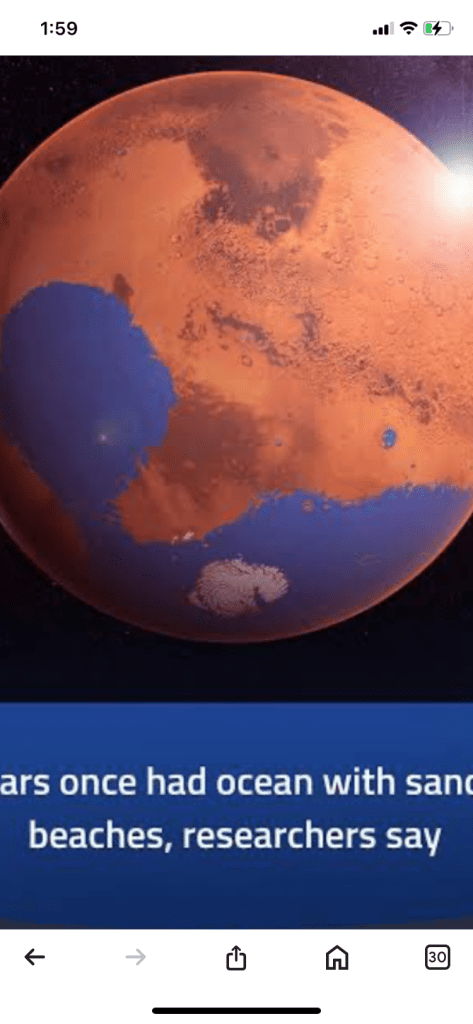
Based on recent scientific findings, it’s more accurate to say that Mars had beaches in its ancient past. Here’s a breakdown:
- Evidence of Ancient Shorelines:
- Research, particularly involving data from China’s Zhurong rover, indicates the presence of buried beach deposits.
- These findings suggest that Mars once had a large ocean, with waves that shaped shorelines, similar to beaches on Earth.
- Ground penetrating radar has been used to find layers of rocks that validate the theory of an ancient ocean.
- Past vs. Present:
- Today, Mars is a cold, dry planet.
- The water that once existed on its surface is now largely frozen in polar ice caps or locked beneath the surface.
- Therefore, while Mars had beaches billions of years ago, it does not have active beaches in the present day.
In essence, the discoveries point to a much wetter and potentially more habitable past for Mars.
Mars may have once hosted an ocean with waves that lapped against sandy beaches 3.6 billion years ago, according to new research. China’s Zhurong rover and its ground-penetrating radar detected the ancient shorelines when it operated from May 2021 to May 2022.
The rover landed in Utopia Planitia, a plain within the largest known impact basin on Mars, near a series of ridges in the planet’s northern hemisphere. Scientists have long questioned whether the ridges might represent the remnants of a shoreline, so Zhurong set out in search of evidence of ancient water.
The study, based on data collected by Zhurong as its radar instrument peered beneath the surface to examine hidden rock layers, was published Monday in the journal Proceedings of the National Academy of Sciences.
We’re finding places on Mars that used to look like ancient beaches and ancient river deltas,” said study coauthor Benjamin Cardenas, assistant professor of geology in the department of geosciences at Penn State, in a statement. “We found evidence for wind, waves, no shortage of sand — a proper, vacation-style beach.”
What’s more, it’s possible the Martian environment was warmer and wetter for tens of millions of years longer than previously suspected, the study authors wrote.
The revelations add to the increasing evidence that the red planet once had a warmer, wetter climate as well as an ocean that covered one-third of the Martian surface — conditions that might have created a hospitable environment for life.
Scientists have found evidence of water on Mars in the form of underground reservoirs and flowing liquid.
Underground reservoirs
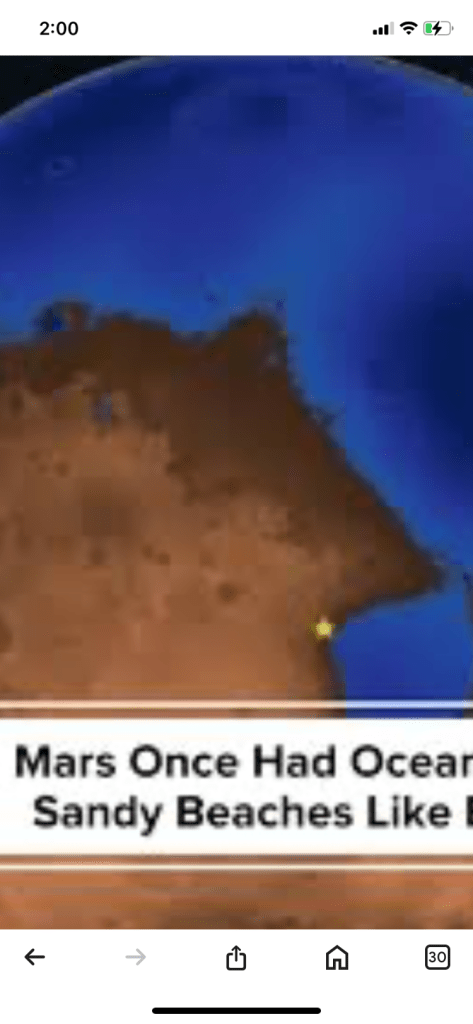
- Seismic data from NASA’s Insight lander suggests a large underground reservoir of liquid water. The reservoir could cover the entire planet to a depth of 1 to 2 kilometers.
- The water is trapped in tiny cracks and pores in rock in the middle of the Martian crust.
- The discovery suggests that much of the water that once filled the planet’s oceans still exists.
Flowing liquid
- NASA’s Mars Reconnaissance Orbiter (MRO) has detected signatures of hydrated minerals on slopes where dark streaks appear to flow down steep slopes during warm seasons.
- These darkish streaks appear to ebb and flow over time.
Implications
- These discoveries could transform our understanding of Mars’ past and hint at a habitat where life could potentially thrive there today.
- The existence of an ocean of this size means a higher potential for life.
Previous history
- Billions of years ago, Mars was warm, wet, and had an atmosphere that could have supported life.
- Most of the water on Mars disappeared, leaving only ice on the surface, most of it in the polar caps.
Please like subscribe comment your precious thoughts on universe discoveries
Full article source google
https://www.amazon.in/b?_encoding=UTF8&tag=555101-21&link
This is Amazon link if you want to buy anything from Amazon you can click on that it will help my website grow freinds
https://www.buymeacoffee.com/Satyam55
Please donate me a coffee freinds to help my website grow if you like my website universe discoveries
4742822
 Universe discoveries
🙏🌹
Aum Shanti
LikeLike