

It’s important to clarify that when discussing exoplanet “years” and their durations, we’re talking about the time it takes for a planet to complete one orbit around its star. Recent information highlights some very interesting exoplanets with extremely short orbital periods. Here’s a breakdown of what I found:
- WASP-121b:
- This exoplanet is known for having an extremely short “year.”
- A “year” on WASP-121b lasts only about 30 Earth hours, not 30 earth days. This means it orbits its star incredibly quickly.
- This makes time move much faster on this planet compared to Earth.
- Other WASP Planets:
- It is important to note that the WASP designation is used for many exoplanets. So there are many WASP planets.
- For example WASP-193b has a year that last 6.25 earth days.
- The very short orbital periods of planets like WASP-121b is due to the very close proximity of the planet to its host star.
Therefore, while there are exoplanets with very short orbital periods, the statement of 30 earth days equaling one year is not correct. It is closer to 30 earth hours.
Wasp planets 🪐 and their characteristics
The “WASP” designation refers to the Wide Angle Search for Planets, a project that has discovered a large number of exoplanets. These exoplanets, therefore, are known as “WASP planets.” Here’s a summary of their key characteristics:
- Hot Jupiters:
- Many WASP planets are “hot Jupiters,” which are gas giant planets that orbit very close to their host stars. This results in extremely high temperatures.
- Their close proximity leads to very short orbital periods (their “years”).
- Transit Method Detection:
- The WASP project primarily uses the transit method to detect exoplanets. This involves observing the slight dimming of a star’s light as a planet passes in front of it.
- Diverse Characteristics:
- While many are hot Jupiters, WASP planets exhibit a range of characteristics in terms of size, mass, and atmospheric composition.
- For example, researchers have used the James Webb Space Telescope to study the atmospheres of some WASP planets, revealing details about their composition and weather patterns.
- Tidally Locked:
- Due to their close proximity to their stars, many WASP planets are tidally locked, meaning that one side of the planet always faces the star. This results in extreme temperature differences between the day and night sides.
- Examples:
- WASP-12b:
- Known for its extremely hot temperature and being “swallowed” by its star.
- WASP-39b:
- A “hot Saturn” that has been extensively studied by the James Webb Space Telescope, revealing details about its atmospheric composition.
- WASP-43b:
- Displays extreme temperature differences between its day and night sides, due to being tidally locked.
In essence, WASP planets offer a valuable opportunity to study the diversity of exoplanets and to gain a better understanding of planetary formation and evolution.
- Displays extreme temperature differences between its day and night sides, due to being tidally locked.
Life on wasp planets
When considering the possibility of life on WASP planets, it’s crucial to understand their extreme characteristics. Here’s a breakdown:
- Extreme Conditions:
- Most WASP planets, especially the well-known “hot Jupiters,” have incredibly high temperatures. These temperatures are far beyond the range that could support life as we know it.
- The intense radiation from their host stars and the tidal locking that many experience create environments that are hostile to life.
- Atmospheric Conditions:
- While some WASP planets have atmospheres that have been studied, the compositions found are typically not conducive to life.
- For example, the presence of certain gasses can be detected, but those detected gasses so far, do not point to life.
- Lack of Habitable Zones:
- The concept of a “habitable zone” refers to the region around a star where temperatures allow for liquid water to exist on a planet’s surface.
- WASP planets generally orbit too close to their stars to be within these habitable zones.
- Current Understanding:
- Based on our current understanding of life, it’s highly unlikely that life could exist on most known WASP planets.
- It is important to remember that the search for exoplanets, and the study of their atmospheres is a very active area of science, and future discoveries could change our current understanding.
In summary, the extreme temperatures, radiation, and atmospheric conditions of most WASP planets make them very unlikely places to find life.
Which exoplanets can have life
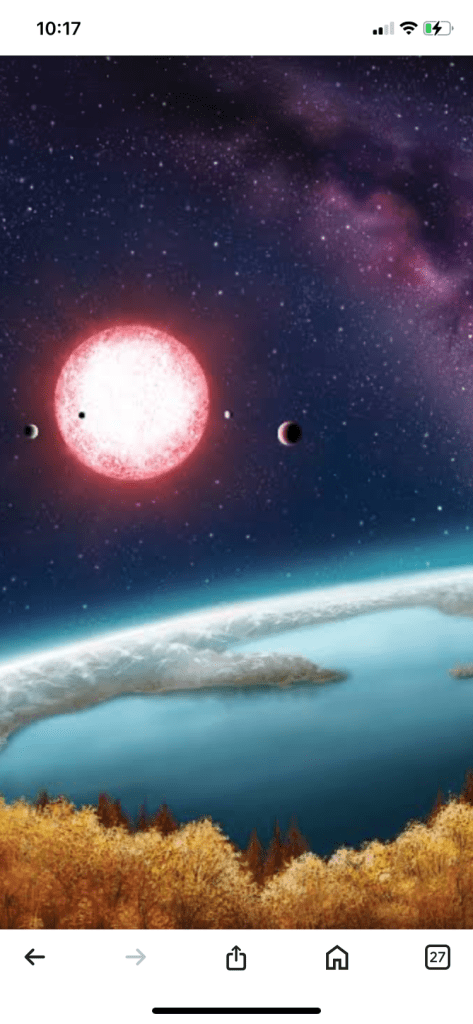
The search for exoplanets that could potentially harbor life is one of the most exciting areas of modern astronomy. Here are a couple of exoplanets that have generated significant interest, along with the caveats:
- K2-18b:
- This exoplanet has received a lot of attention due to observations from the James Webb Space Telescope.
- It’s a “Hycean” world, meaning it could have a hydrogen-rich atmosphere and liquid water oceans.
- The detection of certain molecules in its atmosphere has sparked discussions about potential biosignatures.
- However, it’s important to note that further research is needed to confirm these findings and to fully understand the planet’s environment.
- TRAPPIST-1e:
- This exoplanet is part of the TRAPPIST-1 system, which has multiple Earth-sized planets orbiting a red dwarf star.
- TRAPPIST-1e is located within the star’s habitable zone, meaning it could potentially have liquid water on its surface.
- It’s considered one of the most promising exoplanets for further study.
- Gliese 12 b:
- Recently discovered, Gliese 12 b is an earth sized exoplanet, located within it’s stars habitable zone.
- Because of its location within the habitable zone, there is the possibility of liquid water existing on the planets surface.
- Further study is required to understand if the planet retains an atmosphere.
Key factors that scientists consider when assessing the potential for life on an exoplanet include: - Habitable zone: The region around a star where temperatures allow for liquid water.
- Atmospheric composition: The presence of certain gases, such as water vapor, carbon dioxide, and oxygen.
- Planet size and composition: Rocky planets are more likely to support life as we know it.
It’s crucial to remember that while these exoplanets show promise, the search for extraterrestrial life is ongoing. More observations and data are needed to confirm whether any of them truly harbor life.
Please like subscribe comment your precious comment on universe discoveries
Full article source google
This is Amazon link if you want to buy anything from Amazon you can click on that it will help my website grow freinds
https://www.amazon.in/b?_encoding=UTF8&tag=555101-21&link
https://www.buymeacoffee.com/Satyam55
Please donate me a coffee freinds to help my website grow if you like my website universe discoveries
4742822
 Universe discoveries
Well researched information.
LikeLike
Thanks ☺️ sir
LikeLiked by 1 person
You are welcome
LikeLike
🙏🌹
Aum Shanti
LikeLike
Exo planets are very interesting. This was a very interesting post.
LikeLike
Yes 👍 and when we found habitable exoplanets it sounds more interesting 🤔
LikeLiked by 1 person
Yes that is certainly very exciting
LikeLike
Great information
LikeLiked by 1 person
Thanks 🙏
LikeLiked by 1 person