
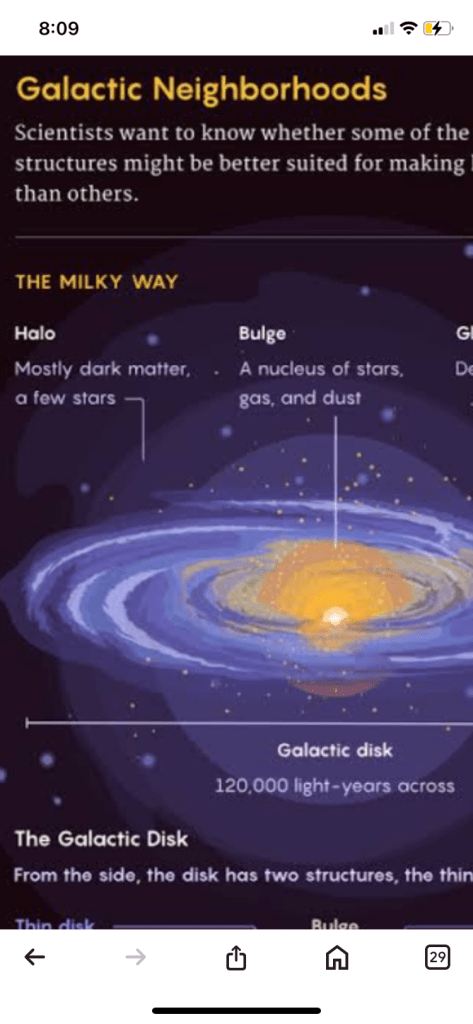
It’s important to understand that “habitable” on a galactic scale is complex. It’s not just about finding Earth-like planets, but also about the overall galactic environment. Here’s a breakdown of what research suggests:
- Elliptical Galaxies:
- Studies indicate that massive elliptical galaxies may potentially host significantly more habitable planets than spiral galaxies like the Milky Way.
- These galaxies, particularly those with high “metallicity” (elements heavier than hydrogen and helium) and lower star formation rates, could be more conducive to the formation of stable planetary systems.
- Research has shown that some of these galaxies could potentially host 10,000 times as many Earth-like planets as the Milky Way.
- One example of a near by elliptical galaxy is Maffei 1.
- Factors for Habitability:
- Metallicity: The presence of heavier elements is crucial for planet formation.
- Star Formation Rate: A lower star formation rate can lead to a more stable environment with fewer disruptive events like supernovae.
- Galactic Habitable Zone: Just like stars have habitable zones, galaxies also have regions where conditions are more favorable for life. Factors like radiation levels and the frequency of supernovae play a role.
It’s important to note that this is an area of ongoing research, and there are different perspectives on which types of galaxies are most likely to host life.
Alpha centori is habitable

The Alpha Centauri system is of great interest to scientists regarding the potential for habitability. Here’s a breakdown:
- The System:
- Alpha Centauri is a triple star system, consisting of Alpha Centauri A, Alpha Centauri B, and Proxima Centauri.
- Proxima Centauri, a red dwarf, has a known planet, Proxima b, which is within its habitable zone.
- There are also indications of potential planets within the habitable zones of Alpha Centauri A and B.
- Habitability Factors:
- The presence of planets within habitable zones is a key factor. These zones are regions where liquid water could exist on a planet’s surface.
- However, habitability is complex. Factors like a planet’s atmosphere, its stability, and the radiation environment from its stars all play crucial roles.
- Red dwarf stars, like proxima centauri, are known to have high levels of stellar flare activity, which can be detrimental to life.
- Current Understanding:
- Proxima b is currently considered one of the most likely candidates for a potentially habitable exoplanet due to its location.
- Scientists are still gathering data to determine the true habitability of planets within the Alpha Centauri system.
- So, while the system holds promise, it’s not definitively known if any of its planets are truly habitable.
In summary, Alpha Centauri has potential for habitable planets, but more research is needed to confirm this.
Habitable planets like earth

The search for Earth-like exoplanets is one of the most exciting areas of modern astronomy. Here’s a look at what scientists are looking for and some notable examples:
What Makes an Exoplanet Earth-like?
- Habitable Zone:
- This is the region around a star where temperatures allow liquid water to exist on a planet’s surface. Liquid water is considered essential for life as we know it.
- Rocky Composition:
- Earth is a rocky planet, and scientists believe that rocky planets are more likely to support life than gas giants.
- Size and Mass:
- Planets similar in size and mass to Earth are more likely to have Earth-like gravity and atmospheres.
- Atmosphere:
- A suitable atmosphere is crucial for regulating temperature and providing protection from harmful radiation.
Notable Exoplanets: - Kepler-452b:
- Often referred to as “Earth’s cousin,” this planet orbits a star very similar to our sun.
- It’s slightly larger than Earth and resides in the habitable zone.
- TRAPPIST-1e:
- This planet is part of the TRAPPIST-1 system, which contains multiple Earth-sized planets in the habitable zone.
- It’s considered one of the most promising candidates for habitability.
- Gliese 12 b:
- This is a recent discovery. It is an earth sized exoplanet in its stars habitable zone.
- It is located only 40 light years away.
- Proxima Centauri b:
- This exoplanet orbits Proxima Centauri, the closest star to our sun.
- It’s within the habitable zone, but its star is a red dwarf, which can present challenges for habitability.
Important Considerations: - Determining true habitability is complex. Even if a planet is in the habitable zone, other factors, such as atmospheric composition and stellar activity, can play a significant role.
- Ongoing and future missions, like the James Webb Space Telescope, are providing valuable data that will help us better understand these exoplanets.
The search for Earth-like exoplanets is a continuous process, and new discoveries are constantly being made.
Please like subscribe comment your precious thoughts on universe discoveries
Full article source google
This is Amazon link if you want to buy anything from Amazon you can click on that it will help my website grow freinds
https://www.amazon.in/b?_encoding=UTF8&tag=555101-21&link
https://www.buymeacoffee.com/Satyam55
Please donate me a coffee to help grow my website universe discoveries freinds
 Universe discoveries
🙏🌹
Aum Shanti
LikeLike