
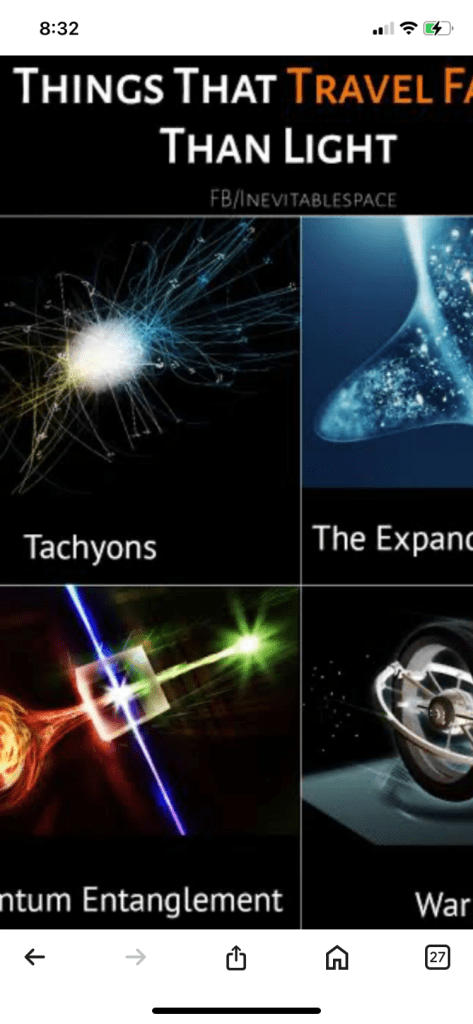
It’s true that science fiction has dreamed up some incredibly imaginative ways to bypass the limitations of Einstein’s theory of relativity. Here’s a look at some of the most popular faster-than-light (FTL) travel methods:
Key Sci-Fi FTL Methods:
- Warp Drive (Star Trek):
- This iconic method involves creating a “warp bubble” around a starship, distorting spacetime to allow it to travel at superluminal speeds.
- Hyperspace (Star Wars):
- Hyperspace travel involves entering a parallel dimension where the laws of physics are different, allowing for faster travel between points in normal space.
- Wormholes (Various):
- Wormholes are theoretical “shortcuts” through spacetime that connect two distant points. Sci-fi often portrays them as tunnels that can be traversed instantaneously.
- Stargates (Stargate):
- These devices create artificial wormholes, allowing for near-instantaneous travel between fixed locations.
- Jump Drives (Various):
- This general term refers to systems that allow ships to “jump” or teleport across vast distances, often by manipulating spacetime or entering another dimension.
- Folding Space (Dune):
- In the “Dune” universe, navigators use the Holtzman effect to fold space, effectively shortening the distance between two points.
- Quantum Slipstream (Various):
- This is a method that uses quantum physics to allow travel through a sub space layer of reality.
- Teleportation (Various):
- While not always used for interstellar travel, teleportation, when used for those purposes, is a very fast method.
- Space Bridges (Transformers):
- These are artificial wormhole generators, that allow for near instant travel between two points.
- The Spore Drive (Star Trek Discovery):
- This drive uses mycelial networks to travel vast distances.
- The Tachyons:
- Tachyons are hypothetical particles that always travel faster than light.
- Phase shifting:
- This is the act of shifting a vessel out of normal space time, and into a phase of reality where FTL travel is possible.
- Dimensional Travel:
- This is the general idea of traveling to another dimension where the rules of physics are different, and then using that dimension to travel faster than light in normal space.
Important Note: - It’s crucial to remember that these are fictional concepts.
- Einstein’s theory of relativity, as far as we currently understand it, places a speed limit on the universe: the speed of light.
- While scientists continue to explore the possibilities of FTL travel, it remains a significant challenge.
I hope this overview is helpful!
Cosmic speed limits can be a major inconvenience but they’ve rarely stopped science fiction in its tracks.
When it comes to space travel, Albert Einstein’s theory of relativity is a major inconvenience. With the laws of physics (currently) prohibiting faster-than-light travel, velocities are limited to a mere 300,000,000 ms-1. By any Earthbound measure that’s very quick indeed, but it’ll still take you 4.2 years to reach our sun’s nearest neighbor, Proxima Centauri.
That sort of timeframe clearly isn’t conducive to all-action space opera — imagine if the Millennium Falcon had taken a decade to travel from Tatooine to Alderaan in “Star Wars: A New Hope” — so sci-fi writers have come up with numerous ingenious ways to jet around the cosmos at quite ludicrous speeds.
We say this with a few caveats… Hollywood tends to assume that spacecraft have access to limitless sources of energy. And that — unless it’s integral to a story, as in “Flight of the Navigator”, “Planet of the Apes” and “Interstellar” — time dilation isn’t going to cause starship crews any bother. Nonetheless, there’s no doubt that a little bit of scientific flexibility leads to more exciting adventures. So, in that spirit of interstellar exploration, here are 13 of the most memorable ways to travel faster than light — or, failing that, cheat.
Can in future we can surpass speed of light to do interstellar travel
The question of whether we can surpass the speed of light for interstellar travel is one that blends scientific inquiry with the realm of possibility. Here’s a breakdown of the current understanding:
The Challenge of the Speed of Light:
- Einstein’s Relativity:
- Einstein’s theory of special relativity establishes the speed of light in a vacuum as a universal speed limit.
- As an object with mass approaches the speed of light, its mass increases infinitely, requiring an infinite amount of energy to accelerate it further.
- Current Scientific Understanding:
- Based on our current understanding of physics, traveling faster than light (FTL) appears to be impossible.
Potential Avenues and Considerations: - Wormholes:
- Theoretical wormholes, or “shortcuts” through spacetime, could potentially allow for faster-than-light travel.
- However, the existence and stability of wormholes are still highly speculative.
- Warp Drive:
- The concept of a warp drive, which involves distorting spacetime around a spacecraft, is another theoretical possibility.
- While intriguing, it would require manipulating vast amounts of energy and potentially exotic matter, which are currently beyond our capabilities.
- New Physics:
- It’s possible that future discoveries in physics could reveal new phenomena or principles that allow for FTL travel.
- Science is constantly evolving, and our understanding of the universe is always expanding.
- Effective Faster Than Light travel:
- It is worth noting that some concepts deal with “effective” faster than light travel. For example, by time dilation, traveling at very high speeds, close to the speed of light, time for the traveler slows down relative to those who remain stationary. Therefore, very long distances could be traveled within a human lifetime, from the travelers point of view.
Key Takeaways: - While FTL travel remains a staple of science fiction, it faces significant challenges based on our current understanding of physics.
- However, scientific exploration and discovery continue, and future breakthroughs could potentially open new possibilities.
- It is important to differentiate between actual FTL, and the effects of extreme time dilation, which would allow for very long journeys to be completed within a human life time.
In essence, while the possibility of FTL travel is captivating, it remains a highly speculative concept.
Please like subscribe comment your precious thoughts on universe discoveries
Full article source google
This is Amazon link if you want to buy anything from Amazon you can click on that it will help my website grow freinds
https://www.amazon.in/b?_encoding=UTF8&tag=555101-21&link
https://www.buymeacoffee.com/Satyam55
Please donate me a coffee to help grow my website universe discoveries freinds
 Universe discoveries
Well researched post.
Thanks for sharing.
LikeLike
Thanks ☺️ sir
LikeLiked by 1 person
You are welcome
LikeLike
🙏🌹
Aum Shanti
LikeLike