
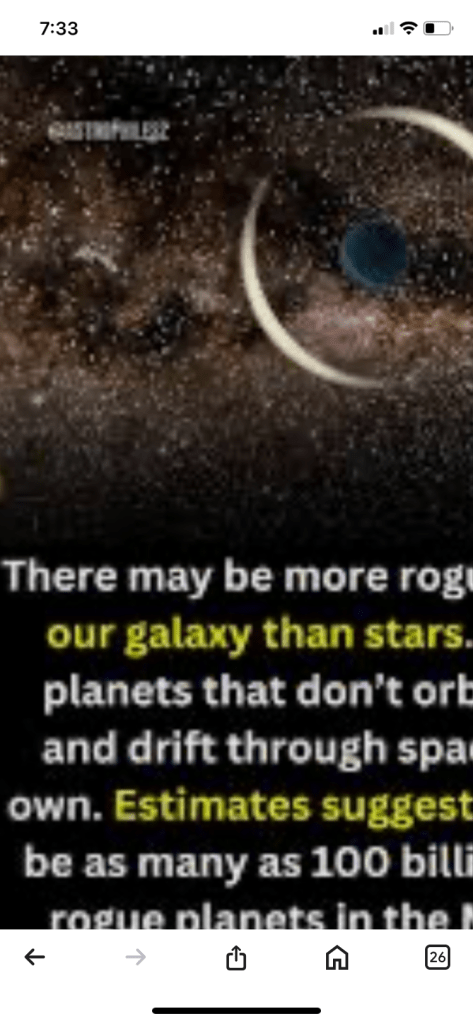
It’s challenging to give an exact number of rogue planets roaming the Milky Way, but here’s what we know:
- Abundance:
- Scientists estimate that there could be billions, or even trillions, of these free-floating planets in our galaxy.
- Some studies suggest there could be many more rogue planets than stars.
- Estimates range from numbers that indicate there could be between 100 to 100,000 rogue planets for every star in the milky way.
- Detection Challenges:
- Rogue planets are difficult to detect because they don’t orbit stars and emit very little light.
- Recent advancements in telescopes, like the Euclid Space Telescope, are helping astronomers discover more of these elusive objects.
- Recent Discoveries:
- Recent studies, including those using the Euclid telescope, have significantly increased the number of known rogue planets.
- These studies reinforce the theory that these planets are very common in the Milky Way.
- Future Observations:
- Telescopes like the upcoming Nancy Grace Roman Space Telescope are expected to greatly increase the amount of rogue planets we find, and refine our understanding of how many are in the galaxy.
In essence, while the exact number is still uncertain, current research indicates that rogue planets are likely very abundant in the Milky Way.
What are rougue planets
Essentially, rogue planets are celestial bodies that possess planetary mass but do not orbit a star. Instead, they wander freely through the vastness of interstellar space. Here’s a breakdown:
- Untethered Worlds:
- Unlike the planets in our solar system, which are gravitationally bound to the Sun, rogue planets are “free-floating.”
- They travel independently through the galaxy.
- Origins:
- Scientists believe that many rogue planets were likely ejected from their original planetary systems due to gravitational interactions with other planets or stars.
- There’s also the possibility that some rogue planets may form independently, similar to how stars form, from collapsing gas clouds.
- Detection Challenges:
- Because they don’t emit their own light like stars, and they don’t reflect much light, rogue planets are very difficult to detect.
- Astronomers use techniques like gravitational microlensing to find them, which involves observing how their gravity bends and magnifies the light from distant background stars.
- Prevalence:
- Despite the challenges in detecting them, research indicates that rogue planets are likely quite common in the Milky Way galaxy.
In simple terms, imagine planets that have been kicked out of their solar systems and are now drifting through space on their own.
Most planets in the cosmos probley don’t orbit stars
The idea that a significant portion of planets in the cosmos might not orbit stars is gaining traction within the scientific community. Here’s a breakdown of the key points:
- Rogue Planet Abundance:
- Studies suggest that rogue planets, also known as free-floating planets, could be incredibly numerous. Some estimates indicate that there might be far more of these planets than there are stars.
- This implies that a substantial fraction of planetary bodies in the galaxy could be wandering independently.
- Formation and Ejection:
- These rogue planets can originate in a couple of ways. Many are believed to form within planetary systems and are later ejected due to gravitational interactions.
- It is also possible that some form independently, from collapsing gas clouds, similar to how stars form.
- Detection Challenges and Advancements:
- Detecting these rogue planets is very difficult, as they don’t emit their own light.
- However, advancements in technology, particularly gravitational microlensing, are allowing astronomers to find increasing numbers of them.
- The upcoming Nancy Grace Roman Space Telescope is expected to greatly increase our understanding of the amount of rogue planets that exist.
- Implications:
- If rogue planets are as abundant as some scientists predict, it would significantly alter our understanding of planetary formation and the distribution of planets in the galaxy.
In summary, while star-orbiting planets are well-known, the possibility of a vast population of free-floating planets is becoming increasingly compelling.
Can a rougue planet hit earth in the future
The possibility of a rogue planet colliding with Earth, while not impossible, is considered extremely unlikely. Here’s a breakdown:
- Vastness of Space:
- The distances between celestial objects in space are immense. This vastness significantly reduces the probability of a collision.
- Even though there may be large numbers of rogue planets, the sheer size of the milky way, makes direct collisions very rare.
- Orbital Dynamics:
- Our solar system’s orbital dynamics are relatively stable. While gravitational interactions can occur, they are unlikely to result in a direct collision with a rogue planet.
- The orbits of the planets within our solar system have been stable for billions of years.
- Detection and Tracking:
- Astronomers are constantly monitoring the skies for potentially hazardous objects. As technology improves, our ability to detect and track these objects increases.
- Future telescopes will greatly improve our ability to track objects that may come close to earth.
- Low Probability:
- While a collision is theoretically possible, the probability is incredibly low. Scientists consider it a very remote risk.
In essence, while the universe is a dynamic place, the odds of a rogue planet directly impacting Earth are very, very small.
Please like subscribe comment your precious thoughts on universe discoveries
Full article source google
https://www.amazon.in/b?_encoding=UTF8&tag=555101-21&link
This is Amazon link if you want to buy anything from Amazon you can click on link to help my website universe discoveries grow freinds
https://www.buymeacoffee.com/Satyam55
Please donate me a coffee to help grow my website universe discoveries freinds
 Universe discoveries
Very nice information.
Thanks for sharing.
LikeLike
🙏🌹👍
Aum Shanti
LikeLike
That is a fascinating topic. This blew my mind “Estimates range from numbers that indicate there could be between 100 to 100,000 rogue planets for every star in the milky way.” Imagine if that was true. I know rogue planets are probably very cold and dead but still.
LikeLike