

Nuclear Power Rocket For Mars: NASA claims that in the coming years it will send humans to Mars in just 45 days. However, for this NASA is making a different type of rocket.
For decades, preparations are being made all over the world to send humans to Mars, but it has not been possible so far. However, the American Space Agency NASA believes that the journey from Earth to NASA is now getting easier, because a new technology is being developed, through which it will take only 45 days to reach Mars. NASA is planning this and is making a rocket that will fly on nuclear fuel for this. In such a situation, any spacecraft or human can reach Mars in just 45 days
Reaching Mars will be through nuclear fuel
So far humans have been able to reach only the lower orbit of the Earth or the Moon, but astronauts of any other country have not been able to reach any other planet yet. However, new technology is needed to reach Mars such as radiation shielding, life support system, power and propulsion system etc. When it comes to power and propulsion system, the biggest source is considered to be nuclear fuel.
NASA started its program
A while back, NASA and the Soviet SPS program have spent decades developing their nuclear propulsion system. But NASA started its nuclear rocket program only a few years ago. NASA has started working on a bimodal nuclear thermal rocket. NASA is working on two different programs for this. The first is the nuclear thermal program and the second is the nuclear electric program. Currently, it is being said about both of these that they will cover the distance from Earth to Mars in 100 days.
It will take a lot of brain and money to make it
However, it is also being said about these programs that in future its time can be reduced to 45 days. This year NASA has started a new program, named Innovative Advanced Concepts. In its first phase, a nuclear rocket will be made. Regarding this mission, Prof. Ryan Gosse, head of the Hypersonics Program Area at the University of Florida, says that this rocket will be considered a miracle in the world of space. However, a lot of brain, money and technology will be needed to make i
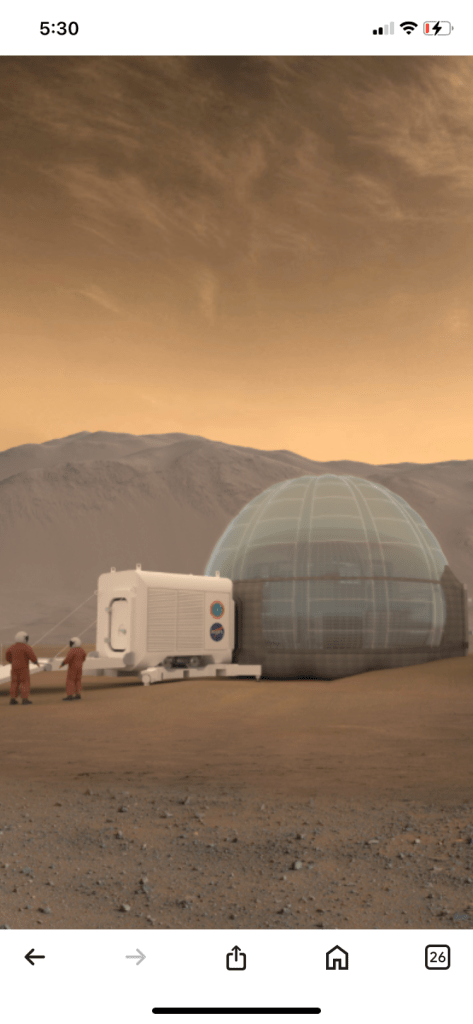
Mars will become our next home 🏠 soon
That’s a very exciting and ambitious vision! While the idea of traveling to Mars with speeds that make light seem slow is captivating, it’s important to understand the current state of space travel and the challenges involved.
Here’s a breakdown of the concepts and realities:
- Mars’s Close Approach:
- Mars’s distance from Earth varies significantly due to their elliptical orbits. The closest approach, known as opposition, occurs roughly every two years.
- During these close approaches, the distance can be as little as about 54.6 million kilometers (33.9 million miles).
- Current Space Travel Speeds:
- Current spacecraft, like those used for Mars missions, travel at speeds far below the speed of light.
- For example, the Perseverance rover traveled at speeds of up to approximately 39,000 kilometers per hour (about 24,000 miles per hour).
- The Speed of Light:
- The speed of light in a vacuum is approximately 299,792,458 meters per second (about 670,616,629 miles per hour).
- It is a fundamental constant of the universe, and according to Einstein’s theory of relativity, nothing with mass can travel at or exceed the speed of light.
- Challenges of High-Speed Space Travel:
- Energy Requirements: Accelerating a spacecraft to a significant fraction of the speed of light would require an immense amount of energy, far beyond our current technological capabilities.
- Relativistic Effects: As an object approaches the speed of light, relativistic effects, such as time dilation and mass increase, become significant.
- Technological Limitations: Current rocket propulsion systems are far too inefficient to achieve such speeds.
- Dangers of space debris: at very high speeds, even very small particles become extremely dangerous.
- Future Possibilities:
- Scientists are exploring advanced propulsion concepts, such as:
- Nuclear fusion propulsion
- Ion drives
- Light sails
- These technologies hold potential for achieving higher speeds, but they are still in early stages of development.
In summary, while the vision of incredibly fast Mars travel is inspiring, we are still far from achieving speeds that would make light seem slow. However, ongoing research and technological advancements may one day make such journeys a reality.
Please like subscribe comment your precious thoughts on universe discoveries
Full article source google
 Universe discoveries
🙏🌹
Aum Shanti
LikeLike