

The trade relationship between the United States and China remains complex and fraught with tension. Here’s a breakdown of the key elements, reflecting the current situation:
- Escalating Tariffs:
- Recent developments show a significant escalation in the trade war, with the U.S. implementing substantial tariff increases on Chinese goods.
- China has responded with retaliatory tariffs on U.S. products, leading to a cycle of escalating measures.
- The focus of some of the tarrifs, include issues related to fentanyl production.
- Economic Impact:
- These tariffs are having a significant impact on global markets, with concerns about disruptions to supply chains and potential economic slowdowns.
- The trade war is also affecting businesses and consumers in both countries, with increased costs and uncertainty.
- Geopolitical Tensions:
- The trade war is intertwined with broader geopolitical tensions between the U.S. and China, including issues related to technology, security, and regional influence.
- It is clear that the trade war is becoming a very large part of the overall relationship between the two nations.
- Global Implications:
- The trade war has implications for the global economy, as it disrupts established trade patterns and creates uncertainty for businesses worldwide.
- The world trade organization, is also having to deal with the effects of this trade war.
It’s important to note that the situation is dynamic and subject to change
History of trade war between USA and china
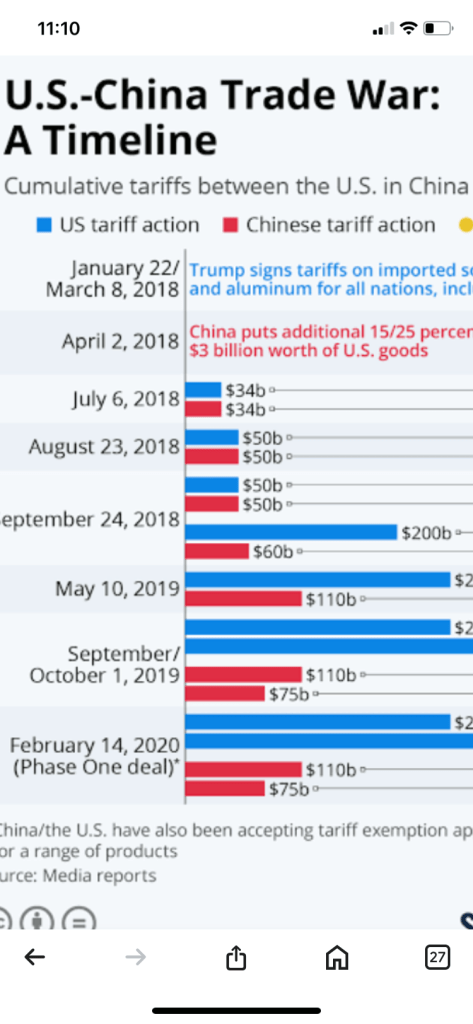
The trade war between the United States and China is a complex and evolving issue with roots that extend back several decades. Here’s a historical overview:
Key Historical Points:
- Early Trade Relations:
- The relationship between the U.S. and China has evolved significantly since China’s economic reforms began in the late 1970s.
- China’s entry into the World Trade Organization (WTO) in 2001 marked a major turning point, leading to a surge in bilateral trade.
- However, concerns arose in the U.S. regarding the trade imbalance, intellectual property theft, and unfair trade practices.
- The Trump Era:
- In 2018, the Trump administration initiated a series of tariffs on Chinese goods, citing these concerns.
- China responded with retaliatory tariffs, leading to a tit-for-tat escalation.
- The focus of the trade war included reducing the U.S. trade deficit, protecting American intellectual property, and addressing forced technology transfers.
- The Biden Era:
- While the Biden administration has maintained some of the tariffs imposed by its predecessor, it has also sought to engage with China on other fronts.
- The focus has shifted somewhat to include strategic competition, particularly in areas such as technology and supply chain security.
- There has been increased focus on semiconductor technology, with the US placing restrictions on exports to china.
- Continued Tensions:
- Even into 2025, the trade relationship remains strained, with ongoing disputes over tariffs, technology, and geopolitical influence.
- Currently there are very large tarrifs being placed on Chinese goods entering the United states, and reciprocal tarrifs being placed on US goods entering China.
- The trade war has had significant effects on global markets, causing supply chain disruptions, and economic uncertainty.
Key Factors Contributing to the Trade War: - Trade Imbalance: The large trade deficit between the U.S. and China has been a major source of contention.
- Intellectual Property Theft: The U.S. has accused China of widespread intellectual property theft, which it says harms American businesses.
- Forced Technology Transfer: Concerns exist that China forces foreign companies to transfer technology in exchange for market access.
- National Security Concerns: Growing concerns about China’s technological advancements and military ambitions have also played a role.
It is important to understand that the trade war is not just about economics; it is also about geopolitics and the shifting balance of power in the world.
The future of USA and china trade war

Predicting the precise future of the U.S.-China trade war is challenging due to its dynamic nature, influenced by numerous political, economic, and technological factors. However, we can highlight some key trends and potential scenarios:
Key Trends:
- Technological Competition:
- The focus is increasingly shifting towards technological competition, particularly in areas like semiconductors, artificial intelligence, and advanced manufacturing.
- Both countries are investing heavily in these sectors, aiming to achieve technological dominance.
- This competition will likely lead to further restrictions on technology transfer and trade.
- Supply Chain Diversification:
- Both the U.S. and many of its allies are seeking to diversify their supply chains, reducing reliance on China.
- This trend is driven by concerns about national security and economic resilience.
- This will cause changes to the global trade systems, as new trade partners are found.
- Geopolitical Factors:
- The trade war is intertwined with broader geopolitical tensions, including disputes over Taiwan, the South China Sea, and human rights.
- These tensions could escalate, further complicating trade relations.
- The overall relationship between the two nations is becoming increasingly strained.
- Continued Tariff Pressure:
- It is likely that tariffs will continue to be a tool used by both sides.
- The tarrifs are being used as leverage, and will likely continue to be used as such.
- The effects of those tarrifs will continue to cause changes to the global economy.
Potential Scenarios: - Escalation:
- Increased tariffs, trade restrictions, and technological decoupling.
- Potential for further deterioration of diplomatic relations.
- Significant disruption to global supply chains and economic growth.
- Managed Competition:
- Both countries seek to manage their economic competition while maintaining some level of trade.
- Focus on specific areas of cooperation, such as climate change.
- Continued tensions over technology and geopolitical issues.
- Partial Decoupling:
- A splitting of trade, where trade of certain goods is heavily reduced, while trade of other goods continues.
- This would cause large changes to the global economy.
Overall: - The U.S.-China trade relationship is likely to remain complex and challenging.
- Technological competition and geopolitical factors will play a significant role in shaping the future.
- The global economy will continue to be affected by the tensions between these two major powers.
It is important to stay informed about the latest developments, as the situation is constantly evolving.
Please like subscribe comment your precious comment on universe discoveries
Full article source google
https://www.amazon.in/b?_encoding=UTF8&tag=555101-21&link
This is Amazon link if you want to buy anything from Amazon you can click on link to help my website universe discoveries grow freinds
https://www.buymeacoffee.com/Satyam55
Please donate me a coffee to help grow my website universe discoveries freinds
 Universe discoveries
Thanks for sharing this thoughtful summary on the U.S.-China trade war—it’s clear you’ve highlighted some of the most important trends and scenarios that could unfold. The shift toward technological competition and supply chain diversification really does feel like the new front in this economic standoff, and your emphasis on how this impacts global dynamics is spot on.
Just a quick suggestion to make your piece even stronger:
You might want to proofread for small typos like “tarrifs” (should be “tariffs”) and “freinds” (should be “friends”).
It would be helpful to separate your Amazon link and the promotional message more clearly from the analytical content, so it doesn’t break the professional tone of your insights.
Consider adding a conclusion or call to reflection—for example, encouraging readers to consider how these shifts might affect their industries or investments.
LikeLike
🙏🌹👍
Aum Shanti
LikeLike
While China has not been playing the trade game fairly, tariffs were also enacted on countries who are. For example, the tariffs between the EU and the US were roughly the same and relatively low (EU’s tariffs on US for non-agricultural goods was 1.6%). Despite that Trump falsely claimed that the EU’s tariffs were 39% and enacted high tariffs on EU (for a while).
LikeLike