

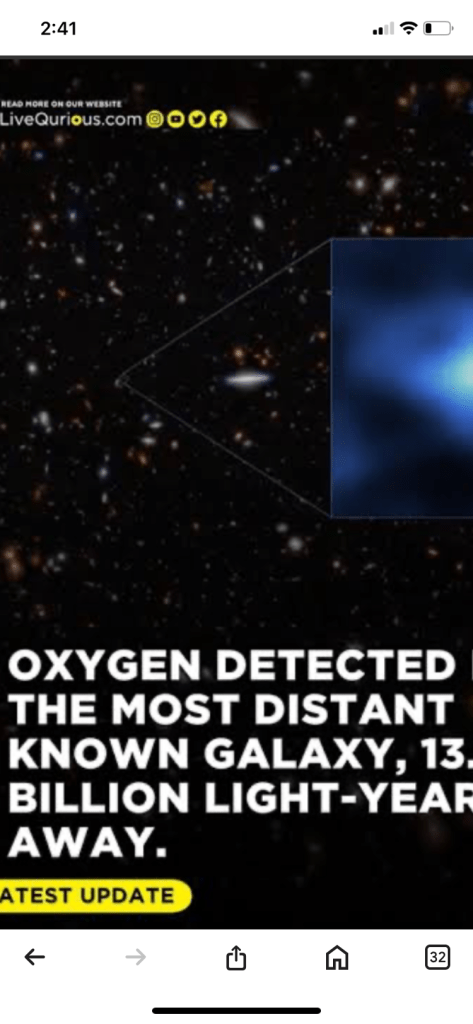
The James Webb Space Telescope (JWST) has played a crucial role in a groundbreaking discovery: the detection of oxygen in JADES-GS-z14-0, the most distant galaxy known. Here’s a breakdown of the key points:
- Distance and Age:
- This galaxy is incredibly far away, with its light taking 13.4 billion years to reach us. This means we’re seeing it as it was when the universe was only about 300 million years old, roughly 2% of its current age.
- Unexpected Discovery:
- The presence of oxygen in such an early galaxy was surprising to astronomers. It suggests that star formation and the production of heavy elements like oxygen occurred much faster in the early universe than previously thought.
- JWST and ALMA:
- JWST was instrumental in initially identifying and measuring the distance to JADES-GS-z14-0.
- Follow-up observations with the Atacama Large Millimeter/submillimeter Array (ALMA) confirmed the presence of oxygen.
- Implications:
- This discovery challenges existing models of galaxy formation and evolution in the early universe.
- It raises questions about how galaxies could mature so rapidly and produce significant amounts of heavy elements so soon after the Big Bang.
In essence, this finding provides valuable insights into the early universe and how galaxies like our own came to be.
Jades galaxy
The term “JADES galaxy” refers to galaxies discovered as part of the JWST Advanced Deep Extragalactic Survey (JADES). This survey utilizes the powerful James Webb Space Telescope (JWST) to explore the very early universe. Here’s a breakdown of what that entails:
- JWST Advanced Deep Extragalactic Survey (JADES):
- This is a program designed to use JWST to study distant, early galaxies.
- Its goal is to understand how galaxies formed and evolved in the early universe.
- It involves deep-field observations, capturing light from extremely faint and distant objects.
- Key Findings:
- JADES has led to the discovery of some of the most distant galaxies ever observed, including JADES-GS-z14-0.
- These observations provide valuable insights into the “cosmic dawn,” the period when the first stars and galaxies formed.
- It is providing data that is altering previous understandings of how quickly galaxies developed.
- Significance:
- JADES observations are crucial for understanding the early universe.
- They help astronomers to test and refine theories of galaxy formation and evolution.
- The data from the JADES program is providing astronomers with information about the chemical make up of very early galaxies, such as the surprising discovery of oxygen.
In essence, “JADES galaxies” are those that have been found and studied through this specific and very important JWST program, that is pushing the boundries of our knowledge of the early universe.
How is oxygen significance in early galaxy and could there be life in jades galaxy

The discovery of oxygen in early galaxies like those found by the JADES survey is significant for several reasons, and it also sparks questions about the potential for life. Here’s a breakdown:
Significance of Oxygen:
- Indicator of Star Formation:
- Oxygen, and other heavier elements, are not formed during the Big Bang. They are created through nuclear fusion within stars. Therefore, the presence of oxygen signifies that stars have already lived and died in these early galaxies.
- This means that star formation occurred surprisingly rapidly in the early universe.
- Chemical Evolution:
- Oxygen is a crucial element for the chemical evolution of galaxies. Its presence indicates that these galaxies are more chemically mature than previously thought.
- Understanding the distribution of oxygen helps astronomers trace the processes that led to the formation of more complex elements.
- Conditions for Life:
- While oxygen is essential for life as we know it, its presence alone does not guarantee life. However, it is a critical ingredient.
- The detection of oxygen suggests that the early universe might have had the necessary chemical building blocks for life to emerge sooner than previously imagined.
Can Life Exist in JADES Galaxies? - Challenges:
- The early universe was a very different place. Conditions were likely much more extreme, with intense radiation and frequent cosmic events.
- These early galaxies are also very young, cosmically speaking. Whether they would have had enough time for life to develop is a major question.
- The environmental conditions in these early galaxies are very different than those we see in our local area of the universe.
- Possibilities:
- The presence of oxygen indicates that the basic chemical ingredients for life could have been present.
- It opens up the possibility that life might have arisen earlier in the universe than we currently believe.
- It is important to remember that life may exist in forms that are completely foreign to us, and not require the same conditions that life on earth does.
- Further Research:
- More research is needed to understand the conditions within these early galaxies.
- Future observations with JWST and other telescopes will provide more data on the chemical composition and environment of these galaxies.
In summary, the discovery of oxygen in early galaxies is a significant finding that sheds light on the rapid evolution of the early universe. While it raises the possibility of life, further research is needed to determine whether these galaxies could have supported it.
Please like subscribe comment your precious thoughts on universe discoveries
Full article source google
https://www.amazon.in/b?_encoding=UTF8&tag=555101-21&link
This is Amazon link if you want to buy anything from Amazon you can click on link to help my website universe discoveries grow freinds
https://www.buymeacoffee.com/Satyam55
Please donate me a coffee to help grow my website universe discoveries freinds
 Universe discoveries
Nice information.
Thanks for sharing.
LikeLike
🙏🌹
Aum Shanti
LikeLike
Oxygen in such a young Universe, or old galaxy, is indeed interesting. Thank you for an interesting read.
LikeLike
yes oxygen in early universe also indicates that life started much earlier in universe than we thought 🙏🎸
LikeLiked by 1 person