

The 1971 India-Pakistan War was a significant conflict with deep roots in the political and social landscape of the subcontinent. Here’s a breakdown of the key aspects:
Causes of the War:
- Bangladesh Liberation War: The primary trigger was the Bangladesh Liberation War (also known as the Bangladesh War of Independence) in East Pakistan (now Bangladesh).
- Suppression in East Pakistan: The government of West Pakistan disregarded the results of the 1970 elections where the Awami League, representing East Pakistan, won a majority. This led to widespread protests and a demand for greater autonomy in the East.
- Brutal Crackdown: In March 1971, the Pakistani military launched “Operation Searchlight,” a brutal crackdown on the Bengali population in East Pakistan. This resulted in widespread atrocities, including mass killings, rape, and the displacement of millions of refugees who fled to neighboring India.
- Indian Support for Mukti Bahini: India supported the Mukti Bahini, the Bengali guerrilla resistance movement, providing them with training and resources.
- Pakistani Pre-emptive Strikes: The war officially began on December 3, 1971, when Pakistan launched “Operation Chengiz Khan,” pre-emptive air strikes on several Indian air bases in the western part of the country. India retaliated by declaring war.
The War: - The war was fought on two fronts: the eastern front (in East Pakistan) and the western front (along the India-Pakistan border).
- The Indian military, in conjunction with the Mukti Bahini, achieved rapid success in the East.
- The Indian Navy and Air Force played crucial roles in blockading East Pakistan and providing air support.
- The war lasted for only 13 days.
Outcome of the War: - Creation of Bangladesh: The most significant outcome was the independence of Bangladesh. On December 16, 1971, the Pakistani forces in East Pakistan surrendered in Dhaka.
- Pakistani Surrender: Approximately 93,000 Pakistani servicemen surrendered to the Indian Army, the largest military surrender since World War II.
- Indian Victory: India achieved a decisive military and political victory.
- Territorial Changes: On the western front, Indian forces captured some Pakistani territory, which was largely returned as a gesture of goodwill under the 1972 Simla Agreement. India retained some gains in Jammu and Kashmir.
- Geopolitical Impact: The war significantly altered the geopolitical landscape of South Asia, with India emerging as a major regional power. It also strained relations between India and Pakistan for a long time.
- Human Cost: The war and the preceding events in East Pakistan resulted in a massive human tragedy, with estimates of civilian deaths in Bangladesh ranging from hundreds of thousands to millions. Millions were also displaced.
The 1971 war remains a defining moment in the history of the subcontinent, marking the birth of a new nation and leaving a lasting impact on the relationship between India and Pakistan.
Why did 1971 India Pakistan war happened
The 1971 India-Pakistan War was a direct consequence of the Bangladesh Liberation War and the events leading up to it. Here’s a breakdown of the key reasons:

- Political Discontent in East Pakistan: Following the partition of British India in 1947, Pakistan was formed with two geographically and culturally distinct regions: West Pakistan and East Pakistan (now Bangladesh). Despite having a larger population, East Pakistan felt politically and economically marginalized by the ruling authorities in West Pakistan.
- Suppression of Bengali Nationalism: The Awami League, led by Sheikh Mujibur Rahman, won a clear majority in the 1970 Pakistani general elections, advocating for greater autonomy for East Pakistan. However, the West Pakistani leadership refused to recognize the election results and transfer power.
- Brutal Military Crackdown: In March 1971, the Pakistani military launched “Operation Searchlight,” a violent crackdown on the Bengali population, intellectuals, and political activists in East Pakistan. This resulted in widespread atrocities, including mass killings, rape, and the displacement of millions of Bengali refugees who fled to India.
- Refugee Crisis in India: The massive influx of refugees placed an immense strain on India’s resources and created significant social and economic challenges.
- Indian Support for the Mukti Bahini: India began to actively support the Mukti Bahini, the Bengali resistance movement, providing them with shelter, training, and arms. This further escalated tensions with Pakistan.
- Pakistani Pre-emptive Strikes: Facing growing international pressure and Indian support for the liberation movement, Pakistan launched “Operation Chengiz Khan” on December 3, 1971. This involved pre-emptive air strikes on several Indian Air Force bases.
- India’s Declaration of War: Pakistan’s air strikes served as the immediate trigger for India to formally declare war, entering the conflict in support of the Bengali nationalist forces.
In essence, the 1971 war was a culmination of political marginalization, human rights abuses, and the resulting liberation struggle in East Pakistan, with India’s direct involvement ultimately leading to the creation of Bangladesh.
India position now in world 🌎 in defence
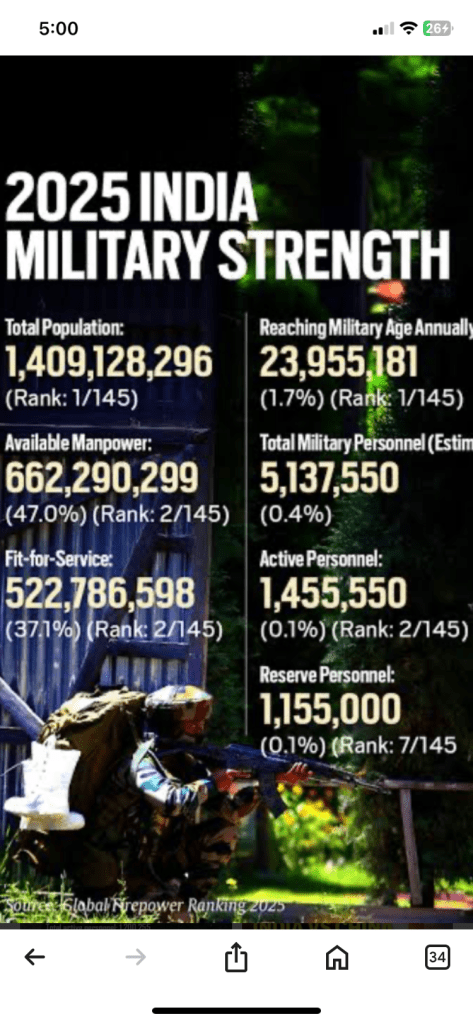
India holds a significant position in the world in terms of defence capabilities and military strength. Here’s a breakdown of its current standing:
Global Rankings:
- 4th Largest Military Power: According to the Global Firepower Index 2025, India is ranked as the 4th most powerful military in the world, following the United States, Russia, and China. This ranking considers various factors, including military strength, financial stability, and logistical capabilities.
- 5th Largest Defence Spender: As per the Stockholm International Peace Research Institute (SIPRI) report of 2024, India is the 5th largest military spender globally, allocating an estimated $86.1 billion to its armed forces. This reflects India’s commitment to modernizing its military and enhancing its strategic preparedness.
Military Strengths: - Large Active and Reserve Forces: India possesses the world’s second-largest active military personnel and a substantial reserve force, providing it with significant manpower.
- Diverse Military Assets: India has a well-equipped military across its three services (Army, Navy, and Air Force), including:
- Army: A large inventory of tanks (including T-90 Bhishma and Arjun), armored vehicles, artillery systems (including BrahMos missiles and Pinaka rocket systems), and a growing arsenal of indigenous weaponry.
- Air Force: A formidable fleet of fighter jets (including Rafale and Su-30MKI), helicopters, and transport aircraft, making it the fourth-largest air force globally.
- Navy: A capable blue-water navy with aircraft carriers, destroyers, frigates, corvettes, and submarines, projecting power across the Indian Ocean and beyond.
- Indigenous Defence Production: India is increasingly focused on achieving self-reliance in defence production through initiatives like “Make in India.” It has a growing defence industrial base, including public sector undertakings (DPSUs), private companies, and numerous MSMEs, contributing to the development and manufacturing of advanced military platforms, weapons, and technologies.
- Defence Exports: India has emerged as a significant exporter of defence equipment to over 100 countries, with the USA, France, and Armenia being major buyers in recent years. Its export portfolio includes items like bulletproof jackets, aircraft (Dornier-228), helicopters (Chetak), fast interceptor boats, and torpedoes.
- Nuclear Capabilities: India possesses nuclear weapons, which act as a strategic deterrent.
- Advancements in Technology: India is making strides in developing and integrating advanced technologies in its defence forces, including:
- Missile systems (e.g., Agni, Prithvi, Akash, BrahMos).
- Aerospace technologies (e.g., LCA Tejas).
- Radar and electronic warfare systems.
- Naval systems and technologies.
- Unmanned aerial vehicles (UAVs) and drone technology.
- Cybersecurity and Artificial Intelligence.
Strategic Partnerships:
India has established strong defence partnerships with several countries to enhance its capabilities, acquire advanced technologies, and ensure interoperability. Key partners include: - Russia: A long-standing and crucial partner, historically the primary supplier of military equipment to India. Defence cooperation continues through military-technical agreements.
- United States: A rapidly growing defence partner, with increasing cooperation in joint exercises, technology transfer, and defence procurement. The “US-India COMPACT” initiative aims to further strengthen military partnership and technology collaboration.
- Israel: A significant partner in the supply of advanced military technologies, including missile systems, avionics, and electronic warfare systems.
- France: A key supplier of fighter jets (Rafale), submarines, and other defence equipment, with ongoing collaborations.
- United Kingdom: сотрудничество focuses on areas like air defence, maritime propulsion, and integrating defence industries into the global supply chain.
- European Union (EU): India and the EU are exploring a significant security and defence partnership to counter common threats and enhance mutual security.
Challenges and Future Focus:
Despite its strengths, India faces ongoing challenges, including: - Reducing dependence on foreign arms imports and achieving greater self-reliance.
- Modernizing its ageing military equipment.
- Integrating new technologies effectively.
- Addressing regional security challenges and border disputes.
India’s future focus in defence includes: - Increasing indigenous defence production and exports.
- Investing in research and development of advanced military technologies.
- Strengthening cybersecurity and space capabilities.
- Enhancing maritime security.
- Further developing strategic partnerships to achieve its defence objectives.
In conclusion, India currently holds a strong position in world defence, ranking among the top military powers and defence spenders globally. Its focus on indigenous production, technological advancements, and strategic partnerships indicates a continued commitment to strengthening its defence capabilities and playing a significant role in regional and global security.
Please like subscribe comment your precious comment on universe discoveries
Full article source google
https://www.amazon.in/b?_encoding=UTF8&tag=555101-21&link
This is Amazon link if you want to buy anything from Amazon you can click on link to help my website universe discoveries grow freinds
https://www.buymeacoffee.com/Satyam55
Please donate me a coffee to help grow my website universe discoveries freinds
 Universe discoveries
🙏🌹
Aum Shanti
LikeLike