
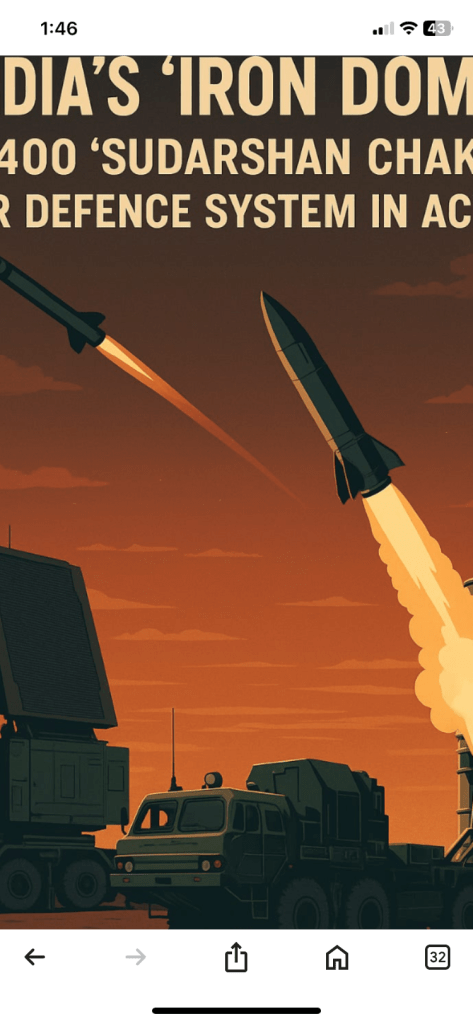
While there are no confirmed reports of India developing a single new defense system that is definitively “more powerful” than the S-400 at this moment, India is actively working on and inducting several advanced air defense systems to create a robust multi-layered shield. Here’s a breakdown of India’s current and future air defense capabilities:
Current Air Defense Systems:
- S-400 Triumf: This Russian-made system is a long-range surface-to-air missile system with a detection range of up to 600 km and an engagement range of up to 400 km. It can track and engage various aerial targets, including aircraft, ballistic and cruise missiles, and drones. India has acquired five squadrons, with three currently operational and the remaining two expected by 2026-27. The Indian Air Force has named it “Sudarshan Chakra.”
- Barak-8 MR-SAM: Jointly developed with Israel, this is a medium-range surface-to-air missile system with a range of over 70 km, capable of intercepting various threats like cruise missiles and aircraft. It is being progressively inducted by the Indian Air Force, Army, and Navy.
- Akash: An indigenous short-range surface-to-air missile system with a range of 25 km, designed to neutralize multiple aerial threats simultaneously. The Air Force has inducted 15 squadrons, and the Army operates four regiments with more planned.
- Spyder: An Israeli-origin short-range, quick-reaction anti-aircraft missile system with a 15 km range, inducted by the Air Force and Army.
- Other Systems: India also operates shorter-range systems like the Russian Igla-S, Igla-1M, OSA-AK-M, Pechora missiles, and upgraded L-70 anti-aircraft guns.
India’s Next-Generation Air Defense Systems and Initiatives: - Project Kusha (Long-Range Surface-to-Air Missile – LR-SAM): India is indigenously developing this long-range SAM system with an expected interception range of around 350 km. It is anticipated to be ready by 2028-29.
- Akash-NG (Next Generation): This is an advanced version of the Akash missile system with a longer range of 70-80 km and improved capabilities.
- Quick Reaction Surface-to-Air Missile (QRSAM): Developed by DRDO, this system has a range of 30 km and is designed to protect infantry and armored units on the battlefield.
- Very Short-Range Air Defence System (VSHORADS): An indigenously developed man-portable air defense system with a range of up to 6 km, featuring an Imaging Infrared (IIR) seeker for enhanced accuracy. The procurement process for the next-generation VSHORADS is currently underway.
- Medium-Range Surface-to-Air Missile (MRSAM) for Army: Derived from the naval version and co-developed with Israel, this system has a range of 70 km and is designed to neutralize aerial threats at greater distances, protecting mobile formations.
- Integrated Counter-Unmanned Aerial System (C-UAS) Grid: India is deploying technologies to counter hostile drones along its borders, integrating radar detection, electronic jamming, and kinetic interception.
- Integration of Military and Civilian Radars: Efforts are on to fuse data from various radars to create a unified, real-time air picture for enhanced situational awareness.
Comparison with S-400:
While some of these upcoming indigenous systems like the LR-SAM (Project Kusha) aim for comparable or slightly shorter ranges than the S-400, the focus is on building a comprehensive, multi-layered air defense network. This network integrates systems with varying ranges and capabilities to provide robust protection against a wide spectrum of aerial threats.
It’s important to note that the “power” of a defense system isn’t solely determined by its range. Factors like the number of targets it can engage simultaneously, its electronic warfare capabilities, the types of missiles it can deploy, and its integration into a larger network are also crucial.
Therefore, while India may not have a single system that directly outclasses the S-400 in every aspect right now, its focus on indigenous development and the integration of multiple advanced systems will significantly enhance its overall air defense capabilities in the coming years.
India ranking in defence in the world

According to the 2025 rankings by Global Firepower, India holds the 4th position in the world in terms of military strength. This ranking is based on a complex formula that considers over 60 factors, including:
- Military personnel: India has a massive active and reserve military force.
- Air power: This includes the number of fighter jets, helicopters, transport aircraft, etc.
- Land forces: This includes the number of tanks, armored vehicles, artillery, etc.
- Naval power: This includes the number of warships, submarines, aircraft carriers, etc.
- Defense budget: India has a significant and growing defense budget.
- Logistics: This assesses a country’s ability to supply its military operations.
- Geography: This considers strategic advantages or disadvantages due to a country’s location.
- Natural resources: This looks at the availability of key resources to support military efforts.
Key aspects of India’s military strength: - Large Active and Reserve Personnel: India has one of the largest active military forces in the world and a substantial reserve force.
- Significant Military Spending: India’s defense budget is among the top few globally, reflecting its commitment to modernizing its armed forces. In 2024, India’s military expenditure was estimated to be around $86.1 billion.
- Indigenous Defense Production: India is increasingly focusing on self-reliance in defense manufacturing through initiatives like “Make in India.”
- Diverse Military Assets: India possesses a wide array of military hardware, including a mix of domestically produced and foreign-sourced equipment across its army, navy, and air force.
Comparison with other top-ranked nations (according to Global Firepower 2025): - United States: Holds the top position with the largest defense budget, advanced technology, and a strong presence across all military domains.
- Russia: Despite ongoing conflicts, Russia maintains a formidable military with a large number of personnel and significant firepower.
- China: China’s military strength is rapidly growing, backed by its strong economy and focus on modernizing its forces and expanding its naval capabilities.
While India ranks fourth overall, each country has its unique strengths and focuses. India’s large manpower and growing defense capabilities position it as a significant military power in the global landscape.
Please like subscribe comment your precious comment on universe discoveries
Full article source google
https://www.amazon.in/b?_encoding=UTF8&tag=555101-21&link
This is Amazon link if you want to buy anything from Amazon you can click on link to help my website universe discoveries grow freinds
https://www.buymeacoffee.com/Satyam55
Please donate me a coffee to help grow my website universe discoveries freinds
 Universe discoveries
Peace!
LikeLike
Yes freind but from both side🙏
LikeLiked by 1 person
Peace from both side heap 🙏🙏🙏
Aum Shanti
LikeLike
Both sides should have dialogue to avoid the worst situation..
LikeLiked by 1 person