

That’s right! Scientists have been investigating the conditions that led to the emergence of complex life on Earth around 591 million years ago, during the Ediacaran period. Recent research points to a fascinating interplay between Earth’s magnetic field and the rise of oxygen levels.
Here’s what the current thinking suggests:
- A Weakened Magnetic Field: Around 591 to 565 million years ago, Earth’s magnetic field experienced an unusual and significant weakening, becoming about 30 times weaker than it is today. This is the feeblest long-term value ever measured.
- Increased Oxygen Levels: This period of a weak magnetic field coincides with a sharp increase in oxygen levels in both the atmosphere and the oceans, occurring roughly between 575 and 565 million years ago.
- The Connection: Scientists propose that the weakened magnetic field might have allowed more hydrogen to escape into space. Since hydrogen combines with oxygen to form water, the loss of hydrogen would have led to a net increase in the percentage of oxygen in Earth’s atmosphere and oceans.
- Aiding Complex Life: This rise in oxygen levels is believed to have been crucial for the evolution and diversification of early complex multicellular organisms, known as the Ediacaran fauna. These were the first large, mobile animals, quite different from the single-celled and microscopic life that dominated before.
Evidence Supporting This Idea: - Analysis of Ancient Crystals: Researchers have analyzed the magnetic properties of ancient plagioclase crystals (about 591 million years old) found in Brazil. These crystals preserve a record of the Earth’s magnetic field strength at the time they formed, revealing the exceptionally weak field.
- Geochemical Markers: The timing of this weak magnetic field aligns with geochemical evidence showing a significant increase in oxygen levels during the late Ediacaran period.
Why This is Significant:
This research suggests a direct link between the Earth’s deep interior processes (which generate the magnetic field) and the evolution of life on its surface. The weakening of the magnetic field, while seemingly a vulnerability, might have inadvertently created the conditions necessary for more complex life to arise.
It’s an exciting area of ongoing research, and scientists are continuing to investigate the intricate relationships between Earth’s geology and the development of life.
The awesome story
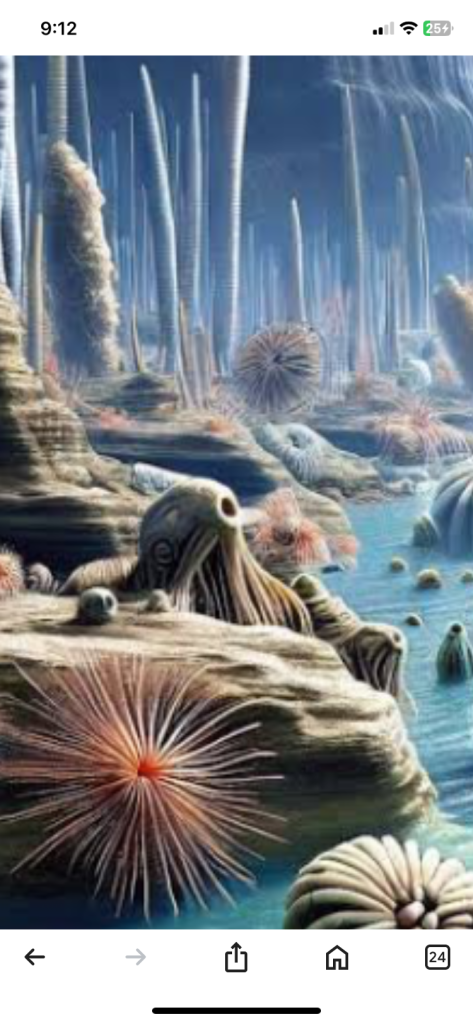
Around six hundred million years ago, our planet almost lost the invisible shield that keeps its surface hospitable. Earth’s magnetic field, generated by whirling molten iron deep below our feet, faded until it was so weak it was barely detectable
At the same moment, oxygen flooded the oceans and atmosphere, and curious soft-bodied creatures began sliding across the seafloor. The coincidence has fascinated geologists and biologists for decades
Fresh measurements from ancient crystals now reveal just how close Earth came to a magnetic stall. They also strengthen the suspicion that a waning field set the stage for the rise of complex life.
The new data trace a dramatic drop in magnetic intensity and help explain why the field later rebounded, saving Earth from becoming a dry, radiation-blasted rock like Mars.
Very weak magnetic field
Crystals dated to 591 million years ago indicate a magnetic field about 30 times weaker than today – the most feeble long-term value ever measured.
Follow-up samples show the enfeebled state persisted for at least 26 million years.
Before and after that window, rocks more than 2 billion years old and younger than 565 million years record a field as sturdy as the modern one, revealing just how exceptional the Ediacaran lull was.
During the low-field stretch, solar wind could punch far deeper into the atmosphere. Charged particles stripped away lightweight hydrogen, a process that left relatively heavy oxygen behind.
The timing lines up with multiple geochemical markers that show a sharp increase in oxygen levels, supporting the idea that the weakened shield helped push Earth past a threshold needed for the development of large, mobile animals.
The magnetosphere shields the Earth from solar wind, thus holding the atmosphere to the Earth. Thus, a weaker magnetosphere means that lighter gases such as hydrogen would be lost from the Earth’s atmosphere,” Xiao explained to CNN.
As hydrogen escaped, oxygen concentrations rose, allowing metabolism-hungry organisms to branch out.
Tarduno agrees that other processes – such as photosynthetic microbes – were certainly at work.
“We do not challenge that one or more of these processes were happening concurrently. But the weak field may have allowed oxygenation to cross a threshold, aiding animal radiation (evolution),” he said.
Strange seafloor pioneers
While the field flickered, the Ediacaran seas hosted life forms unlike anything alive today.
Disk-shaped Dickinsonia spread as wide as 4.6 feet (1.4 meters) across the mud; quilted fronds waved gently in the currents; and slug-like Kimberella scraped microbial mats for food.
These pioneers vanished before the Cambrian period began, around 539 million years ago, but their brief reign proved that multicellular bodies could flourish once oxygen climbed to breathable levels.
Please like subscribe comment your precious comment on universe discoveries
Full article source google
 Universe discoveries
🙏🌹
Aum Shanti
LikeLiked by 1 person
Nice and well researched article.
LikeLiked by 1 person