
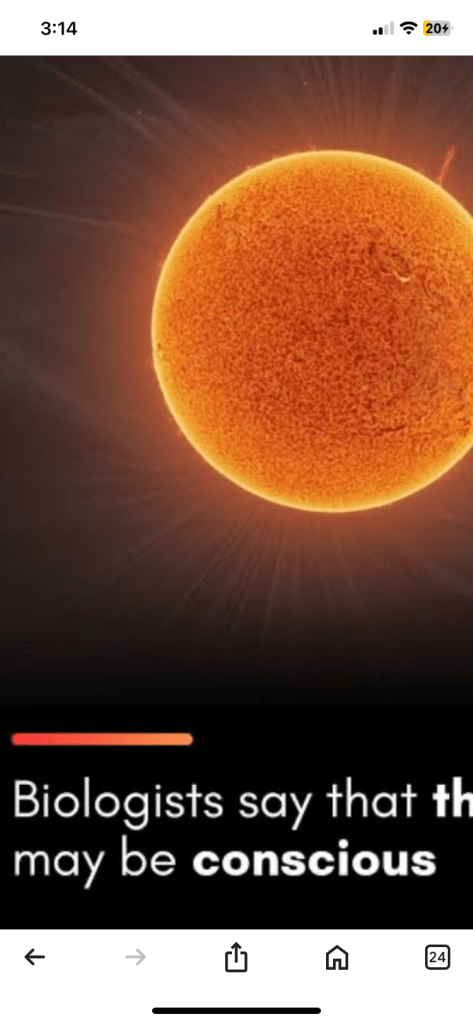
That’s a fascinating idea that’s definitely sparking a lot of discussion! The concept you’re describing is often referred to as panpsychism. It’s the philosophical view that consciousness or mind is a fundamental and ubiquitous feature of reality, existing throughout all levels of nature, not just in complex brains.
It’s true that panpsychism has seen a resurgence in interest among philosophers and even some scientists in recent years. There are several reasons for this:
- The Hard Problem of Consciousness: Traditional neuroscience has made great strides in understanding the neural correlates of consciousness – the brain activity that seems to accompany conscious experience. However, it hasn’t yet fully explained why and how physical processes in the brain give rise to subjective awareness. Panpsychism offers a potential way to sidestep this “hard problem” by suggesting that consciousness isn’t something that emerges from matter but is inherent in it to some degree.
- The Limits of Materialism: Some argue that purely materialistic views of the universe struggle to account for the existence of consciousness at all. If everything is just matter and energy interacting according to physical laws, where does subjective experience come from? Panpsychism proposes a more fundamental role for consciousness in the fabric of reality.
- Interpretations of Quantum Mechanics: Certain interpretations of quantum mechanics, like the Integrated Information Theory (IIT) proposed by Giulio Tononi, have been linked to panpsychist ideas. IIT suggests that consciousness is related to the amount of integrated information in a system, and even simple systems might have a tiny degree of consciousness.
- Addressing the Combination Problem: One of the major challenges for panpsychism is the “combination problem”: if fundamental particles have some form of consciousness, how do these tiny experiences combine to form the rich, unified consciousness we experience? Different versions of panpsychism offer various solutions to this.
However, it’s important to note that panpsychism is still a minority view within mainstream science. It faces significant challenges and criticisms: - Lack of Empirical Evidence: Currently, there’s no direct scientific way to measure or detect consciousness in fundamental particles or even simple organisms in a way that would definitively support panpsychism.
- The Combination Problem (again): As mentioned, explaining how micro-consciousnesses combine into macro-consciousness remains a significant hurdle.
- Alternative Explanations: Many neuroscientists and philosophers believe that consciousness will eventually be explained through a deeper understanding of complex brain processes without needing to invoke fundamental consciousness.
What would the implications be if panpsychism were true? It would be revolutionary, impacting our understanding of: - Ethics: If even plants or atoms have some form of consciousness, our ethical considerations might need to be drastically expanded.
- The Nature of Reality: Our fundamental understanding of what the universe is made of would shift from purely inert matter to something with an inherent mental aspect.
- Our Place in the Universe: We might see ourselves as part of a continuum of consciousness rather than a unique and isolated phenomenon.
In conclusion, while the idea of panpsychism is gaining traction and offers some intriguing perspectives on the hard problem of consciousness, it remains a complex and debated philosophical theory with significant scientific challenges. The implications of its truth would be profound, requiring a fundamental rethinking of our understanding of reality and our place within it.
The “Hard Problem” of Consciousness:
Panpsychism is partly motivated by the difficulty in explaining how physical matter, like the brain, gives rise to subjective experiences. If consciousness is a fundamental property of reality, it might be easier to understand how it arises in complex systems
Different Interpretations:
Panpsychism can take different forms. Some versions might suggest that all things are equally conscious, while others might propose a spectrum of consciousness, with higher levels in more complex organisms
- Evidence and Arguments:Some scientists and philosophers are drawn to panpsychism because it seems to offer a simpler explanation for the existence of consciousness than alternative theories that only attribute it to complex systems. They argue that it aligns with the principles of quantum mechanics, which suggest that the universe is fundamentally interconnected and that the properties of matter can be described by probabilities rather than deterministic outcomes.
- Implications:Panpsychism could have significant implications for our understanding of the universe, life, and the nature of reality. If consciousness is a fundamental feature of reality, it might suggest that we are all part of a larger, interconnected network of consciousness.
- Ongoing Research:Researchers at Duke University and Yale University are exploring the origins of matter and consciousness, seeking to understand how the universe itself might be aware.
A report from Quanta Magazine notedthat experts have declared there is a “realistic possibility” that insects, octopuses, crustaceans, fish, and other overlooked animals experience consciousness
That radical possibility – panpsychism – holds that every bit of the universe possesses a flicker of experience, however faint. Interest in the idea has surged again as researchers wrestle with the “hard problem of consciousness,” the stubborn mystery of how physical stuff gives rise to subjective feeling
Panpsychism through the ages
The question is older than science itself. Thales of Miletus, puzzling over magnets in the 6th century B.C., claimed they must carry a soul because they move iron.
A generation later, Anaxagoras said that “everything contains a portion of mind,” foreshadowing today’s talk of micro-experiences combining into richer ones.
Greek Stoics spoke of the universe as a living creature animated by “logos,” the rational breath binding all things. This principle was thought to permeate all matter, giving rise to the interconnectedness of all things.
Science meets philosophy today

Modern neuroscience attacks the mystery head-on. Giulio Tononi at the University of Wisconsin put forward Integrated Information Theory (IIT) in 2004, claiming that a system’s consciousness equals the amount of integrated information it generates, a value symbolized by “Φ.”
High Φ signals a richer, more unified experience; low Φ signals a dim one
Crucially, IIT treats consciousness as “intrinsic and independent of external observers,” meaning it could arise in any structure – animal brains, artificial networks, or, in principle, a block of silicon – if the informational web is tight enough.
Researchers are now testing IIT’s predictions with brain-stimulation experiments and computer models.
Some early results suggest that loss of consciousness, as in deep anesthesia, coincides with a sharp drop in measurable integration. The data are tentative, but they push the theory beyond armchair speculation
Why does any of this matter?
Panpsychism alarms some thinkers who worry that ascribing feeling to atoms cheapens the concept of consciousness.
The main technical hurdle is the “combination problem”: even if electrons feel a whisper, how do countless whispers merge into the loud voice of human thought? No consensus mechanism exists.
What’s next for panpsychism?
Future progress will rely on sharper experiments and clearer concepts. Neuroscientists are refining Φ-based metrics, while physicists hunt quantum signatures in biology
Wherever the search leads, it forces us to face an unsettling possibility: consciousness might be less a rare jewel than a basic note in the cosmic score.
If so, the challenge is not to grant minds to stones but to understand how nature composes simple tones into the symphony we call waking life.
Please like subscribe comment your precious comment on universe discoveries
Full article source google
https://www.amazon.in/b?_encoding=UTF8&tag=555101-21&link
This is Amazon link if you want to buy anything from Amazon you can click on link to help my website universe discoveries grow freinds
https://www.buymeacoffee.com/Satyam55
Please donate me a coffee to help grow my website universe discoveries freinds
 Universe discoveries
Interesting write up.
LikeLike
Thanks sir🙏
LikeLiked by 1 person
🙏🌹☯️
Aum Shanti
LikeLike