
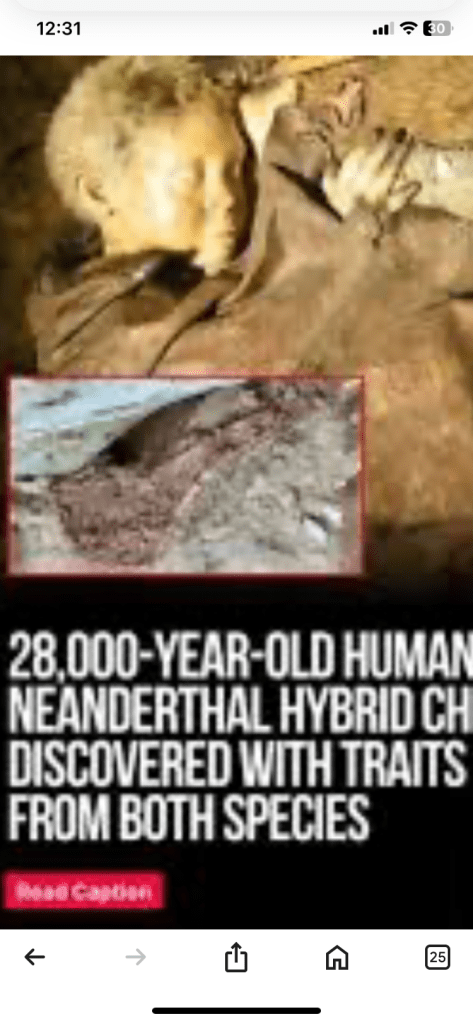
A 28,000-year-old skeleton of a child, known as the “Lapedo child” or “Lagar Velho 1,” found in a rock shelter in central Portugal, has provided significant evidence confirming interbreeding between early modern humans and Neanderthals. The child’s remains, discovered 27 years ago, exhibit a mosaic of physical features characteristic of both groups.
Key details about this discovery:
- Mixed Features: Analysis of the skeleton revealed a blend of traits: the limb proportions were similar to those seen in Neanderthals (short, stocky legs), while the skull and jaw had features reminiscent of modern humans (like a prominent chin). This combination strongly supports the idea of ancient interbreeding.
- Dating: Recent advanced radiocarbon dating methods, which circumvented issues like soil contamination that had previously made accurate dating difficult, have confirmed the child’s age to be around 28,000 years old. This places the child’s life squarely within the period when both modern humans and Neanderthals were present in Europe.
- Cultural Significance: The child’s burial site, colored with red pigment and indicating a careful burial, suggests that hybrid individuals were integrated into their communities and that cultural practices might have been shared across different human groups.
- Genetic Confirmation: While direct genetic evidence from the Lapedo child itself is not available, the morphological evidence aligns with broader genetic studies that have already confirmed significant interbreeding between humans and Neanderthals. These studies show that many people today of non-African descent carry 1-4% Neanderthal DNA in their genomes.
- Timeline of Interbreeding: Genetic research indicates that interbreeding between Neanderthals and modern humans occurred multiple times over thousands of years, starting approximately 50,500 years ago and lasting for about 7,000 years. The Lapedo child’s age suggests that the genetic exchange, or at least the presence of hybrid individuals, continued for an extended period.
This discovery of the Lapedo child strengthens the understanding that the interaction between Homo sapiens and Neanderthals was not simply a replacement, but also involved admixture and integration.
Recent testings
Recent testing shows the remains are around 28,000 years old, which supports the idea that these populations did more than simply coexist. Genetic studies already confirm that many people today carry some Neanderthal DNA
Being able to successfully date the child felt like giving them back a tiny piece of their story, which is a huge privilege,” said Bethan Linscott from the University of Miami, who helped lead the effort to pinpoint the child’s age.
Piecing together an ancient grave
Archaeologists mentioned that the bones were colored with red pigment. That detail suggests the child, likely only around four years old, might have been wrapped for a special burial.
The skeleton’s body proportions indicate mixed heritage. Experts say these features align with evidence that humans and Neanderthals shared genetic material, which still appears in modern populations.
Humans and Neanderthals confirmation
For years, scientists struggled to determine the age of the child’s bones. Contamination from roots and soil made traditional radiocarbon dating unreliable.
With updated methods, they’ve now shown that the child lived around 28,000 years ago – right in the window when humans and Neanderthals were both present in Europe.
This reaffirms that the child came from a population where the two groups had already blended.
Scientists relied on a method that focuses on analysis of hydroxyproline, an amino acid that helps form bone collagen. By isolating this portion of proteins, they overcame contamination that had previously prevented accurate dating.
Earlier tests failed because of plant material and residue that altered the results. This amino acid-based approach yielded a more trustworthy age estimate that suggested the burial predated modern times by many thousands of years.
The mystery of the red deer bones
Two red deer bones found near the child’s body were once thought to be part of a funeral ritual – maybe offerings or tools used during burial. But new hydroxyproline dating shows that those bones are older than the child, ruling out that theory.
It’s now more likely the deer boneswere already in the ground when the grave was dug. They may have just been moved accidentally during burial or used to help position the body, not placed there for symbolic reasons.
Humans and Neanderthals – what’s next?
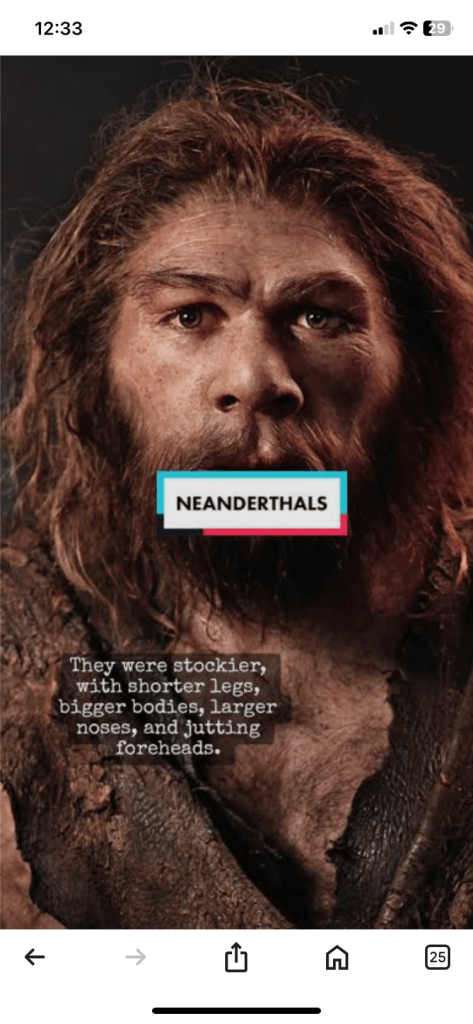
The confirmed interbreeding between humans and Neanderthals, exemplified by discoveries like the Lapedo child, has revolutionized our understanding of human origins. This isn’t just a historical curiosity; it opens up numerous avenues for future research and deeper insights into who we are. Here’s “what’s next” in this exciting field:
- More Precise Timelines and Locations of Interbreeding
- Refining the “When”: While recent studies have narrowed down the primary period of interbreeding to roughly 50,500 to 43,500 years ago, with a more precise average around 47,000 years ago, there’s still room to explore specific instances and regional variations. More ancient DNA samples will help pinpoint additional interbreeding events that might have occurred at different times and places.
- Mapping the “Where”: As more ancient human and Neanderthal remains are discovered and sequenced, researchers can create more detailed maps of where these interactions took place. This will help us understand migration patterns and the geographical overlap of these different human groups.
- Multiple Admixture Events: It’s increasingly clear that interbreeding wasn’t a single event but a series of interactions. Future research will likely focus on identifying these distinct events and their impact.
- Deeper Understanding of the Genetic Legacy
- Functional Implications of Neanderthal DNA: We know that Neanderthal DNA influences various traits in modern humans, from immunity and disease susceptibility (e.g., allergies, risk for certain autoimmune diseases, type 2 diabetes, prostate cancer, even severe COVID-19 infection) to skin and hair characteristics, sleeping patterns, mood, and nicotine addiction. Future research will delve deeper into the specific functions of these introgressed genes and how they were beneficial (or sometimes detrimental) for early modern humans adapting to new environments outside Africa.
- Natural Selection and Neanderthal Genes: Why did some Neanderthal genes persist in modern human populations while others were “selected out”? Scientists will continue to investigate the role of natural selection in shaping our genetic landscape, identifying which genes offered an adaptive advantage (e.g., resistance to new pathogens in Eurasia) and which were gradually lost.
- Variations Across Populations: The amount and type of Neanderthal DNA vary across different modern human populations. Further research will explore these differences and what they tell us about the demographic history and evolutionary pressures faced by different groups.
- Advanced Paleogenomics and Dating Techniques
- Improving Ancient DNA Recovery: Techniques for extracting and analyzing ancient DNA are constantly improving, allowing scientists to work with increasingly degraded and older samples. This includes recovering DNA from unexpected sources, such as soil sediments, which could reveal the presence of hominins even without skeletal remains.
- Beyond DNA: Proteomics and Other Omics: While DNA is crucial, researchers are also exploring ancient proteins (paleoproteomics) and other biomolecules to gain insights into diet, disease, and environmental adaptations that might not be visible from DNA alone.
- Refining Dating Methods: The success with dating the Lapedo child using amino acid analysis highlights the importance of developing and applying more robust dating methods to overcome the challenges of highly degraded ancient materials.
- Cultural and Behavioral Interactions
- Beyond Genes: Cultural Exchange: The Lapedo child’s burial, with its symbolic elements, raises questions about the cultural interactions between humans and Neanderthals. Did they share knowledge, technologies, or artistic expressions? Archaeological findings, combined with genetic insights, will continue to shed light on these complex relationships.
- Social Dynamics of Interbreeding: How were hybrid individuals integrated into their respective societies? Were they accepted, marginalized, or did they play a unique role? The Lapedo child suggests integration, but more evidence is needed to understand the broader social dynamics.
- Cognitive Abilities: Ongoing research into the brains and cognitive abilities of Neanderthals (often using indirect evidence from their material culture and genetic insights) will help us better understand the potential for complex interactions and perhaps even language.
- The Broader Hominin Family Tree
- Denisovans and Other Archaic Hominins: The discovery of Denisovans through ancient DNA (and their own interbreeding with both Neanderthals and modern humans) shows that the human family tree is far more complex than previously imagined. Future research will likely uncover more “ghost lineages” of archaic hominins through ancient DNA analysis.
- Impact on Human Dispersal: Understanding interbreeding events provides crucial context for tracing the “Out of Africa” migrations of Homo sapiens and how they encountered and interacted with existing hominin populations across Eurasia.
In essence, the confirmation of human-Neanderthal interbreeding has moved us from a simple “replacement” narrative to a much richer and more nuanced story of coexistence, interaction, and genetic exchange. The next steps involve meticulously filling in the details of this shared history, understanding its biological and cultural consequences, and continuing to uncover the astonishing complexity of human origins.
Please like subscribe comment your precious comment on universe discoveries
Full article source google
This is Amazon link if you want to buy anything from Amazon you can click on link to help my website universe discoveries grow freinds
https://www.amazon.in/b?_encoding=UTF8&tag=555101-21&link
https://www.buymeacoffee.com/Satyam55
Please donate me a coffee to help grow my website universe discoveries freinds
atOptions = { ‘key’ : ‘36355ff8a51165f647a892b45c54bc22’, ‘format’ : ‘iframe’, ‘height’ : 250, ‘width’ : 300, ‘params’ : {} }; //www.highperformanceformat.com/36355ff8a51165f647a892b45c54bc22/invoke.js25953004
 Universe discoveries
🙏🌹
Aum Shanti
LikeLike
That’s a hell of a article. Wow, that’s awesome.
LikeLike
❤
LikeLike