

India’s ambitious Mumbai-Ahmedabad High-Speed Rail Corridor, often referred to as the “Bullet Train” project, is indeed incorporating impressive engineering feats, including significant underground sections and deep stations.
Here’s a breakdown of the key information:
- Underground Station at Bandra Kurla Complex (BKC), Mumbai: This will be India’s first underground bullet train station and the only underground station on the Mumbai-Ahmedabad corridor. The platforms are planned at a depth of about 26 meters (approximately 85 feet) below ground level. The total excavation for the station site goes down to about 32 meters (around 105 feet), which is equivalent to a 10-storey building. The station will have three floors: platform, concourse, and service floor.
- Underground and Undersea Tunnels: A significant portion of the route in Maharashtra, specifically a 21-kilometer tunnel between Bandra Kurla Complex (BKC) and Shilphata, will be underground. This includes a 7-kilometer undersea section beneath the Thane Creek, an ecologically sensitive intertidal zone. The undersea tunnel will be 25-65 meters deep from the ground level, with the deepest construction point reaching 114 meters below Parsik Hill near Shilphata.
- “Patal Lok” Reference: The term “Patal Lok” is a colloquial and somewhat dramatic way to refer to the extreme depth of these underground structures, evoking a sense of wonder and surprise at the engineering challenges being overcome. It highlights the novelty and scale of India’s venture into high-speed rail infrastructure.
This project is a testament to India’s commitment to adopting advanced technologies and executing complex engineering projects. The underground sections and deep stations are crucial for navigating dense urban areas and environmentally sensitive zones.
Bullet trains and rapid rail 🚂 projects in future in India
India is indeed making significant strides in its high-speed and rapid rail networks, with ambitious plans for the future. The vision is to create a “future-ready” railway system by 2030, as outlined in the National Rail Plan (NRP) for India – 2030.
Here’s a breakdown of future bullet train and rapid rail projects:
Bullet Train (High-Speed Rail – HSR) Projects:
The Mumbai-Ahmedabad High-Speed Rail Corridor (MAHSR), also known as the Bullet Train project, is currently under construction and is the flagship project. While it’s experiencing some delays, the first phase in Gujarat is expected to be operational by the end of 2027, with full completion anticipated by 2028.
Beyond this, several other High-Speed Rail corridors are planned under the “Diamond Quadrilateral Project” and other initiatives, with trains designed to operate at speeds of 320 km/h or more. These include:
Under Various Stages of Planning/Approval/DPR Preparation:
- Delhi–Varanasi High-Speed Rail Corridor: Approximately 865 km, connecting Delhi, Noida, Agra, Lucknow, and Varanasi. (DPR under preparation)
- Delhi–Ahmedabad High-Speed Rail Corridor: Approximately 886 km, linking Delhi, Jaipur, Udaipur, and Ahmedabad. (Awaiting Approval)
- Mumbai–Nagpur High-Speed Rail Corridor: Approximately 736 km, connecting Mumbai, Nashik, and Nagpur. (Awaiting Approval)
- Mumbai–Hyderabad High-Speed Rail Corridor: Approximately 711 km, linking Mumbai with Hyderabad. (Awaiting Approval)
- Varanasi–Howrah High-Speed Rail Corridor: Approximately 711-760 km, connecting Varanasi to Howrah via Patna. (DPR under preparation)
- Delhi–Amritsar High-Speed Rail Corridor: Approximately 465-480 km, connecting Delhi, Ambala, and Ludhiana. (DPR under preparation)
- Chennai–Mysuru High-Speed Rail Corridor: Approximately 435 km. (DPR under preparation)
- Hyderabad–Bengaluru High-Speed Rail Corridor: Approximately 618 km. (Proposed)
- Nagpur–Varanasi High-Speed Rail Corridor: Approximately 855 km. (Proposed)
- Patna–Guwahati High-Speed Rail Corridor: Approximately 850 km. (Proposed)
- Amritsar–Jammu High-Speed Rail Corridor: Approximately 190 km. (Proposed)
- Thiruvananthapuram–Kasaragod High-Speed Rail Corridor (SilverLine): 529.45 km, proposed for 200 km/h. (Awaiting Approval)
- Pune–Nashik High-Speed Rail Corridor: 235.15 km, approved for 200 km/h. (Approved)
The government’s long-term vision is to establish over 10 high-speed corridors covering more than 5,000 km of HSR track. There’s also a strong emphasis on developing indigenous high-speed trains under the “Make-in-India” initiative.
Rapid Rail (Regional Rapid Transit System – RRTS) Projects:
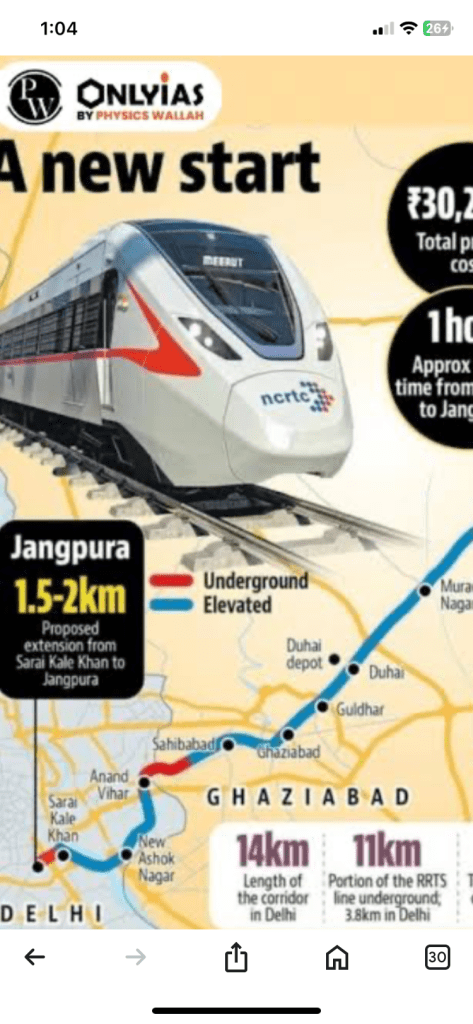
While “Bullet Train” refers to very high-speed inter-city connectivity, “Rapid Rail” or RRTS projects focus on semi-high-speed commuter services within large regions, particularly the National Capital Region (NCR). These trains, like the “Namo Bharat,” are designed for speeds up to 160 km/h (operational speed around 100 km/h) to provide faster, more comfortable regional travel.
Key RRTS Corridors under development/proposal: - Delhi–Ghaziabad–Meerut RRTS Corridor: This is the most advanced RRTS corridor, with sections already operational (Namo Bharat trains). The full corridor is expected to be completed in phases.
- Delhi–Gurugram–SNB–Alwar RRTS Corridor: This corridor aims to connect Delhi with Gurugram, Shahjahanpur, Neemrana, Behror (SNB), and further extend to Alwar. Construction on the Gurugram section is expected to begin in August 2026.
- Delhi–Panipat RRTS Corridor: This corridor will connect Delhi to Panipat via Sonipat.
- Proposed Gurugram-Faridabad-Noida RRTS Link: A new 60-km rapid rail route has been proposed to connect these key NCR cities, further enhancing regional connectivity. This corridor will also connect with the Ghaziabad-Jewar airport corridor.
National Rail Plan (NRP) 2030:
The NRP aims to create a “future-ready” railway system by 2030 and beyond, up to 2050. Key objectives include: - Increasing the Railways’ share in freight transport to 45%.
- Reducing transit time for freight by increasing average speed to 50 Kmph.
- Achieving 100% electrification of the railway network.
- Multi-tracking congested routes.
- Upgrading speed to 160 kmph on Delhi-Howrah and Delhi-Mumbai routes.
- Upgrading speed to 130 kmph on all other Golden Quadrilateral and Golden Diagonal routes.
- Eliminating all level crossings on key routes.
- Identifying new Dedicated Freight Corridors and High-Speed Rail Corridors.
India’s push for bullet trains and rapid rail projects signifies a major leap in its transportation infrastructure, aiming to improve connectivity, boost economic growth, and offer more efficient and sustainable travel options for its vast population.
Please like subscribe comment your precious comment on universe discoveries
Full article source google
https://www.amazon.in/b?_encoding=UTF8&tag=555101-21&link
This is Amazon link if you want to buy anything from Amazon you can click on link to help my website universe discoveries grow freinds
https://www.buymeacoffee.com/Satyam55
Please donate me a coffee to help grow my website universe discoveries freinds
 Universe discoveries
🙏👍🌹
Aum Shanti
LikeLike