

The concept of “undivided India” typically refers to the geographical expanse that was under British rule before its partition in 1947. This includes the territories that became modern-day India, Pakistan, and Bangladesh.
Boundaries of Undivided India (British India before 1947):
The British Indian Empire was a vast entity. Its boundaries were generally:
- North: Extended up to the Himalayas, bordering Tibet and Nepal.
- West: Included territories that are now part of Pakistan, bordering Afghanistan and Iran.
- East: Included territories that are now part of Bangladesh and Myanmar (Burma), bordering China, French Indochina, and Siam (Thailand).
- South: Extended to the Indian Ocean, encompassing the peninsula and islands like Sri Lanka (Ceylon) which were administered separately but often considered part of the broader “Indian subcontinent” or under British influence.
It’s important to note that the term “Akhand Bharat” (Undivided India) in some contexts refers to an even larger historical and cultural sphere, encompassing Afghanistan, Bangladesh, Bhutan, India, Maldives, Myanmar, Nepal, Pakistan, Sri Lanka, and Tibet. However, from a political and administrative standpoint, “undivided India” before 1947 primarily refers to the British Indian Empire.
Countries that broke away and became separate:
The most significant and direct separation from British India occurred in 1947: - Pakistan: Created in 1947 as a separate Muslim-majority nation.
- Bangladesh: Originally East Pakistan, it became independent from Pakistan in 1971.
Other regions that were once part of the broader British Indian administration or influence, and subsequently became independent countries, include: - Myanmar (Burma): Separated from British India in 1937.
- Sri Lanka (Ceylon): Gained independence in 1948, though it was administered separately from British India for some time.
- Afghanistan: While never formally part of British India, it was a significant area of British influence and was separated earlier, in 1876, due to various Anglo-Afghan wars and agreements.
- Nepal and Bhutan: These were largely independent princely states under British influence, rather than direct British rule, and maintained their separate identities.
In summary, the immediate and most impactful breakaways from “undivided India” (British India) were Pakistan and Bangladesh. Other neighboring countries, though sometimes culturally and historically linked to the broader Indian subcontinent, had distinct paths to independence or maintained their sovereignty under British influence.
A statue of akand bharat
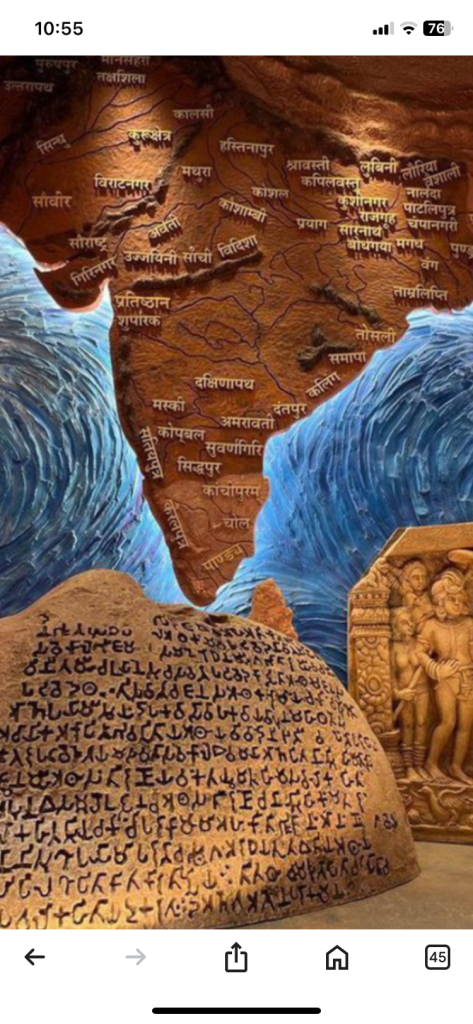
A statue of Akhand Bharat has been installed in the new Parliament House, which was opposed by many countries. There are many organizations in the country that keep demanding Akhand Bharat from time to time and their dream is that the country will one day become Akhand Bharat again. For now, let us tell you about Akhand Bharat today. Akhand Bharat means that Bharatvarsh whose boundaries were very wide in ancient times. Today there are many countries on the world map which were earlier included in that Akhand Bharat. You must be aware of Pakistan and Bangladesh, but not only these two countries but between the years 1857 to 1947 many countries broke away from Akhand Bharat and started being called different countries.
- Which countries broke away and became separate
During the period of Chandragupta Maurya and Emperor Ashoka, the boundaries of India extended to many countries. Some people consider the earlier undivided India as Akhand Hindustan or Vishal Bharat. Ancient India included countries like Afghanistan, Bangladesh, Bhutan, Maldives, Myanmar, Nepal, Pakistan, Sri Lanka and Tibet. Pakistan and Bangladesh are considered to be the major countries that broke away from undivided India. Pakistan became a separate country after the partition of India in 1947. After independence, when India and Pakistan were divided, today’s Bangladesh used to be the eastern part of Pakistan. It was created as a separate country Bangladesh in 1971. - When did the countries separate?
First of all let’s talk about Afghanistan, in the 18th century it was established as an independent country by Ahmed Shah Abdali. In the year 1937, today’s Myanmar which was earlier Burma was separated from Akhand Bharat. Nepal and Bhutan also separated from Akhand Bharat. After the Gorkha war from 1814 to 1816, Nepal handed over Sikkim, Kumaon, Garhwal, Terai to British India. Some part of Tibet was earlier a part of India but later in 1950 China occupied Tibet. Today, despite being separated from India, these countries are still connected to the Indian subcontinent culturally, religiously and historicall. Why was India called sone ki chidya called in past - India was called “Sone ki Chidiya” (सोने की चिड़िया), which translates to “The Golden Bird,” not because it literally had a golden bird, but as a metaphorical expression of its immense wealth, prosperity, and cultural richness in ancient and medieval times.
Here are the key reasons why India earned this epithet:
Abundance of Natural Resources: India was historically rich in a variety of valuable resources, including fertile land for agriculture, minerals (especially gold, diamonds, and other precious stones), and diverse flora and fauna that produced sought-after goods like spices, timber, and medicinal plants.
Thriving Trade and Commerce: India was at the heart of global trade routes, including the Silk Road. Its strategic location facilitated extensive trade with various parts of the world, including the Roman Empire, the Middle East, and Southeast Asia. Indian goods like textiles (cotton and silk), spices (pepper, cardamom, cinnamon), gemstones, and ivory were highly coveted in international markets. This robust trade brought in vast amounts of wealth, often in the form of gold and silver, from other nations.
Advanced Economy and Manufacturing: Beyond raw resources, India had highly developed manufacturing capabilities. Its artisans were skilled in producing fine textiles, metalwork, jewelry, pottery, and intricate crafts. The quality of these products was superior, making them highly desirable globally.
High Contribution to Global GDP: Historical economic studies, such as those by economist Angus Maddison, estimate that India accounted for a significant portion of the world’s GDP during the first millennium CE (some estimates go as high as 25%). This demonstrates its economic dominance on the global stage.
Rich Cultural and Intellectual Heritage: India was also a hub of intellectual and spiritual advancements. It contributed significantly to fields like mathematics (the concept of zero, decimal system), astronomy, medicine (Ayurveda), philosophy, literature, and art. Universities like Nalanda and Takshashila attracted scholars from across the world, further enhancing its reputation and influence.
Prosperous Kingdoms and Empires: Throughout its history, India saw the rise of powerful and wealthy empires like the Mauryas, Guptas, and Mughals, who invested in infrastructure, art, architecture, and fostered economic growth. Many temples, built with significant resources, also held vast quantities of gold and precious stones, further symbolizing the nation’s wealth.
In essence, “Sone ki Chidiya” symbolized India’s self-sufficiency, its vibrant economy, its valuable exports, and the overall prosperity that attracted traders, explorers, and unfortunately, invaders, to its shores. The phrase serves as a reminder of India’s glorious economic and cultural past before the era of extensive colonial exploitation. - Please like subscribe comment your precious comment on universe discoveries
- Full article source google
https://www.amazon.in/b?_encoding=UTF8&tag=555101-21&link
This is Amazon link if you want to buy anything from Amazon you can click on link to help my website universe discoveries grow freinds
https://www.buymeacoffee.com/Satyam55
Please donate me a coffee to help grow my website universe discoveries freinds
 Universe discoveries
Nice information shared.
LikeLiked by 1 person
Thanks ☺️ sir
LikeLiked by 2 people
Stay connected and stay happy.
LikeLiked by 1 person
🙏👍🌹
Aum Shanti
LikeLike
Thank you!
Joanna
LikeLiked by 1 person
Nestled in the western part of India, the Princely State of Patdi was once a small but significant dominion in the Saurashtra region of Gujarat. Before India’s independence in 1947, Patdi held an important place among the princely states of Kathiawar, contributing to the region’s rich cultural and political tapestry. Although modest in size compared to the larger princely states like Baroda or Bhavnagar, Patdi stood out for its heritage, local governance, and the pivotal role it played in the socio-economic development of its territory.
https://www.indianetzone.com/princely_state_patdi
LikeLike