
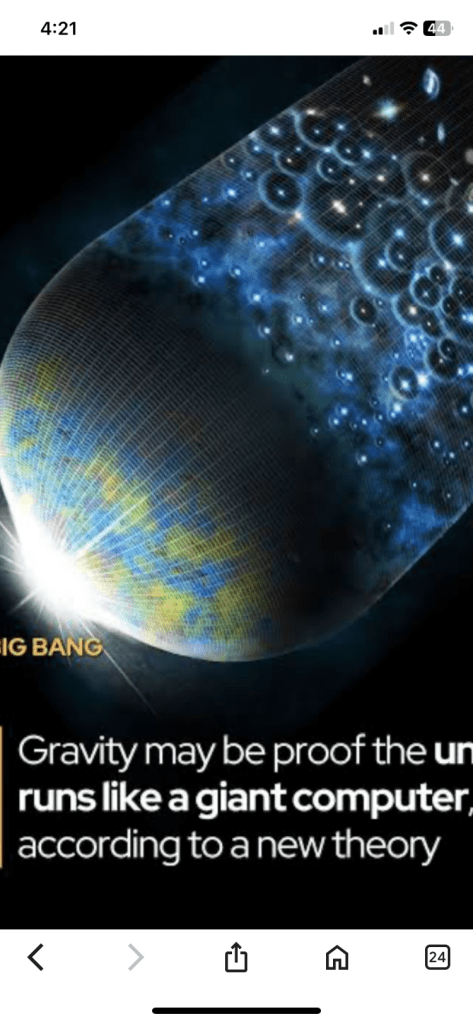
The idea of “space-time computers that run on gravity” is a fascinating and highly theoretical concept, drawing from cutting-edge research in physics, particularly the intersection of quantum mechanics, general relativity, and information theory. While we don’t have anything resembling such a computer today, there are some intriguing theoretical avenues being explored:
- Gravity as a Computational Process:
- Information Physics: A relatively new branch of science, information physics, suggests that physical reality itself might be made up of structured information. Dr. Melvin Vopson, a physicist from the University of Portsmouth, has proposed that gravity isn’t just a fundamental force but an emergent property of the universe attempting to organize information and matter efficiently.
- Minimizing Information Entropy: Vopson’s work suggests that gravity acts as a computational optimization process where matter self-organizes to minimize the complexity of information encoding within space-time. In this view, gravitational attraction is a by-product of the universe trying to “compress data” and conserve computational power.
- Universe as a Giant Computer: This perspective leads to the speculative idea that the universe might function like a giant computer, or even a simulated construct. If gravity is a result of computational processes, then the universe itself could be seen as continuously calculating and organizing itself.
- Gravitational Computing Concepts:
- Quantum Gravity Computers (Hypercomputers): Some theoretical frameworks, particularly those attempting to unify quantum mechanics and general relativity (quantum gravity), suggest the possibility of “hypercomputers” or “quantum gravity computers.” These are hypothesized to be exponentially more powerful than even quantum computers, potentially capable of solving problems that are not Turing-computable (problems that cannot be solved by any classical computer).
- Spacetime Curvature for Computation: Einstein’s general theory of relativity describes gravity as the curvature of space-time. If space-time itself is a medium for information, then manipulating its curvature in precise ways might, in theory, allow for computational processes. However, how this would practically translate into operations like “bits” or “gates” is entirely unknown.
- Holographic Principle: The holographic principle, which connects quantum gravity in certain space-times with quantum field theories on a lower-dimensional space-time, offers another theoretical link. Some research suggests that quantum entanglement could be equivalent to wormholes in space-time, implying a deep connection between quantum information and the fabric of reality.
Feasibility and Challenges: - Highly Speculative: It’s crucial to emphasize that these ideas are currently in the realm of theoretical physics and philosophy. There is no known way to build a computer that directly runs on gravity or manipulates space-time for computation.
- Lack of Empirical Evidence: While theories like Vopson’s derive existing laws from information principles, direct empirical evidence of gravity as a computational process, or of its use for computation, is absent.
- Quantum Gravity Theory: A complete and consistent theory of quantum gravity is still one of the biggest challenges in physics. Until we have a better understanding of how gravity behaves at the quantum level, designing a “gravity computer” remains a distant dream.
- Controlling Spacetime: Even if theoretically possible, the energy and technological requirements to manipulate space-time to the degree needed for computation would be immense, far beyond our current capabilities.
In summary, while the notion of space-time computers running on gravity is a captivating concept emerging from new theoretical frameworks that link gravity, information, and computation, it remains purely theoretical. It requires significant breakthroughs in our understanding of the universe and technology before it could move from science fiction to scientific reality.
Future space time computers

New mathematical work provides a way to identify when information has been changed by manipulating space-time – and it may form a foundation for future space-time computers
A mathematical test for the nature of space-time – the fabric of physical reality – may be the first step towards novel computer-like devices that process information using gravity.
Is space-time an unchanging expanse, or can it be warped in ways that affect a signal travelling through it? According to Albert Einstein’s theory of special relativity, it is static – but his theory of general relativityreveals something completely different. In this framework, massive objects make space-time dimple and curve, like when a ball is dropped onto a taut sheet, which could change the path of a signal moving nearby.
Eleftherios-Ermis Tselentis at the Brussels Polytechnic School in Belgium and Ämin Baumeler at the University of Lugano in Switzerland have now developed a mathematical test for whether space-time in any given region is unchanging or not.
They analysed a scenario where three or more people exchange information by messaging each other. They asked whether it is possible to tell if one of the people – nicknamed Alice, Bob and Charlie – could change the way that information travels by warping space-time. Could Alice receive a message meant for Bob because the region of space-time that the signal travelled through got distorted? Could she reverse causality for Charlie and Bob – so that Bob might receive a response from Charlie before even messaging him – by messing with space-time near her?
Tselentis and Baumeler derived an equation that could help Alice, Bob and Charlie know when these situations are possible. After several rounds of sending messages to each other, they could tally up who got what message when, then plug that data into the equation.
Gravity can help space time computers
Yes, the concept that gravity could play a role in “space-time computers” is being explored in theoretical physics, though it’s important to understand this is highly speculative and far from any practical application. The central idea revolves around a relatively new perspective on gravity itself.
Here’s how gravity could potentially relate to space-time computing:
- Gravity as an Emergent Computational Process:
- Information Physics: This field suggests that physical reality, including gravity, might be fundamentally made of information. Dr. Melvin Vopson is a prominent researcher in this area.
- Minimizing Information Entropy: Vopson’s work proposes that gravity isn’t just a force, but an emergent property of the universe attempting to organize information efficiently. In this view, matter self-organizes to minimize the “complexity of information encoding within space-time.”
- Universe as a Computer: This leads to the intriguing idea that the universe itself might be a giant computational system. If gravity is a result of these underlying computational processes, then it could be seen as an optimizing mechanism, much like data compression in a computer. The universe, in a sense, calculates and organizes itself to be more computationally efficient. For example, it’s more “computationally effective” to track one large object than many small ones, leading to gravitational attraction as a way to “compress” information.
- Gravitational Computing Concepts (Theoretical):
- Quantum Gravity and Hypercomputation: Some theoretical frameworks, particularly those attempting to unify quantum mechanics and general relativity (quantum gravity), hint at the possibility of “hypercomputers.” These are hypothetical machines that could potentially solve problems beyond the capabilities of even quantum computers. If gravity is intimately linked to quantum information and the fabric of space-time, then a deeper understanding of quantum gravity might reveal ways to harness space-time curvature for computation.
- Manipulating Space-time for Information Processing: If space-time itself can encode and process information (as suggested by information physics), then perhaps future technologies could manipulate its curvature or properties to perform calculations. This is an extremely futuristic and currently unfathomable concept, as it would require unprecedented control over the fundamental structure of reality.
- Holographic Principle and Entanglement: The holographic principle in theoretical physics suggests a deep connection between gravity, space-time, and information. Some research even suggests that quantum entanglement, a key resource for quantum computing, could be related to wormholes in space-time. These connections imply that the interplay between gravity and quantum information might offer new paradigms for computation.
Challenges and Speculation:
It’s crucial to reiterate that these ideas are on the very edge of theoretical physics and are highly speculative. - No Empirical Evidence: While these theories offer intriguing mathematical frameworks, there’s currently no experimental evidence to support the idea of gravity as a direct computational mechanism or to demonstrate how it could be harnessed for computing.
- Lack of a Complete Quantum Gravity Theory: A comprehensive theory of quantum gravity, which would describe gravity at the quantum level, is still elusive. Such a theory would be essential for understanding how to manipulate gravity for computational purposes.
- Technological Impossibility (Currently): Even if the theoretical underpinnings were solidified, the ability to control and manipulate space-time to perform computations is far beyond any current or foreseeable technology.
In essence, the idea that “gravity can help space-time computers” stems from the fascinating and evolving notion that gravity itself might be a manifestation of informational processes within the universe. If proven, it could revolutionize our understanding of reality and potentially open entirely new, albeit incredibly distant, avenues for computation.
Please like subscribe comment your precious comment on universe discoveries
Full article source google

https://www.amazon.in/b?_encoding=UTF8&tag=555101-21&link
This is Amazon link if you want to buy anything from Amazon you can click on link to help my website universe discoveries grow freinds
https://www.buymeacoffee.com/Satyam55
Please donate me a coffee to help grow my website universe discoveries freinds
 Universe discoveries
Very interesting read.
Thanks for sharing.
LikeLike
Thanks ☺️ sir
LikeLiked by 1 person
🙏🌹
Aum Shanti
LikeLike
Interesting!
LikeLike
Thanks
LikeLiked by 1 person