

Space Radio Signal: A mysterious object named ASKAP J1832-0911 seen in space has surprised scientists by sending radio waves and X-ray signals every 44 minutes. This discovery was made in collaboration with Curtin University and NASA.
Highlights
ASKAP J1832-0911 sends signals every 44 minutes
This discovery has been made by Curtin University and NASA
Scientists believe it to be a magnetar or binary star system
Melbourne: Humans have always been interested in knowing whether there is life on any planet other than Earth? A new discovery from Australia has revived this question again. A mysterious object named ASKAP J1832-0911 has surprised astronomers. This object sends radio waves and X-ray signals every 44 minutes. Each of its signals reaches for a full two minutes. It is so unique that scientists are saying, ‘I have never seen anything like this before’
According to Dr. Andy Wang of Australia’s Curtin University, ‘This discovery is like finding a needle in a haystack.’ This object was captured with the help of ASKAP radio telescope and NASA’s Chandra X-ray Observatory. Coincidentally, when Australia’s radio telescope was scanning this part, the Chandra X-ray Observatory was also keeping an eye on the same area at the same time. This unique object is associated with a new type of astronomical events called Long-Period Transients (LPTs), which were first discovered in 2022. But this is the first time that X-rays have also been seen coming out from an LPT.
What do scientists believe?
Scientists believe that this object could be a magnetar, that is, it is probably the core of a dead star, which has tremendous magnetic power. Or it could also be a binary star system, in which one star is a highly magnetic white dwarf. But even these theories are not able to solve this mystery completely. According to reports, Prof. Nanda Reya of Spain’s Institute of Space Science says, ‘This one discovery indicates that many more such objects may be hidden in the universe.’ Also, capturing such signals simultaneously in both radio and X-ray mediums opens a new path for future discoveries.
The mystery of life in universe
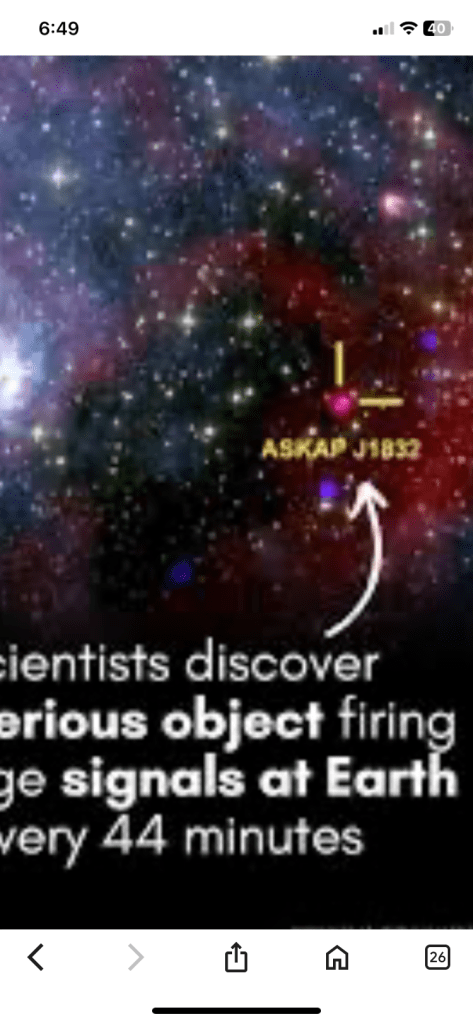
Scientists have indeed detected a mysterious object in space that is sending out synchronized radio waves and X-rays every 44 minutes. This object has been named ASKAP J1935+2148 (though some sources also refer to it as ASKAP J1832-0911).
Here’s what we know so far:
- What it is: It’s an astronomical object that emits regular pulses of both radio waves and X-rays, lasting for a few minutes each time, every 44 minutes.
- Where it was found: It was discovered by chance in 2023 using the Australian Square Kilometre Array Pathfinder (ASKAP) radio telescope, and its X-ray emissions were later confirmed by NASA’s Chandra X-ray Observatory. It’s located about 15,000 light-years away within our Milky Way galaxy.
- Why it’s mysterious: This object’s behavior is unlike anything astronomers have seen before.
- Long period: Known pulsars (a type of neutron star) usually spin incredibly fast, emitting bursts every few seconds or milliseconds. This object’s 44-minute period is exceptionally long, classifying it as a “long-period transient” (LPT).
- Dual emissions: It’s the first known LPT to emit in both radio and X-ray wavelengths simultaneously.
- Challenges existing theories: Its characteristics don’t fully align with current understanding of dead stars like neutron stars (including magnetars, which are neutron stars with powerful magnetic fields) or white dwarfs. While some theories suggest it could be an unusual type of magnetar or a binary star system, none fully explain its unique behavior.
In short, no one knows exactly “who” or “what” is sending these signals. Scientists are baffled and excited by this discovery because it could represent a completely new type of cosmic object, challenging our existing knowledge of the universe and stellar evolution. It’s an active area of research, and further observations are needed to unravel this cosmic mystery.
Where could be aliens in the universe

The question of “where could aliens be in the universe” is one of the most profound and exciting in science! While we haven’t definitively found extraterrestrial life yet, scientists are looking in a few key places:
Within Our Solar System: The Search for Microbes
While we’re unlikely to find advanced civilizations here, some of the most promising places for microbial life within our own solar system include:
- Mars: Evidence suggests Mars once had abundant liquid water, making it potentially habitable in the past. Scientists are looking for signs of ancient life or even microbes surviving underground.
- Europa (Jupiter’s moon): This moon is believed to harbor a vast liquid ocean beneath its icy shell, warmed by tidal forces from Jupiter. It has the potential for hydrothermal vents, similar to those that support life at the bottom of Earth’s oceans.
- Enceladus (Saturn’s moon): Like Europa, Enceladus has a subsurface ocean, and Cassini spacecraft observations have detected plumes of water vapor and organic molecules erupting from its surface, strongly suggesting active hydrothermal activity.
- Titan (Saturn’s moon): Titan is unique for its liquid methane and ethane lakes and rivers on the surface. While very cold, it has complex organic chemistry, and some scientists speculate about exotic forms of life that could thrive in these conditions.
- Ganymede (Jupiter’s moon): Jupiter’s largest moon also appears to have a subsurface ocean.
- Venus (Atmosphere): Despite its scorching surface, some scientists hypothesize that microbial life could exist in the cooler, higher-altitude clouds of Venus, where water vapor and oxygen are present.
Beyond Our Solar System: Exoplanets and Habitable Zones
The vast majority of the universe’s potential alien homes lie outside our solar system, on planets orbiting other stars – these are called exoplanets. - Habitable Zone (Goldilocks Zone): This is the region around a star where conditions are “just right” for liquid water to exist on a planet’s surface. Not too hot, not too cold.
- Earth-like Exoplanets: Scientists are particularly interested in finding exoplanets that are similar in size and composition to Earth, located within their star’s habitable zone. The number of confirmed exoplanets is constantly growing, with thousands found so far. Estimates suggest there could be hundreds of millions, if not billions, of potentially habitable planets in the Milky Way galaxy alone.
- K2-18b: A Recent Intriguing Discovery: The James Webb Space Telescope recently detected strong signs of certain biosignature chemicals (like dimethyl sulfide, DMS, which on Earth is primarily produced by marine algae) in the atmosphere of exoplanet K2-18b. This “hycean world” (a proposed type of planet with a liquid water ocean and a hydrogen-rich atmosphere) is about 124 light-years away and lies within its star’s habitable zone. While not definitive proof of life, it’s considered the “most promising” evidence yet.
- Red Dwarf Systems: Red dwarf stars are the most common type of star in our galaxy, and while their habitable zones are very close to the star, the sheer number of them means they could host many potentially habitable planets. However, these planets might also be exposed to intense radiation from the star.
Galactic Habitable Zone: Where Stars and Planets Align
Beyond individual star systems, scientists also consider the “galactic habitable zone.” This is a region within a galaxy where conditions are most favorable for life to arise and thrive. Factors include: - Proximity to the Galactic Center: Being too close to the galactic center means more intense radiation, frequent supernova explosions, and strong gravitational forces that could disrupt planetary systems.
- Distance from the Galactic Edge: Being too far from the galactic edge means a lack of heavy elements needed to form rocky planets.
- Spiral Arms: While spiral arms are where new stars form, they can also be prone to supernovae. Regions between the spiral arms, but not too far out, are often considered more stable.
In essence, scientists are looking for places with liquid water, the necessary chemical building blocks for life, and stable environments. The search is ongoing, and every new discovery, like the signals from ASKAP J1935+2148 or the atmospheric findings on K2-18b, brings us closer to understanding the potential for life beyond Earth.
Please like subscribe comment your precious comment on universe discoveries
Full article source google
 Universe discoveries
Very interesting.😊
LikeLike
🙏🌹
Aum Shanti
LikeLike