
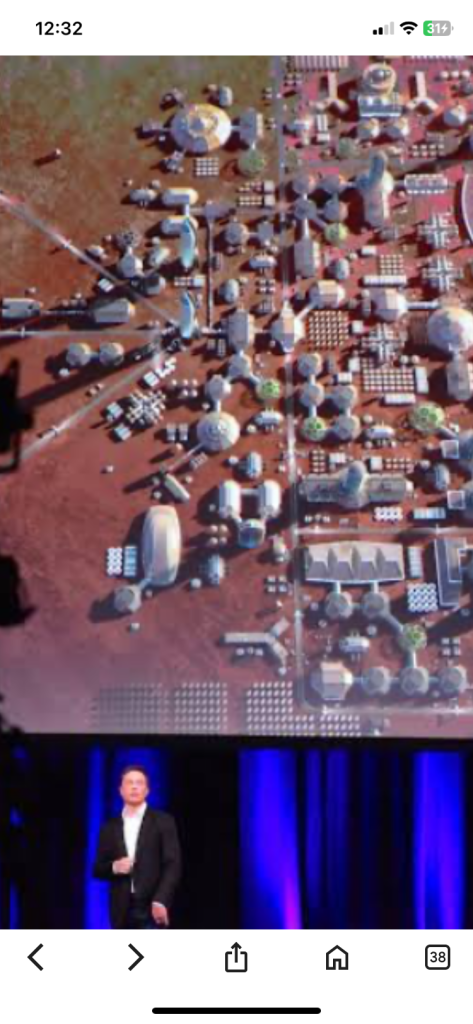
Elon Musk has consistently reiterated his ambitious plans to colonize Mars, aiming to establish a self-sustaining human civilization on the Red Planet.
While a specific, definitively chosen “site of the first city” hasn’t been unveiled with precise coordinates, Musk has proposed a name for the inaugural Martian city: “Terminus.” He stated this name was inspired by Isaac Asimov’s Foundation series, though he has also indicated that the final decision will ultimately rest with the future residents of Mars.
Regarding the timeline and the plan to get there:
- Starship is central: SpaceX’s fully reusable Starship spacecraft and Super Heavy rocket are the cornerstone of Musk’s Mars colonization strategy.
- Initial uncrewed missions: SpaceX aims to send Starship to Mars by the end of next year (meaning late 2025 or early 2026, given the current date), potentially carrying Tesla’s humanoid robot, Optimus, for initial test missions and to prepare the environment.
- Human landings: If these robotic landings are successful, human landings on Mars could commence as early as 2029, though Musk has suggested 2031 is a more likely timeframe.
- Self-sustaining city: Musk envisions a self-sustaining Martian city that doesn’t rely on continuous supply shipments from Earth. This will require transporting millions of tonnes of cargo and eventually a population of around one million people. He has stated it could take at least 20 years to develop a fully self-sustaining settlement.
- Cost reduction: A critical aspect of the plan is drastically reducing the cost of sending payload to Mars, aiming for a cost of around $100,000 per ton.
- Infrastructure development: Early missions will focus on preparing landing surfaces, setting up power generation, and building habitats, likely including transparent domes for growing crops. There are also mentions of utilizing local resources like Martian atmospheric carbon dioxide and subsurface water ice.
While the exact location of “Terminus” on Mars hasn’t been pinpointed publicly, the overall plan involves a phased approach, starting with cargo and robotic missions to lay the groundwork for a permanent human presence.
In pursuit of mars colonisation

In pursuit of Mars colonization, Elon Musk has laid out an ambitious roadmap for SpaceX. He aims for an uncrewed Starship launch in late 2026 and a crewed landing by 2029 (or possibly 2031). These targets spark both excitement and skepticism, but Musk’s track record shows he often delivers on his bold deadlines—even when they slip.
His vision extends beyond the technical feat of reaching Mars. Musk wants to prove that humans can live and work on another planet. To do that, SpaceX must master orbital refueling, build reliable habitats, and scout the ideal landing site for a new settlement
Testing hardware and preparing the ground
SpaceX plans five uncrewed Starship v3 demonstration flights in the 2026 window (November–December). Each mission will test the rocket’s systems, practice orbital refueling, and deliver Tesla’s Optimus humanoid robots to Mars. These robots will unload cargo and scout terrain, paving the way for future crewed missions
The goal is to prove that Starship can survive launch, transit, and landing while carrying essential cargo. Demonstrating safe landings and payload handling is key before any astronauts step foot on the Red Planet.
Potential sites for colonization
SpaceX has zeroed in on prime landing zones that avoid the ice caps, offer accessible water ice, and feature flat terrain. The top candidate is Arcadia Planitia, a volcanic plain in Mars’s northern hemisphere. There, subsurface ice lies just a few centimeters below the surface, the ground is smooth, and mid-latitude sun exposure is high—ideal for solar power and agriculture.
Other regions near equatorial latitudes are also under study, but Arcadia’s combination of resources and terrain makes it the leading contender for the first Martian city.
Mars launch schedule
- 2026: 5 Starship v3 launches to test hardware and prep Mars (10 t payload each)
- 2028–2029: 20 launches to set up infrastructure and begin crewed missions (75 t payload each)
- 2030–2031: 100 launches to expand the colony (150 t payload each)
- 2033: 500 launches to establish a thriving settlement (300 t payload each)
This ramp-up reflects SpaceX’s goal of achieving a self-sustaining outpost within a decade.
Conclusion
SpaceX’s Mars plan is both bold and complex, blending cutting-edge technology with geopolitical and ethical challenges. Today’s choices in space exploration will shape humanity’s future. If Musk succeeds, we may witness the dawn of a new era where Mars becomes our second home and an unprecedented social laboratory. As Elon Musk puts it, “Turning science fiction into reality”—as swiftly as possible.
Please like subscribe comment your precious comment on universe discoveries
Full article source google
https://www.amazon.in/b?_encoding=UTF8&tag=555101-21&link
This is Amazon link if you want to buy anything from Amazon you can click on link to help my website universe discoveries grow freinds
https://www.buymeacoffee.com/Satyam55
Please donate me a coffee to help grow my website universe discoveries freinds
Hello freinds i am satyam Rastogi a blogger from India I love new universe discoveries and i wish one day humanity becomes interstellar species and for that our new generation must read articles on my website universe discoveries
 Universe discoveries
🙏🌹
Aum Shanti
LikeLike
Great information.
Thanks for sharing.
LikeLike
Hope he has fun
LikeLiked by 1 person