
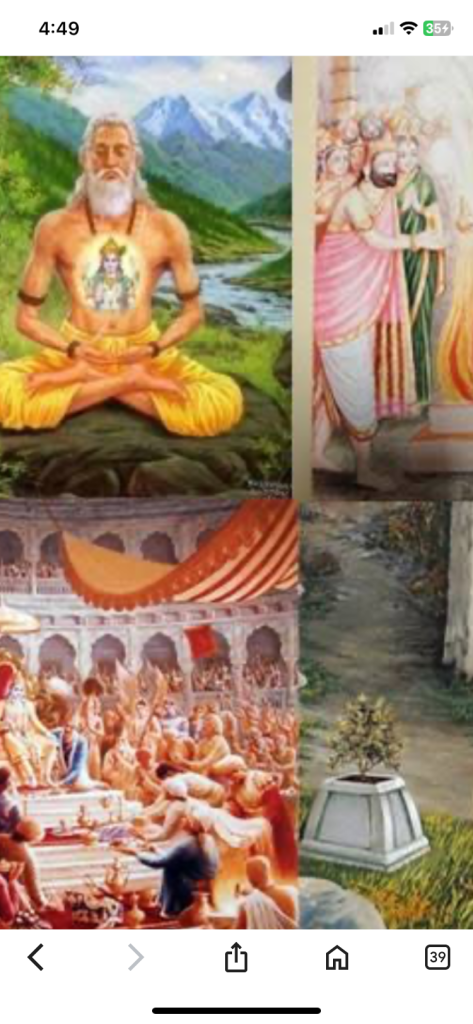
In Hindu scriptures, time is cyclical and divided into four great epochs or ages, known as Yugas. These four yugas collectively form a Chatur Yuga or Maha Yuga, and they follow each other in a continuous cycle, each representing a progressive decline in dharma (righteousness), morality, and human lifespan.
The four yugas are:
- Satya Yuga (or Krita Yuga) – The Golden Age:
- Duration: The longest of the yugas, lasting 1,728,000 human years (4,800 divine years).
- Characteristics: This is considered the age of truth, perfection, and spiritual enlightenment. Dharma stands on all four legs, meaning righteousness is at its peak. Humans are highly virtuous, honest, compassionate, and live in harmony with nature and each other. There is no crime, deceit, or suffering. People are spiritually advanced, close to the divine, and have exceptionally long lifespans. The Vedas are one, and there is no need for agriculture as the Earth yields its riches on its own.
- Treta Yuga – The Silver Age:
- Duration: Lasts 1,296,000 human years (3,600 divine years).
- Characteristics: Dharma declines to three-quarters. Virtue and righteousness diminish slightly. While people are still largely virtuous, self-interest begins to appear. Emperors rise, and wars become more frequent. Human stature and lifespan decrease compared to the Satya Yuga. Lord Rama’s incarnation is associated with this yuga.
- Dvapara Yuga – The Bronze Age:
- Duration: Lasts 864,000 human years (2,400 divine years).
- Characteristics: Dharma declines further, standing on two legs, meaning virtue and sin are equally balanced. People become more tainted with dark qualities, and discontent and conflict become more prevalent. Diseases become rampant. The Vedas are divided into four parts. Human lifespan significantly reduces. Lord Krishna’s incarnation occurred in this yuga.
- Kali Yuga – The Iron Age (The Present Age):
- Duration: The shortest yuga, lasting 432,000 human years (1,200 divine years).
- Characteristics: This is considered the age of darkness, ignorance, and conflict. Dharma stands on only one leg, meaning righteousness is at its lowest point. Corruption, immorality, violence, and hypocrisy are widespread. People become slaves to their passions and lack virtue. Lifespans are the shortest, and there is a general decline in human character and spiritual understanding. We are currently believed to be in the Kali Yuga. At the end of Kali Yuga, it is believed that Lord Kalki will appear to re-establish dharma and initiate the next Satya Yuga.
The entire cycle of these four yugas repeats endlessly, illustrating the cyclical nature of time in Hindu cosmology, where periods of purity and virtue are followed by periods of decline, eventually leading back to a new age of truth.
The different avatar of Vishnu Bhagwan in four yugas
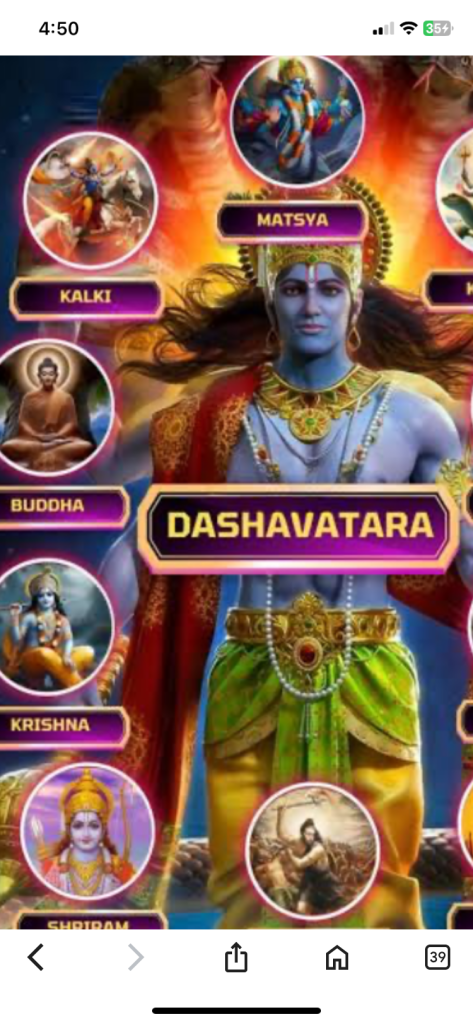
Lord Vishnu, as the preserver of the universe, takes various Avatars (incarnations) to restore dharma (righteousness) and protect humanity whenever evil forces dominate. While there are numerous avatars of Vishnu, the Dashavatara (ten principal avatars) are the most prominent and are traditionally associated with the different Yugas.
Here’s a breakdown of Vishnu’s prominent avatars as they are believed to have appeared across the four yugas:
Satya Yuga (Krita Yuga – The Golden Age)
The Satya Yuga saw a higher frequency of divine intervention due to the extreme levels of righteousness and the significant threats that arose.
- Matsya (The Fish): To save the sage Manu and the Vedas from a great flood.
- Kurma (The Tortoise): To support Mount Mandara during the Samudra Manthan (churning of the cosmic ocean) for the nectar of immortality.
- Varaha (The Boar): To rescue the Earth (Bhudevi) from the demon Hiranyaksha, who had submerged her in the cosmic ocean.
- Narasimha (The Man-Lion): To defeat the demon king Hiranyakashipu, who had a boon that made him immune to death from man or beast, day or night, inside or outside, on land or in the air. Narasimha, being neither fully man nor beast, killed him at twilight on the threshold.
Treta Yuga (The Silver Age)
As dharma began to decline, Vishnu appeared in more human or human-like forms to establish righteousness. - Vamana (The Dwarf Brahmin): To trick the demon king Bali into relinquishing his control over the three worlds. Vamana asked for three paces of land, then expanded to cosmic proportions, covering all realms in two steps, leaving Bali with nowhere to place the third.
- Parashurama (The Warrior with an Axe): To curb the arrogance and tyranny of the Kshatriya (warrior) class, who had become oppressive and disregarded dharma. He famously rid the Earth of wicked kings multiple times.
- Rama (The Perfect King/Prince): The central figure of the epic Ramayana, Lord Rama incarnated to defeat the demon king Ravana and uphold dharma, embodying ideal human values, duty, and sacrifice.
Dvapara Yuga (The Bronze Age)
In this age of balanced good and evil, Vishnu appeared in more direct human forms to guide humanity and participate in significant historical events. - Balarama (Elder Brother of Krishna): Often considered the eighth avatar in some traditions, Balarama is a manifestation of Shesha (the cosmic serpent on whom Vishnu rests) and accompanies Krishna.
- Krishna (The Divine Cowherd/Statesman): The central figure of the Mahabharata and the Bhagavad Gita, Lord Krishna played a pivotal role in guiding the Pandavas, delivering profound philosophical teachings, and participating in the Kurukshetra War to establish dharma.
Kali Yuga (The Iron Age – The Present Age)
In this age of significant decline in dharma, one primary avatar is prophesied. - Kalki (The Destroyer of Filth/Chaos): This is the tenth and final prophesied avatar of Vishnu. He is yet to appear. It is believed that at the end of the Kali Yuga, when adharma is at its peak, Lord Kalki will appear riding a white horse, wielding a flaming sword, to destroy the wicked and re-establish dharma, thus ushering in a new Satya Yuga.
It’s important to note that while these are the generally accepted associations, there can be slight variations in the order or inclusion of certain avatars in different Hindu texts and traditions. However, the Dashavatara list is widely recognized and revered.
Soul levels in four yugas
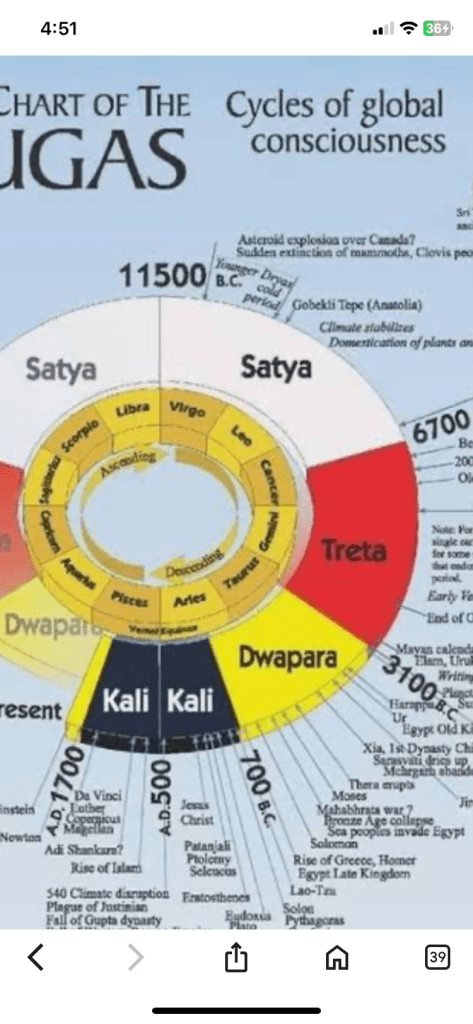
The concept of “soul levels” in the four Yugas refers to the collective spiritual and moral consciousness of humanity in each age. As time progresses through the Yuga cycle, there’s a gradual decline in dharma, virtue, and spiritual awareness, which directly impacts the ease with which individuals can connect with their higher selves or achieve spiritual liberation.
Here’s a breakdown of the soul levels in each Yuga:
Satya Yuga (Krita Yuga – The Golden Age)
- Highest Consciousness: This is the age of ultimate truth and spiritual perfection. Souls are inherently pure and deeply connected to the divine.
- Effortless Spirituality: There’s no need for elaborate rituals or complex scriptures. People naturally live in harmony with cosmic laws (dharma). Meditation is the primary and most effective means of spiritual realization, leading directly to moksha (liberation).
- Direct Perception: Many souls are capable of directly perceiving the divine or experiencing higher states of consciousness, like nirvikalpa samadhi.
- Minimal Ego: Self-interest and ego are virtually non-existent. Actions are motivated by universal love and a sense of oneness.
- Long Lifespans: The extended lifespans allow ample time for spiritual practices and realization.
Treta Yuga (The Silver Age) - Declining Consciousness: Dharma stands on three legs, indicating a slight decline in purity. While spirituality is still strong, a degree of self-interest begins to emerge.
- Focus on Rituals and Sacrifice: The primary means of spiritual progress shifts from direct meditation to elaborate Vedic fire sacrifices (Yajna). These rituals help maintain spiritual discipline and connect with the divine, compensating for the slight decrease in natural spiritual inclination.
- Emergence of Dualism: People start to perceive more duality, leading to the rise of distinct social structures and the need for external rules.
- Mental Powers: Humans possess strong mental powers, including telekinesis and telepathy, but these are often used for collective good or righteous causes.
- Reduced Lifespan: Lifespans are shorter than in Satya Yuga, necessitating more structured spiritual practices.
Dvapara Yuga (The Bronze Age) - Balanced Consciousness: Dharma stands on two legs, signifying a balance between virtue and vice. The divine intellect (intuitive understanding) diminishes, and human beings rely more on their reasoning and intellect.
- Deity Worship and Temple Building: The primary path to spiritual liberation becomes archa-vigraha (deity worship) and the construction of temples. Devotion (Bhakti) plays a more significant role.
- Increased Conflict and Self-Interest: Greed, dissatisfaction, and false pride become more prominent. Conflict, both internal and external, increases.
- Need for Discrimination: The lines between good and evil blur, even within families, requiring individuals to exercise greater discrimination in their choices.
- Further Reduced Lifespan: Lifespans are considerably shorter, and diseases become more prevalent, prompting people to seek spiritual solace.
Kali Yuga (The Iron Age – The Present Age) - Lowest Consciousness: Dharma stands on only one leg, meaning righteousness is at its minimum. The collective consciousness is largely materialistic, driven by ego, greed, and conflict.
- Ease of Liberation through Naam Japa: Paradoxically, despite the immense challenges, the path to liberation in Kali Yuga is considered the easiest. Simply chanting the holy names of God (Nama Japa or Sankirtana) is said to be sufficient for spiritual progress and liberation. This reflects the divine mercy, as other spiritual practices are much harder to maintain in this age.
- Dominance of Illusion (Maya): The veil of maya (illusion) is thickest, making it difficult for people to perceive spiritual truths or differentiate between right and wrong.
- Short Lifespans and Suffering: Lifespans are the shortest, and suffering (mental and physical) is widespread, serving as a catalyst for seeking spiritual answers for those who are inclined.
- Emphasis on External Symbols: People often focus on external religious symbols or rituals without understanding their inner meaning.
- Opportunity for Rapid Progress: Despite the challenges, a sincere soul who endeavors in spiritual practice in Kali Yuga can make rapid progress because the effort required is considered relatively small for the immense spiritual benefits.
In essence, the “soul levels” in each Yuga reflect the prevailing spiritual atmosphere and the primary means by which souls can progress towards liberation. While the outward conditions decline, the inner potential for spiritual growth remains, with the path becoming simpler and more accessible in each subsequent age, culminating in the emphasis on chanting and devotion in Kali Yuga.
Please like subscribe comment your precious comment on universe discoveries
Full article source google
https://www.amazon.in/b?_encoding=UTF8&tag=555101-21&link
This is Amazon link if you want to buy anything from Amazon you can click on link to help my website universe discoveries grow freinds
https://www.buymeacoffee.com/Satyam55
Please donate me a coffee to help grow my website universe discoveries freinds
Hello freinds i am satyam Rastogi a blogger from India I love new universe discoveries and i wish one day humanity becomes interstellar species and for that our new generation must read articles on my website universe discoveries


🙏👍🌹
Aum Shanti
LikeLike
Very interesting read.
LikeLike