
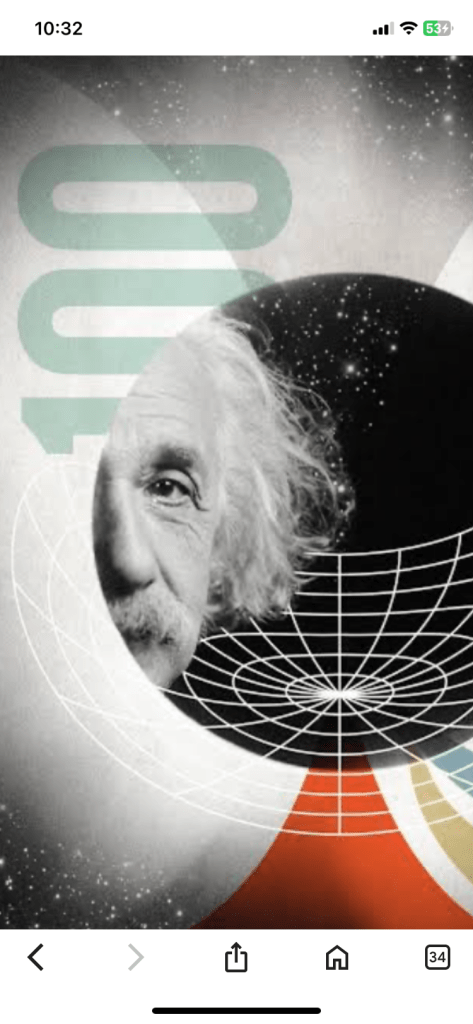
Physicists are actively pursuing a “theory of everything” that would reconcile Einstein’s theory of general relativity with quantum mechanics. This unification has been a long-standing challenge, as the two theories describe the universe at vastly different scales – general relativity governs gravity and large-scale cosmic phenomena, while quantum mechanics explains the behavior of particles at the smallest scales.
Several recent breakthroughs and theoretical frameworks are attempting to bridge this gap:
- Gravity from Entropy / Quantum Relative Entropy:
- Queen Mary University of London (Professor Ginestra Bianconi): This approach, published in early 2025, proposes that gravity arises from quantum relative entropy. It treats spacetime as a quantum operator and uses concepts from quantum information theory to describe the interplay between spacetime geometry and matter. This theory also predicts a cosmological constant that aligns with observations of the universe’s accelerated expansion and suggests a possible connection between the proposed “G-field” and dark matter.
- This concept takes inspiration from John Wheeler’s idea that “Matter tells space how to curve, and space tells matter how to move,” and aims to make this relationship explicit in a statistical framework.
- Postquantum Theory of Classical Gravity:
- University College London (Jonathan Oppenheim and colleagues): Published in Physical Review X, this theory, proposed in late 2024/early 2025, takes a different approach. Instead of trying to quantize gravity, it explores how classical gravity might interact with quantum systems in new ways. The core idea is that spacetime may remain classical and unaffected by quantum mechanics, while quantum theory is modified to account for intrinsic unpredictability mediated by spacetime. This framework aims to unify the two by preserving their distinct characteristics.
- Unified Gravity (Gauge Theory Approach):
- Aalto University (Mikko Partanen and Jukka Tulkki): Proposed in May 2025, this theory aims to treat gravity with the same mathematical structure (gauge theory symmetries) as the other fundamental forces in the Standard Model (electromagnetic, weak, and strong nuclear forces). Instead of relying on curved spacetime as in general relativity, this model introduces a spacetime dimension field, allowing gravity to function like other quantum forces. It also appears to be “renormalizable” in initial calculations, potentially avoiding the mathematical inconsistencies that have plagued other attempts.
- The Alena Tensor:
- A new mathematical object, the Alena Tensor, proposed in January 2025, attempts to reconcile curved spacetime (general relativity) and flat spacetime (quantum mechanics) by transforming curved spacetime into a flat model while retaining essential physical properties. It has also shown that charged particles inherently possess spin, aligning with quantum mechanics.
Common Themes and Challenges: - “Theory of Everything”: Many of these theories aim to be a step towards a unified theory that can explain all fundamental forces and phenomena in the universe.
- Mathematical Consistency: A major hurdle has been avoiding mathematical inconsistencies, such as infinite probabilities, when trying to combine general relativity and quantum mechanics. The new theories are attempting to circumvent these issues.
- Experimental Verification: While these theories offer promising theoretical frameworks, they remain largely untested experimentally due to the extreme conditions (e.g., high energies, strong gravitational fields) required to observe quantum gravitational effects. Future experiments and observations of phenomena like black holes, the early universe, and even very small gravitational pulls on microscopic particles may provide crucial insights.
The ongoing research in these diverse areas represents a significant and exciting frontier in physics, with the potential to fundamentally reshape our understanding of the cosmos.
For over 100 years two theories have shaped our understanding of the universe quantum mechanics and Einstein relativity theory

For over 100 years, two theories have shaped our understanding of the universe: quantum mechanics and Einstein’s general relativity. One explains the tiny world of particles; the other describes gravity and the fabric of space. But despite their individual success, bringing them together has remained one of science’s greatest unsolved problems
Now, a team of researchers at University College London has introduced a bold new idea. Rather than tweaking Einstein’s theory to fit into quantum rules, they suggest flipping the script. Their model, called a “postquantum theory of classical gravity,” aims to rethink the deep link between gravity and the quantum world.
Quantum mechanics thrives on probabilities, uncertainty, and the strange behavior of subatomic particles. It’s helped explain the structure of atoms and power modern technology. Meanwhile, general relativity offers a grand view of the universe, where planets and stars bend spacetime and create what we feel as gravity.
But these two worldviews clash at the deepest levels. When scientists try to combine them, the math breaks down. Equations become inconsistent. Models collapse. Despite decades of effort, no unified framework has fully solved the puzzle.
Divide Between Quantum Mechanics and Relativity
What makes the UCL proposal stand out is its refusal to force gravity into a quantum mold. Instead, it explores how classical gravity might interact with quantum systems in entirely new ways. This shift opens a door to theories that haven’t been fully explored before.
Physicists have often assumed that Einstein’s theory must be modified,” the researchers noted. “But what if the problem isn’t gravity at all? What if it’s the quantum part that needs rethinking?” This provocative question lies at the heart of their approach.
If proven, their work could transform how we view the universe. It offers a new path—one that doesn’t aim to crush gravity into quantum form, but instead lets each theory play by its own rules. That simple yet radical idea could help solve one of the most stubborn mysteries in physics
Quantum Nature of Spacetime
Another experimental proposal aims to verify the quantum nature of spacetime through a phenomenon called “gravitationally mediated entanglement.” These experiments, though challenging, hold immense promise in advancing our understanding of the fundamental laws of nature.
Professor Sougato Bose, an expert in the field who was not involved in the recent UCL announcement but had previously proposed the entanglement experiment, emphasized the importance of these endeavors, stating, “Experiments to test the nature of spacetime will take a large-scale effort, but they’re of huge importance from the perspective of understanding the fundamental laws of nature. I believe these experiments are within reach – these things are difficult to predict, but perhaps we’ll know the answer within the next 20 years.”
In the words of Professor Oppenheim, “Now that we have a consistent fundamental theory in which spacetime does not get quantized, it’s anybody’s guess.” The journey has just begun, and the future of physics has never looked more intriguing
Please like subscribe comment your precious comment on universe discoveries
Full article source google
 Universe discoveries
Wow! Very interesting post! Greetings from Italy
LikeLike
Those theories are certainly very interesting
LikeLike
🙏🌹
Aum Shanti
LikeLike
An interesting topic! Relativity theory has always fascinated me, but UCL’ s bold attempt is appreciable. Good work, Satyam!
LikeLiked by 1 person
Thanks sir its really wonderful
LikeLiked by 1 person