

The physicist who has dedicated a significant portion of his life to the quest of building a time machine, with the goal of shaking up science, is Ronald Mallett.
His motivation stems from a deeply personal tragedy: the sudden death of his father when Mallett was just 10 years old. Inspired by H.G. Wells’ “The Time Machine” and the idea that time might be a dimension we could navigate, Mallett resolved to find a way to go back in time and prevent his father’s death.
Mallett, a theoretical physicist and professor emeritus at the University of Connecticut, bases his work on Albert Einstein’s general theory of relativity. His research focuses on the idea that an intense and continuous rotating beam of light could manipulate spacetime, potentially creating “closed timelike curves” (CTCs) that would allow for travel into the past. He has developed a theoretical equation and a prototype illustrating how lasers could be used to twist space and time.
While Mallett’s work has generated significant interest, it also faces considerable skepticism and challenges from the scientific community. The immense energy requirements, technological hurdles, and the inherent paradoxes of time travel (like the grandfather paradox) are major obstacles. However, his relentless pursuit of this seemingly impossible goal continues to push the boundaries of theoretical physics and spark discussions about the fundamental nature of time.
Here’s what you’ll learn when you read this story:
- After the death of his father, theoretical physicist Ronald Mallett embarked on a lifelong quest to build a time machine.
- Inspired by Albert Einstein’s concept of time dilation—wherein timemoves differently based on your point of reference—he began studying black holes.
- The time travel theory Mallett has developed is mathematically sound, but just because it theoretically works doesn’t mean it will in practice.
Ronald Mallett’s 70-year-long obsession with time travel was borne out of tragedy, but also out of love. A theoretical physicist originally from the Bronx, Mallett was always a curious kid, and his father, Boyd, who worked in the city as a television repairman, nourished that desire for knowledge.
He was a stickler about education—he’d give me toys like a gyroscope or radio set, and in order to get my allowance, I had to answer questions from my multiplication tables,” Mallett recalls. “For me, the sun rose and set with him.”
In 1955, Mallett’s father unexpectedly died at age 33 from a massive heart attack. A year later, Mallett came across a book that would change his life—a Classics Illustrated version of The Time Machine by H.G. Wells. “When I read that, it was like the sky opened up,” Mallett recalls. “If I could build a time machine and go back into the past, maybe I could see him again.”
Mallett immediately got to work, building his own makeshift time machine out of old television, radio, and bicycle parts. Naturally, it didn’t work, which he says is for the best as it “probably would’ve burned the house down.” Mallett continued to harbor this dream of time travel until eventually stumbling upon the work of Albert Einstein.
Nearly half a century before Mallett began exploring the famous German physicist’s work, Einstein mic-dropped some serious physics knowledge in the form of his Theory of General Relativity. Among many details in this science-altering theory, Einstein noted that time wasn’t as absolute as Newtonian physics had predicted, but instead was interwoven into the fabric of space (hence space-time). This meant that things like velocity and gravity could impact the “flow” of time. So if you were moving faster or closer to a massive object—whether a planet or a black hole—to some reference point, time actually passed more slowly.
Understanding what Einstein calls “time dilation” is the reason why we have GPS, and why all of us—whether traveling in a plane, driving a car, or just taking the elevator—in our own small and imperceptible ways, become time travelers. Yet all of these ideas leverage forward-moving time travel. If time was suddenly mutable as Einstein said, could someone conceivably go back in time
Science fiction was not the popular thing it is now—kids who were interested in science fiction were considered a little suspect,” Mallett says. “People were already worried about me—I was depressed—and if I said I wanted to build a time machine, I didn’t know what the consequences would be.”
Instead, Mallett studied the next best thing—black holes. While Einstein’s work detailed the inner workings of time dilation as well as time’s relationship among gravity, mass, and light, solving some of these field equations seemed to, at least theoretically suggest, that time travel was possible in some extreme circumstances.
“If gravity can affect time, and light can create gravity, then light can affect time,” Mallet says. “It turns out that in Einstein’s theory, a rotating black hole … will actually take time and twist it into a loop.”
Suppose you have a cup of coffee,” Mallett says. “Think of the coffee in the cup as empty space, and think of a spoon as a circulating light beam. You take the spoon, you stir the coffee around. … Now suppose I put a coffee bean in the coffee and stir it around. The coffee will drag that coffee bean around, so if you put a subatomic particle in space and you turn on the circulating light beam, then what you would see is the subatomic particle would move around in empty space due to the fact that the space is dragging the bean around. That’s what I showed in my calculation.”
This would have the effect of essentially returning to a place in space and time you’ve already left, though with one big caveat—you could only go back into time to the point that you turned on this hypothetical time machine. Mallett first introduced these ideas with a paper published in the journal Physics Letters A. Of course, such a radical idea did come with some criticisms, some of which Mallett himself shares.
Was mallet successful in making Time Machine

Ronald Mallett has not yet built a functioning time machine.
He has, however, developed a theoretical equation and a prototype demonstrating how lasers could be used to manipulate spacetime. His research focuses on the idea that an intense and continuous rotating beam of light could create “closed timelike curves” (CTCs), which are a theoretical pathway for time travel into the past.
While Mallett believes he has “cracked the code” for time travel and theoretically solved the problem, the actual construction of such a machine faces immense obstacles, including the need for “galactic amounts of energy” and overcoming significant technological hurdles. His work continues to be primarily theoretical, aiming to lay the scientific groundwork for future possibilities rather than presenting a completed device.
Can we build time 🕰️ machine on mallet research
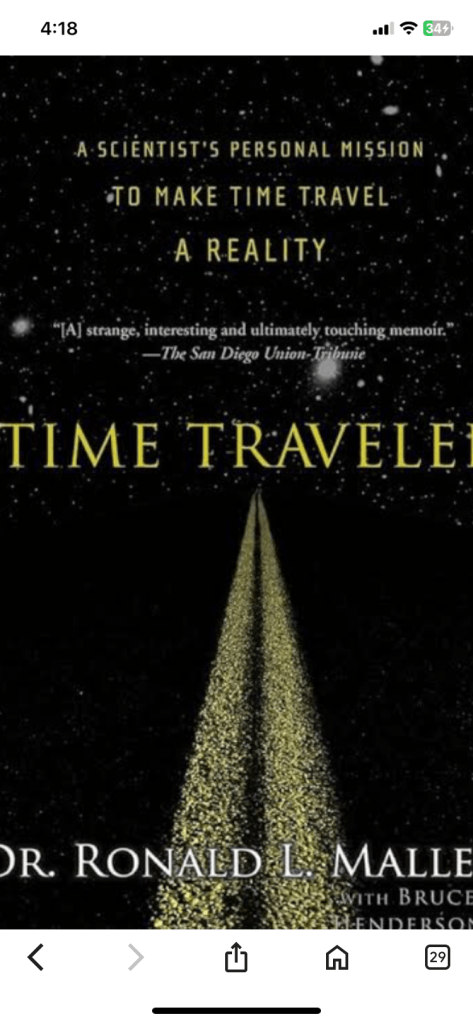
Ronald Mallett’s research offers a fascinating, albeit highly theoretical, approach to time travel. Here’s a breakdown of whether we might be able to build a time machine based on his work in the future:
The Core Idea:
Mallett’s theory, rooted in Einstein’s general relativity, proposes that a sufficiently powerful, circulating beam of light could “twist” spacetime, creating closed timelike curves (CTCs). These CTCs are essentially loops in spacetime that would allow for travel into the past. His prototype demonstrates how lasers could be used to create such a circulating beam.
The Challenges (and why it’s a huge “if”):
- “Galactic Amounts of Energy”: This is the biggest hurdle. The energy required to generate a gravitational field strong enough to twist spacetime in the way Mallett envisions is astronomically vast. We’re talking about energy levels far beyond anything humanity can produce with current or even foreseeable technology. It would likely require the energy equivalent of a black hole, or something similarly extreme.
- Technological Feasibility: Even if we had the energy, the technology to control and focus such an intense, continuous rotating beam of light with the precision needed to create a CTC is incredibly complex and beyond our current capabilities.
- Size of the Machine: The theoretical size of such a time machine is unknown, but it’s likely to be enormous, perhaps even too large to be practical or containable.
- Paradoxes: While Mallett’ believes his theory might avoid some paradoxes (like the grandfather paradox), the concept of time travel to the past inherently raises significant philosophical and physical challenges that are not fully understood. Many physicists believe CTCs are problematic or impossible for this reason.
- Scientific Skepticism: While Mallett’s math is generally considered sound within the framework of general relativity, the application of his solutions to a real-world, finite-sized device in our universe is highly debated. Many physicists express skepticism about the practical feasibility and even the theoretical validity of his specific approach to creating CTCs. Some experiments by other researchers have even claimed to invalidate aspects of his design.
The Future Outlook:
It’s highly unlikely that we will see a functioning time machine based on Mallett’s research in the near future (decades or even centuries). The energy and technological requirements are simply too immense.
However, his work is valuable for several reasons: - Pushes Theoretical Boundaries: Mallett’s research encourages physicists to think deeply about the nature of time and the extreme implications of general relativity.
- Inspires Further Research: Even if his specific method proves impossible, it might spark new ideas or approaches to manipulating spacetime.
- Scientific Debate: His work generates healthy scientific debate, which is crucial for progress in any field.
In conclusion, while Ronald Mallett has laid a theoretical groundwork for a time machine, the practical realization of such a device remains firmly in the realm of science fiction for the foreseeable future. The obstacles are monumental, requiring breakthroughs in energy generation, materials science, and our fundamental understanding of physics that are currently beyond our grasp.
Please like subscribe comment your precious comment on universe discoveries
Full article source google
https://www.amazon.in/b?_encoding=UTF8&tag=555101-21&link
This is Amazon link if you want to buy anything from Amazon you can click on link to help my website universe discoveries grow freinds
https://www.buymeacoffee.com/Satyam55
Please donate me a coffee to help grow my website universe discoveries freinds
Hello freinds i am satyam Rastogi a blogger from India I love new universe discoveries and i wish one day humanity becomes interstellar species and for that our new generation must read articles on my website universe discoveries
Affiliate Disclosure: This blog may contain affiliate links, which means I may earn a small commission if you click on the link and make a purchase. This comes at no additional cost to you. I only recommend products or services that I believe will add value to my readers. Your support helps keep this blog running and allows me to continue providing you with quality content. Thank you for your support!
 Universe discoveries
🙏🌹
Aum Shanti
LikeLike
Very interesting read.😊
LikeLike