
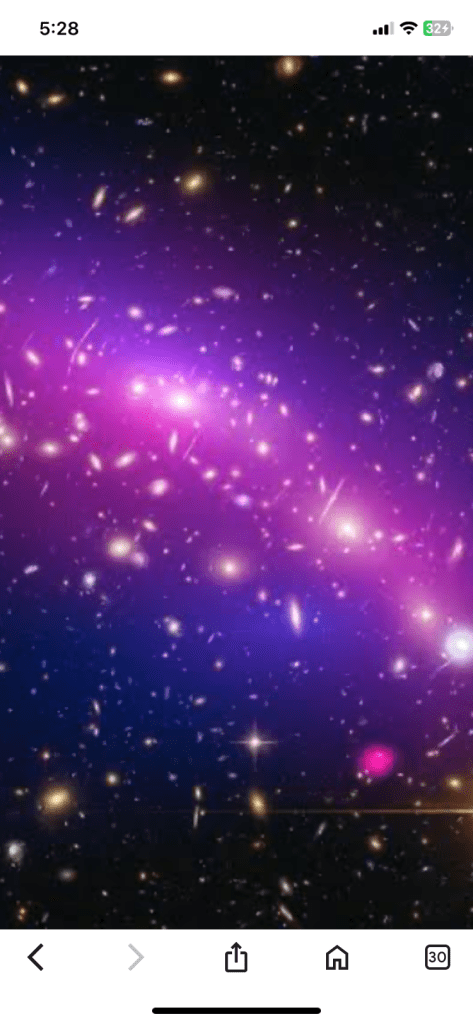
The idea that the universe might have a “memory of its own” is a fascinating and emerging concept in theoretical physics, particularly related to how spacetime might store information. This isn’t memory in the human sense, but rather a persistent imprint of past events.
Here’s a breakdown of the key ideas and related concepts:
- Gravitational Memory:
- Einstein’s General Relativity: This theory predicts that massive objects and events, like merging black holes, create ripples in spacetime called gravitational waves.
- Permanent Imprint: A key aspect of gravitational waves is that they can leave a permanent “memory” in the fabric of spacetime itself. Unlike ordinary waves that simply pass through and leave things unchanged, gravitational waves can slightly and permanently deform spacetime.
- Subtle Effects: This memory is incredibly subtle, potentially causing lasting changes in the relative velocities or positions of objects, even after the wave has passed. Scientists are even exploring if this “gravitational memory” could leave faint traces in the Cosmic Microwave Background (CMB), the afterglow of the Big Bang.
- Quantum Memory Matrix (QMM):
- This is a newer hypothesis that aims to address long-standing physics questions, including the Black Hole Information Paradox.
- Black Hole Information Paradox: According to quantum mechanics, information cannot be destroyed. However, black holes appear to swallow information, and when they eventually evaporate (via Hawking radiation), it’s not clear where that information goes. This creates a paradox.
- QMM as a Solution: The quantum memory matrix proposes that spacetime itself acts as a memory system, retaining information from all interactions. When matter falls into a black hole, it leaves an imprint on this quantum memory matrix, preserving the information even if the black hole later evaporates. This essentially suggests that spacetime isn’t an empty void, but a dynamic system capable of storing information.
- Quantum Computers: This hypothesis is being explored and tested using quantum computers, which can simulate quantum systems at scales not achievable by traditional methods.
- The Universe as a “Cosmic Memory Bank” / Holographic Principle:
- Some theories suggest that the universe, or at least its boundaries, could function like a vast memory bank, akin to a hologram.
- Holographic Principle: This principle suggests that all the information contained within a 3D volume of space could be encoded on a 2D surface at its boundary. If this is true, it implies a fundamental way in which the universe stores information.
Why is this concept important? - Solving Fundamental Mysteries: The idea of universal memory could potentially offer solutions to some of the biggest unsolved mysteries in physics, such as the Black Hole Information Paradox and the nature of dark matter and dark energy.
- Deeper Understanding of Spacetime: It challenges our traditional understanding of spacetime as merely a passive backdrop for events, proposing it’s an active, information-storing medium.
- Rethinking Information and Reality: It prompts deeper philosophical questions about the nature of information, its conservation, and how it’s woven into the very fabric of reality.
While these concepts are still largely theoretical and under active investigation, the possibility that the universe itself possesses a form of “memory” is a profound and exciting frontier in scientific research.
A new hypothesis called the quantum memory matrix

A new hypothesis called the “quantum memory matrix” could solve long-standing physics questions, including the Black Hole Information Paradox and dark matter.
Here’s what you’ll learn when you read this story:
- A new hypothesis known as the Quantum Memory Matrix (QMM) could help explain some of the biggest mysteries of the universe, including the Black Hole Information Paradox.
- The idea is that space-time itself holds a history of quantum information in “memory cells.”
- This is just one of many hypotheses that aim to explain the paradoxes that form when general relativity and quantum field theory collide.
Paradoxes can be scary things in science, as they almost always represent some fundamental misunderstanding of reality and the universe. However, paradoxes can also present opportunities—chances to re-examine what we know and forge previously unimaginable paths toward new understanding.
For example, the Fermi Paradox—which questions why there are so many extraterrestrial worlds, yet absolutely no signs of intelligent life—has pushed scientists to explore various reasons why the universe is so silent. Various temporal paradoxes, such as the Grandfather paradox, have allowed us to probe mind-bending concepts like the multiverse theory. And the same can be said for the Black Hole Information Paradox.
First formulated in the 1970s by physicist Stephen Hawking, the paradox boils down to the idea that black holes appear to destroy information (via Hawking radiation) over incredibly long timescales. However, quantum field theory suggests that quantum information cannot be destroyed, and instead must be conserved. This has led to several theories, including that information is somehow encoded onto the event horizon of the black hole itself and released within the Hawking radiation in a way we simply can’t detect, or that it even travels to a completely different universe.
But for years, Florian Neukart—an assistant professor at Leiden University and the chief product officer at the quantum computing outfit Terra Quantum—has promoted another fascinating idea known as “Quantum Memory Matrix,” or QMM. In a new article published in New Scientist, Neukart details how space-time itself could retain a “memory” that recorded the history of the universe. In a sense, according to Neukart, space-time is a blanket of “memory cells” that could not only solve the Black Hole Information Paradox, but could clarify other major space-time conundrums like dark matter.
In the Black Hole Information Paradox, for example, as an object moves through space, it interacts with these “dials” of space-time that imprint information. When a black hole evaporates—a process that takes around 1068 to 10103 years—the surrounding space-time will remain.
“Information doesn’t vanish after all,” Neukart said. “It has been written somewhere we hadn’t thought to look.”
Please like subscribe comment your precious comment on universe discoveries
Full article source google
 Universe discoveries
🙏
Aum Shanti
LikeLike
Interesting information. I did not know “gravitational waves can slightly and permanently deform spacetime”
LikeLike
Fascinating, Satyam.
LikeLiked by 1 person