

Space News: A new discovery suggests that our galaxy and the surrounding area are located in a giant ‘Hubble Bubble’ with a density lower than the average of the universe. This discovery can solve the puzzle of ‘Hubble tension’ (the difference in the expansion rate of the universe).
Highlights
The Earth is located in a giant ‘Hubble Bubble’, claims new discovery.
The ‘Hubble tension’ is the difference in the rate of expansion of the universe.
Bannik’s team analyzed BAO waves.
Imagine that the entire earth, our solar system and even our galaxy are floating in a vast ’empty space’. A place where the matter is extremely less compared to the average density of the universe. This is not science fiction. This is a scientific theory that has raised new hopes towards solving the most complicated mystery of the universe, ‘Hubble Tension’.
What is ‘Hubble Tension’?
Hubble tension is the paradox in which the rate of expansion of the universe (Hubble Constant) is measured in two different ways. And the results of both are different. The first method is based on the ‘Cosmic Microwave Background’ (CMB) radiation left after the Big Bang, which is the same throughout the universe.
They tell us the average expansion rate of the universe. The second way is to measure the redshift of distant galaxies in the local universe and the light of supernovae, from which the expansion rate of the nearby universe is derived. There is a huge difference in the results of these two methods. This is the ‘Hubble tension’. A mystery that has been troubling scientists for decade
Earth in a ‘Hubble Bubble’?
Indraneel Banik, a scientist at the University of Portsmouth, UK, has claimed that the strongest reason for this paradox could be that our Earth is located in a huge ‘low-density void’, which he calls the ‘Hubble Bubble’.
According to Banic, if we are in a place where there is 20% less matter than the average density of the universe and whose diameter is about 2 billion light years, then it is possible that the speed of the celestial bodies seen from us appears to be higher. Because the objects are being pulled out from that empty space, that is why their speed appears faster than normal. And this gives us the illusion of the universe expanding faster locally.
The sound of the Big Bang provided the strongest clue
Banick’s team analysed ‘baryon acoustic oscillations’ (BAO), sound waves generated in the early moments of the Big Bang, and found that these waves are frozen in a specific angular shape. They act as a ‘standard ruler’ to map the expansion of the universe
According to Banik, if we are really in an empty space, then the angle of these BAO waves and their redshift should change slightly. And this is what he found. He claimed that the calculations done by combining all the BAO data of the last 20 years prove this model with ‘Hubble Bubble’ to be 100 million times more accurate than the model without bubble.
Expansion of the Universe: Dual Picture
This new theory tells that the density in the universe is not the same everywhere. Whereas the ‘Lambda Cold Dark Matter’ (LCDM) model, which was considered the standard model till now, assumes that the universe is uniform in every direction. This inequality is now forcing scientists to review the old models.
Banik’s team is now using the ‘Cosmic Chronometer’ to find out how the rate of expansion in different parts of the universe changed over time. For this, they are doing a comparative study of the age of galaxies, their stellar structure and redshift. If this model and data prove themselves accurate in the future too, then it can become the strongest scientific model to permanently solve the Hubble tension.
The fascinating part
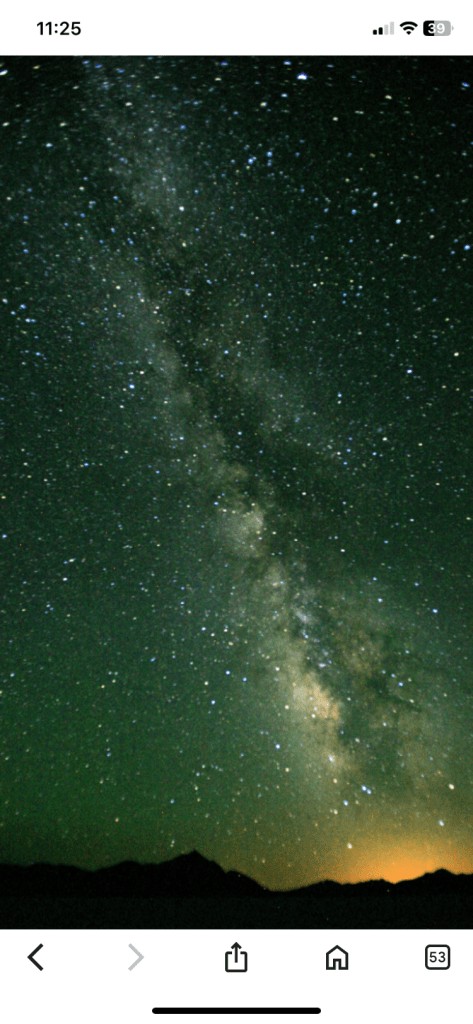
That’s a fascinating and increasingly discussed concept in cosmology! The idea that our galaxy, the Milky Way, and its immediate cosmic neighborhood reside within a giant “Hubble Bubble” or “Local Void” of lower-than-average density is gaining traction as a potential explanation for the Hubble Tension.
Here’s a breakdown of what this means and its implications:
What is the “Hubble Bubble” or “Local Void”?
- Underdensity: It suggests that the region of space we inhabit, extending for roughly 1 to 2 billion light-years, has significantly less matter (galaxies, gas, dark matter) than the average density of the universe as a whole. Estimates suggest it could be around 20% less dense.
- Not truly empty: Like any void in space, it’s not entirely empty. It still contains galaxies, including our own, and galaxy clusters, but they are more sparsely distributed than in surrounding regions.
- The KBC Void: This proposed underdensity is often referred to as the Keenan-Barger-Cowie (KBC) void, named after the astronomers who first identified evidence for it.
Why is this significant? The Hubble Tension.
The primary motivation for this theory is to address the Hubble Tension, one of the biggest mysteries in modern cosmology. Here’s the core of the problem: - Two ways to measure the Hubble Constant (H0):
- Early Universe (CMB & BAO): Measurements based on the cosmic microwave background (CMB) radiation (the afterglow of the Big Bang) and baryon acoustic oscillations (BAO) in the early universe consistently yield a value for the Hubble Constant around 67-68 km/s/Mpc (kilometers per second per megaparsec). This value reflects the expansion rate of the universe in its early stages and globally.
- Local Universe (Supernovae & Cepheids): Measurements using “standard candles” like Type Ia supernovae and Cepheid variable stars in the relatively nearby universe (local measurements) consistently yield a higher value, typically around 72-75 km/s/Mpc.
- The Discrepancy: This significant difference (the “tension”) means that either there’s a fundamental misunderstanding of the universe’s evolution or there’s something about our local environment that affects our measurements.
How does the “Hubble Bubble” help explain the Hubble Tension?
If we are indeed located within a lower-density “bubble,” it could naturally explain why our local measurements of the Hubble Constant appear higher: - Gravitational Pull: Matter outside the void, being denser, would exert a stronger gravitational pull on the galaxies within the void. This would cause galaxies within the void to accelerate away from us faster than they would in a perfectly uniform universe.
- Faster Local Expansion: This “outflow” of matter from the void’s center (where we are located) would make it seem like the local universe is expanding at a faster rate than the global average, thus accounting for the higher Hubble Constant value derived from local observations.
Evidence and Future Prospects: - Galaxy Counts: Observations have indeed shown that the number of galaxies in our local neighborhood is somewhat lower than what’s expected from a perfectly uniform universe.
- Baryon Acoustic Oscillations (BAOs): Recent research suggests that the “sound waves” from the Big Bang (BAOs) might also show distortions that are consistent with the presence of a local void.
- Ongoing Research: While the “Hubble Bubble” theory offers a promising solution, it’s still an active area of research. Scientists are conducting more precise measurements and simulations to confirm its existence and fully understand its implications. It challenges the “cosmological principle,” which states that the universe is largely uniform on large scales.
If confirmed, the “Hubble Bubble” would be a significant discovery, not only resolving the Hubble Tension but also reshaping our understanding of the large-scale structure of the universe and our place within it.
Please like subscribe comment your precious comment on universe discoveries
Full article source google
 Universe discoveries
I did not know about the Hubble Bubble and I did not know much about Hubble Tension even though I’ve read about it in the past. It is a very interesting article.
LikeLiked by 1 person
Thanks Thomas it’s so interesting 🤨 that earth 🌍 and even our galaxy are floating in low density area and may be that’s the reson of life on earth 🌍
LikeLiked by 2 people
🙏🌹
Aum Shanti
LikeLiked by 1 person