
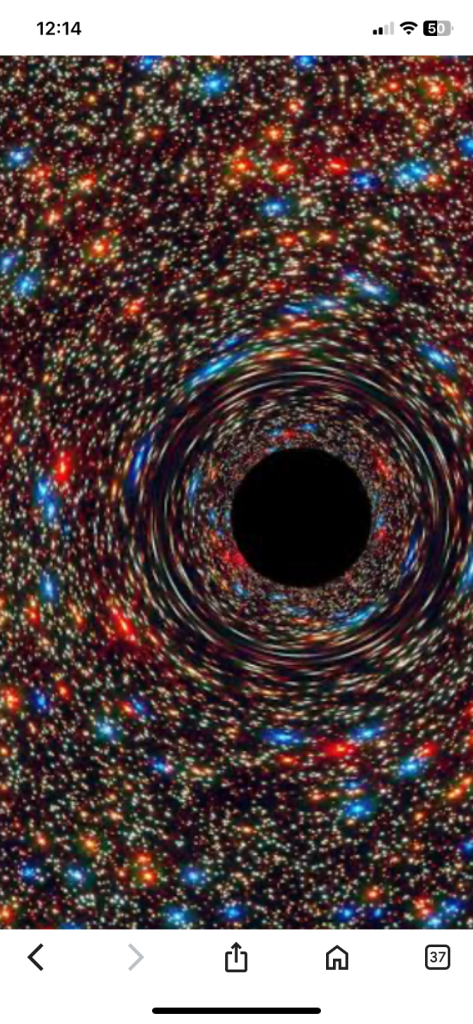
Recent findings from the James Webb Space Telescope (JWST) have indeed sparked renewed interest in a fascinating, albeit speculative, theory: that our universe might exist inside a spinning black hole.
Here’s a breakdown of what’s being discussed:
- Unexpected Galactic Rotation: The JWST has observed a surprisingly high number of ancient galaxies spinning in the same direction. This challenges the previous assumption that galactic rotation would be largely random, with an equal split between clockwise and counter-clockwise spins. This unexpected uniformity suggests an underlying influence or order in the early universe.
- Black Hole Cosmology: This observation has led scientists to revisit “black hole cosmology” or “Schwarzschild cosmology.” This theory proposes that our entire universe could be the interior of a giant, rotating black hole that exists within a larger, “parent” universe.
- How it Could Work:
- No Singularity: Some versions of this theory suggest that instead of collapsing into an infinitely dense singularity, matter inside a black hole might reach a limit, “bounce,” and then expand, forming a new universe. This “bounce” could drive cosmic inflation, explaining the smoothness and flatness of our universe.
- Inherited Spin: If our universe formed within a spinning black hole, the rotation of that parent black hole could have imprinted a preferred direction of spin on the nascent universe, which is now reflected in the synchronized rotation of galaxies we observe.
- Multiverse Implications: This idea also opens up the possibility of a multiverse, where every black hole in our universe could potentially be a “doorway” to another “baby universe,” and vice versa.
- Challenges and Future Research: While intriguing, this is still a highly speculative theory. More evidence is needed to confirm the findings about galactic rotation and to further develop the theoretical framework of black hole cosmology. Scientists are carefully considering alternative explanations for the observed galactic alignment, such as potential biases in measurements due to the Milky Way’s own rotation.
In essence, the JWST’s discovery of a preferred galactic spin direction has provided new observational data that aligns with, and revitalizes, a bold and thought-provoking cosmological theory. However, it’s crucial to remember that this is an active area of research, and further investigation is required to ascertain its validity.
The James Webb telescope
The James Webb Space Telescope (JWST), launched in 2022, continues to reshape how we view the cosmos. Designed to look deeper into space and further back in time than any previous instrument, it has begun to uncover celestial secrets that defy long-standing scientific models. Its advanced imaging technology has spotted ancient galaxies forming just a few hundred million years after the Big Bang—far earlier than scientists thought possible.
One such galaxy, named JADES-GS-z14-0, appears to have taken shape only 250 million years after the universe began. The existence of galaxies so early in cosmic history is already rewriting theories about how galaxies evolve.
Even more puzzling, many of these early galaxies show structured spiral patterns—forms that were believed to develop much later. These findings are throwing a wrench into accepted timelines of galactic development and have sparked debates among cosmologists worldwide.
The Great Galactic Spin Mystery
Beyond age and structure, JWST has revealed something even more unusual—how galaxies spin. A recent study led by Lior Shamir at Kansas State Universityuncovered a strange pattern in the rotation direction of galaxies.
Using data from JWST’s Advanced Deep Extragalactic Survey (JADES), Shamir examined 263 galaxies and discovered that about two-thirds rotated clockwise, while only one-third rotated counterclockwise.
In a universe assumed to be random and isotropic—meaning it has no preferred direction—this finding is deeply unsettling. Normally, scientists would expect roughly equal numbers of galaxies rotating in both directions. Yet JWST’s high-resolution imaging made the imbalance unmistakable. “The difference is so obvious that anyone looking at the image can see it,” Shamir said. “There is no need for special skills or knowledge to see that the numbers are different.”
If our universe is inside a black hole what does it say about multiverse

The idea that our universe might exist inside a spinning black hole has profound implications for the concept of a multiverse, strongly supporting certain versions of it. Here’s how:
- Nested Universes (Hierarchical Multiverse):
- If our universe is the interior of a black hole in a “parent” universe, it logically follows that black holes within our universe could similarly be “doorways” to their own “baby universes.”
- This creates a hierarchical or fractal-like multiverse, where universes are nested within other universes, potentially infinitely. Every black hole becomes a potential seed for a new cosmos.
- This model suggests that the Big Bang of our universe wasn’t the absolute beginning, but rather a “Big Bounce” within a pre-existing structure (the parent black hole).
- Cosmological Natural Selection (Lee Smolin’s Theory):
- This theory, also known as “fecund universes,” proposes that universes that produce more black holes are more likely to “reproduce” and spawn new universes.
- If black holes indeed give birth to new universes, then universes with physical laws that favor black hole formation would be more prevalent in the multiverse. This could potentially explain why our universe has the specific physical constants it does – they are “fit” for black hole production.
- Escape from Singularities (The “Bounce” Concept):
- In traditional black hole theory, matter collapses to an infinitely dense singularity. However, some black hole cosmology models, like those by Nikodem Popławski, suggest that quantum effects prevent this singularity.
- Instead, matter reaches an extreme but finite density and then “bounces” back, expanding to form a new universe. This “bounce” would be the Big Bang from an internal perspective.
- This mechanism inherently suggests a continuous cycle of universe creation, where black holes act as cosmic recyclers, transforming collapsing matter into expanding new spaces.
- Causal Connections (or Lack Thereof):
- A crucial aspect of this black hole multiverse is that each “baby universe” would be behind an event horizon from its parent universe. This means no information or light can escape from our universe to its parent, or vice versa. Similarly, we cannot observe any “baby universes” created by black holes within our own.
- While this makes direct empirical verification challenging, it provides a consistent framework for how multiple universes could exist without interfering with each other’s observable physics.
In summary: The hypothesis that our universe is inside a black hole doesn’t just allow for a multiverse; it actively provides a plausible mechanism for its creation and structure. It transforms black holes from mere cosmic vacuum cleaners into cosmic birthing grounds, linking the fate of collapsing stars to the potential emergence of new realities. While still highly theoretical, the JWST’s recent findings add a tantalizing piece of observational data that aligns with this audacious vision of the cosmos.
Please like subscribe comment your precious comment on universe discoveries
Full article source google
 Universe discoveries
🙏🌹
Aum Shanti
LikeLike
Nice information.
LikeLike