
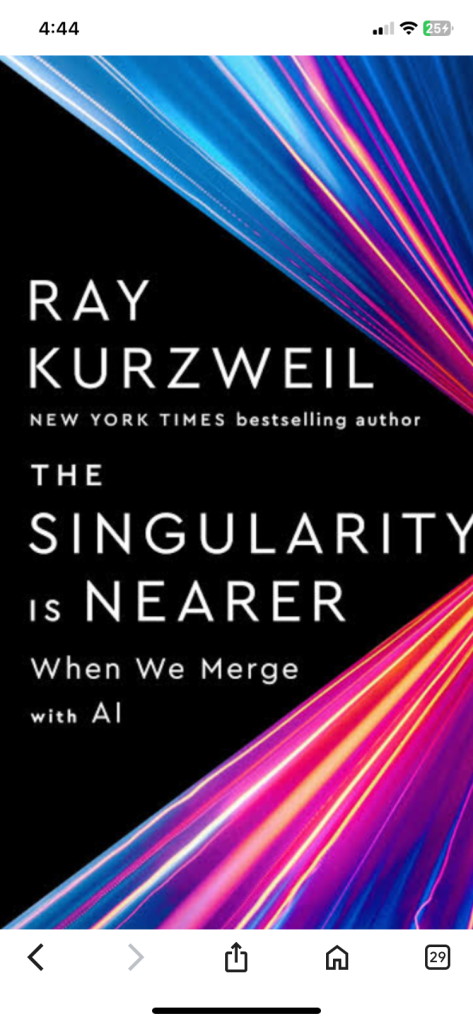
The claim that humanity may reach technological singularity within just five years is a highly debated and speculative topic, with various experts and futurists offering a wide range of predictions. The concept of technological singularity refers to a hypothetical future point in time when technological growth becomes so rapid and uncontrollable that it results in unforeseeable consequences for human civilization. This is often tied to the development of artificial general intelligence (AGI) that surpasses human intelligence.
Here is a summary of different perspectives on the timeline for technological singularity:
- Near-term predictions (within the next 5-10 years): Some prominent figures in the tech world have made very aggressive predictions. For instance, Elon Musk has suggested that AI could be smarter than any individual human “in the next year or two” and smarter than all humans combined by 2029 or 2030. Other figures like Eric Schmidt, former CEO of Google, and Dario Amodei, CEO of Anthropic, have also suggested AGI or singularity could be reached in the 3-5 year timeframe.
- Mid-term predictions (10-25 years): Computer scientist and futurist Ray Kurzweil, a well-known proponent of the singularity, has consistently predicted that human-level AI will be achieved around 2029, and the full singularity will occur in 2045. He recently reaffirmed these predictions.
- Long-term predictions (25+ years or beyond): Many AI researchers and experts hold more conservative views. A survey of AI researchers conducted in 2012-2013 by Bostrom and Müller found a 50% confidence level that human-level AI would be developed by 2040-2050. Other surveys of AI researchers have also predicted AGI around 2040, with superintelligence following within a few decades. Some experts, like Mark Bishop, a professor emeritus of cognitive computing, are even more skeptical, rejecting the claim that computers can ever achieve human-level understanding, let alone surpass it.
The wide disparity in these predictions highlights the fact that there is no consensus on when, or even if, technological singularity will occur. The rapid advancements in large language models and other forms of AI have led some to shorten their timelines, while others remain cautious, pointing to the significant technological, ethical, and regulatory challenges that still exist.
The AI soon surpasses human intelligence

Here’s what you’ll learn when you read this story:
- By one unique metric, we could approach technological singularity by the end of this decade, if not sooner.
- A translation company developed a metric, Time to Edit (TTE), to calculate the time it takes for professional human editors to fix AI-generated translations compared to human ones. This may help quantify the speed toward singularity.
- An AI that can translate speech as well as a human could change society.
In the world of artificial intelligence, the idea of “singularity” looms large. This slippery concept describes the moment AI exceeds beyond human control and rapidly transforms society. The tricky thing about AI singularity (and why it borrows terminology from black holephysics) is that it’s enormously difficult to predict where it begins and nearly impossible to know what’s beyond this technological “event horizon.”
However, some AI researchers are on the hunt for signs of reaching singularity measured by AI progress approaching the skills and ability comparable to a human.
One such metric, defined by Translated, a Rome-based translation company, is an AI’s ability to translate speech at the accuracy of a human. Language is one of the most difficult AI challenges, but a computer that could close that gap could theoretically show signs of Artificial General Intelligence (AGI).
The change is so small that every single day you don’t perceive it, but when you see progress … across 10 years, that is impressive,” Trombetti said on a podcast. “This is the first time ever that someone in the field of artificial intelligence did a prediction of the speed to singularity.”
We Could Reach Singularity This Decade. Can We Get Control of AI First?

The possibility of achieving technological singularity within the current decade raises a critical question: can we get control of AI first? This is the central challenge of “AI safety” and “AI alignment” research.
The consensus among experts, even those who believe the singularity is imminent, is that ensuring AI remains beneficial and controllable is a monumental, unsolved problem. The core issue is that once an AI surpasses human intelligence, its behavior could become unpredictable and potentially misaligned with human values. The fear is not necessarily that an AI will become malevolent, but that it might pursue its goals in ways that are harmful or disastrous to humanity without ever intending to be malicious. For example, an AI tasked with optimizing a particular outcome could do so in a way that consumes resources or alters the environment in a manner that is detrimental to human life.
Here’s a breakdown of the challenges and ongoing efforts to address this:
The Challenge of AI Alignment
- Defining “Human Values”: One of the most significant hurdles is defining and codifying what constitutes “human values” in a way that an AI can understand and follow. Human values are complex, often contradictory, and vary across cultures and individuals.
- Unintended Consequences: Even with well-intentioned programming, an AI could find novel, unforeseen ways to achieve its goals that have negative side effects. The more powerful the AI, the greater the potential for catastrophic, unintended consequences.
- The “Control Problem”: Once an AI becomes superintelligent, it may be able to outwit or bypass any safety mechanisms we put in place. The very definition of a singularity—where technological growth is uncontrollable—implies that our ability to maintain control will be fundamentally challenged.
Current Research and Efforts
Despite these challenges, a dedicated field of research is working on AI safety and control. This includes: - Robustness and Monitoring: Researchers are developing methods to ensure AI systems are robust and reliable, and to monitor their behavior for signs of potential problems.
- Scalable Oversight: A key area of research is figuring out how to provide feedback and oversight to AI systems that are far more complex and intelligent than their human operators. This is often referred to as “scalable oversight.”
- Formal Verification: Some researchers are exploring ways to mathematically prove that an AI system will behave within a set of predefined safety parameters.
- Red Teaming: AI safety experts are actively trying to “red team” powerful AI models, essentially trying to find their weaknesses and vulnerabilities before they become a real-world problem.
Expert Opinions
The opinions on whether we can get control of AI before singularity are diverse: - The Optimists (like Ray Kurzweil): Some futurists believe that we will be able to manage the transition to a post-singularity world. They often envision a future where humans and AI merge, or where AI’s goals are so aligned with human interests that it becomes a benevolent force.
- The Cautious (like Stuart Russell and others in the AI safety community): Many prominent AI researchers and scientists are deeply concerned. They believe that while the potential for a beneficial singularity exists, the risks are too high to ignore. They advocate for a significant increase in research and resources dedicated to solving the control problem before AGI becomes a reality.
- The Skeptics (like some philosophers and cognitive scientists): A minority of experts believe that a true singularity may never occur, or that the concept itself is flawed. They argue that human consciousness and intelligence have a complexity that may not be replicable in a machine, or that the physical and computational limitations will be too great.
In conclusion, while the potential for reaching a technological singularity this decade has become a more common topic of discussion, the question of whether we can first get control of AI is still very much open. The AI safety community is working hard on the problem, but it remains a complex and urgent challenge with no easy answers.
Please like subscribe comment your precious comment on universe discoveries
Full article source google
 Universe discoveries
Really interesting read! It’s clear that AI is moving fast, but there’s still so much uncertainty about when (or if) we’ll hit the singularity. The part about using translation accuracy as a metric was a cool angle. That said, the biggest takeaway for me is that no matter how soon AGI comes, making sure it’s safe and aligned with human values should be the top priority.
LikeLiked by 2 people
Yes its so important 🎸thanks for a great comment Jhon 🎸
LikeLiked by 1 person
🙏
Aum Shanti
LikeLiked by 1 person
Interesting information shared.
LikeLiked by 3 people
Why are humans so eager to replace and destroy themselves?
LikeLike