
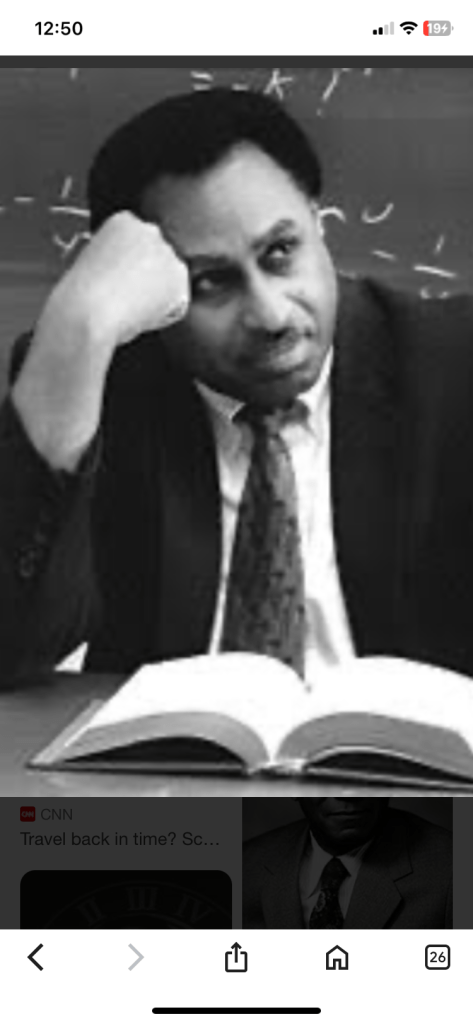
Dr. Ronald Mallett, a retired professor of theoretical physics at the University of Connecticut, has garnered significant media attention for his claims that he has developed the theoretical foundation for a time machine. His work is rooted in Albert Einstein’s general theory of relativity.
Mallett’s personal motivation stems from a desire to go back in time to see his father, who died when Mallett was 10 years old. This personal mission, sparked by reading H.G. Wells’s “The Time Machine” as a child, has driven his academic career and research.
Mallett’s theory proposes that a circulating beam of light from powerful lasers could create a gravitational field strong enough to twist spacetime into a “time loop.” This twisting effect, which he has explored through a solution to Einstein’s gravitational field equations, could, in theory, allow for travel into the past. While he has presented the mathematical framework for his ideas, he acknowledges that the technology to build such a device is currently far beyond our reach.
It’s important to note that Mallett’s claims have been met with both interest and skepticism within the scientific community. While his work is based on established principles of physics, the practical and logical challenges of time travel, such as the grandfather paradox, remain a subject of debate. Mallett’s research has been featured in various media outlets, including documentaries and his own memoir, “Time Traveler: A Scientist’s Personal Mission to Make Time Travel a Reality.”
The point of view

A profound grief that forged a vision
Mallett’s extraordinary pursuit began with devastating tragedy in 1955. At merely 10 years old, he endured his father Boyd’s sudden death—a television repairman whose passion for science had ignited a similar spark in his young son. Boyd Mallett, only 33, succumbed to a heart attack, leaving behind a grief-stricken child searching for solace.
That solace came through H.G. Wells’ The Time Machine. Within its pages, Mallett found a captivating concept: “Time is only a kind of Space.” These words transformed from a literary phrase into a guiding principle, becoming the driving force behind his unwavering commitment to unraveling time’s fundamental mysteries.
The breakthrough moment
His pivotal insight arrived while hospitalized for a heart condition—a profound irony given his father’s heart attack started this journey. The breakthrough was elegantly simple yet revolutionary: “If gravity can bend time, and light can create gravity, then light can bend time.”
“It turns out that black holes can create a gravitational field that could lead to the creation of time loops that could allow us to go back in time,” he explained.
The blueprint for a temporal vortex
Mallett’s vision for a functioning time machine replicates spacetime-warping phenomena around black holes. He offers a compelling analogy: “Picture a cup of coffee. Stir it with a spoon, and the coffee swirls. A spinning black hole does the same to spacetime.”
In Einstein’s general relativity, the universe is a dynamic fabric woven from space and time. Massive objects like black holes warp this fabric—an effect we perceive as gravity. Mallett theorizes that an intense, continuous, circulating beam of light from a ring of powerful lasers could replicate this gravitational torsion, effectively twisting time into a loop.
This “time loop” would theoretically allow information—or perhaps matter—to travel backward in time. He detailed this mathematical concept in his 2006 autobiography, Time Traveler: A Scientist’s Personal Mission to Make Time Travel a Reality.
A legacy that transcends time
Now approaching 80, Dr. Mallett remains steadfast. “I believe my work will show time travel is possible,” he asserts. “Future generations will build on it in ways we can’t yet imagine.”
His equations, though yet to physically bend time, have bent our collective imagination. Ongoing public interest, evidenced by his continued media appearances and Spike Lee’s film adaptation of his memoir, underscores his ideas’ profound impact.
More than a scientific pursuit, Mallett’s story testifies to human resilience, intellectual courage, and hope’s enduring power. Whether his theoretical time machine ever materializes, his legacy is immeasurable—inspiring countless individuals to challenge conventional limits and perceive time not as an unyielding barrier, but as a boundless frontier awaiting exploration.
Please like subscribe comment your precious comment on universe discoveries
Full article source google
 Universe discoveries
🙏🌹
Aum Shanti
LikeLiked by 1 person
Interesting read.
LikeLike