

In March, during its flyby of Mars, the Europa Clipper mission successfully tested its Radar for Europa Assessment and Sounding: Ocean to Near-surface (REASON) instrument. The test, which would have been impossible to conduct on Earth, involved the instrument sending and receiving radio waves as it passed over the planet’s volcanic plains. This test produced a detailed image of Mars’s surface and confirmed that the radar is working as intended, and is ready for its primary mission to peer beneath Europa’s icy crust. The mission’s main goal is to determine if there are places on Europa that could support life.
Europa mission overview
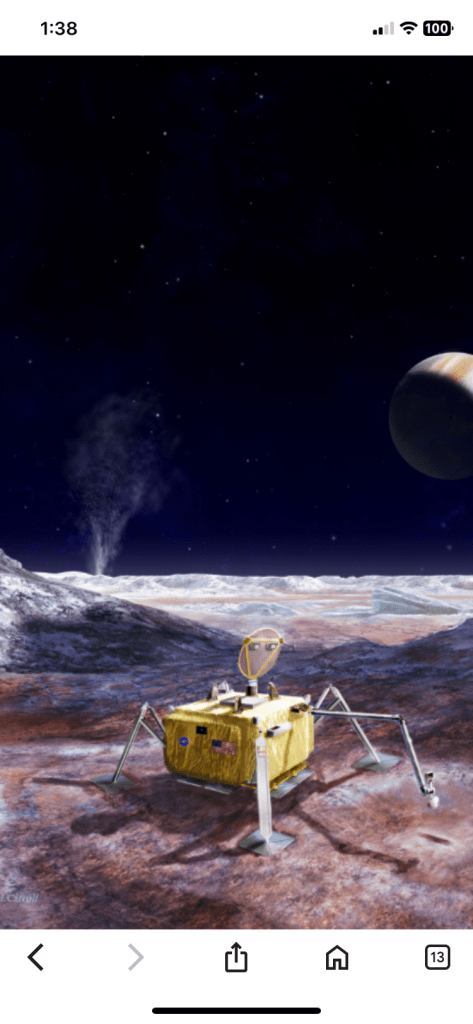
The Europa Clipper is a NASA mission dedicated to studying Jupiter’s icy moon Europa to determine if it has the potential to support life. The spacecraft, launched on October 14, 2024, is the first mission of its kind to focus on an ocean world beyond Earth.
The mission’s primary goal is to determine if there are places beneath Europa’s icy shell that could be habitable. To achieve this, the spacecraft will not orbit Europa directly due to the moon’s intense radiation environment. Instead, it will orbit Jupiter and perform 49 close flybys of Europa, some as close as 16 miles (25 kilometers) above the surface.
The spacecraft, which is the largest ever built by NASA for a planetary mission, is equipped with nine scientific instruments. These instruments will be used to understand the nature of the moon’s ice shell and the ocean beneath it, as well as its composition and geology. The instruments include cameras for high-resolution images, spectrometers to determine chemical composition, and an ice-penetrating radar to search for subsurface water.
The Europa Clipper is expected to arrive at Jupiter in April 2030, after a journey of 1.8 billion miles (2.9 billion kilometers) that includes gravity assists from Mars and Earth.
The engineers were excited that their test worked so perfectly. All of us who had worked so hard to make this test happen — and the scientists seeing the data for the first time — were ecstatic, saying, ‘Oh, look at this! Oh, look at that!’ Now, the science team is getting a head start on learning how to process the data and understand the instrument’s behavior compared to models. They are exercising those muscles just like they will out at Europa.
Europa Clipper’s total journey to reach the icy moon will be about 1.8 billion miles (2.9 billion kilometers) and includes one more gravity assist — using Earth — in 2026. The spacecraft is currently about 280 million miles (450 million kilometers) from Earth.
Europa mission can find alien life

The Europa Clipper mission is not designed to directly find alien life. Its primary goal is to determine if Europa has the conditions necessary to support life, a concept known as “habitability.” The mission will investigate whether the moon has the three main ingredients for life as we know it: liquid water, essential chemical elements, and an energy source.
The spacecraft is equipped with nine scientific instruments to achieve this goal:
- Ice-Penetrating Radar (REASON): This instrument will be used to measure the thickness of Europa’s icy shell and search for pockets of subsurface water.
- Cameras and Spectrometers: These will provide high-resolution images and maps of the moon’s surface, helping scientists identify the presence of organic compounds and other chemicals that may have come from the ocean below.
- Mass Spectrometer (MASPEX) and Surface Dust Analyzer (SUDA): These instruments will analyze any gas plumes or dust grains that may be ejected from Europa’s surface. If plumes exist, they could offer a way to sample the ocean’s chemistry without having to land on the moon. Recent experiments suggest that the dust analyzer could potentially detect biological components like fatty acids and lipids, which are the building blocks of cell membranes.
In essence, Europa Clipper is a precursor mission. It will gather crucial data to inform a future mission that could potentially land on Europa’s surface and directly search for biosignatures or living organisms.
Please like subscribe post your precious comment on universe discoveries
Full article source google
https://www.buymeacoffee.com/Satyam55
https://www.amazon.in/b?_encoding=UTF8&tag=555101-21&link
https://youtube.com/shorts/gA1-KNAHkC8?si=Ma3jjqkLNtWk9NGw
Please click on the above link to watch testing of instruments on mars by Europa clipper
 Universe discoveries
🙏🌹
Aum Shanti
LikeLike
very interesting
LikeLike