

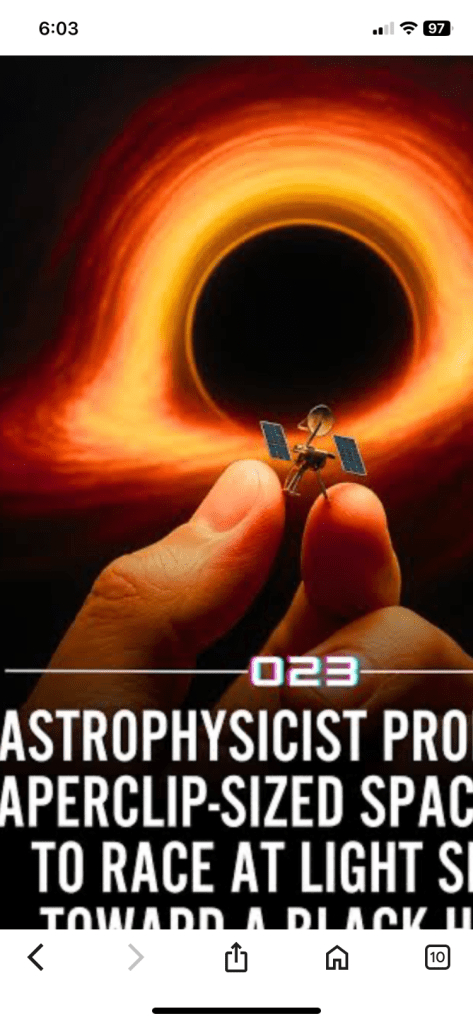
That “crazy” idea is a real proposal from astrophysicist Cosimo Bambi of Fudan University. He has outlined a concept to send a nanocraft, a miniature spacecraft no heavier than a paperclip, to a nearby black hole. This mission would be a long-term project, with a projected journey lasting around 70 years, and it would rely on technology that is still in development. 🚀
Mission Details
The proposed nanocraft would consist of a microchip and a light sail, which would be propelled by powerful lasers from Earth. The laser propulsion would accelerate the tiny craft to approximately one-third the speed of light, making it possible to reach a black hole 20 to 25 light-years away in a few decades. The ultimate goal of the mission is to gather data that could help confirm or challenge Einstein’s theory of general relativity and to investigate whether black holes have true event horizons, which are regions where gravity is so strong that nothing, not even light, can escape.
Challenges Ahead
While the concept is fascinating, it faces significant challenges:
- Finding a Target: The mission hinges on finding a black hole close enough to Earth, which has not yet been discovered. While black holes are invisible, astronomers can detect them by observing their gravitational effects on surrounding stars or the way they distort light. New techniques in gravitational microlensing are making it more feasible to find these smaller, nearby black holes.
- Technological Hurdles: The technology needed to build and propel the nanocraft, as well as to communicate over such vast distances, does not yet exist. The lasers alone are estimated to cost over a trillion euros with current technology, although costs are expected to decrease as technology advances.
Science has always loved 🥰 outrageous challenges

Science has always loved outrageous challenges, but this one might top the list: sending a spacecraft no bigger or heavier than a paperclip straight toward a black hole. The idea comes from astrophysicist Cosimo Bambi of Fudan University in China, who believes it could unlock some of the most profound mysteries in the cosmos—including fresh insights into Einstein’s general theory of relativity.
Right now, the technology doesn’t exist. “In 20 or 30 years, maybe it will,” Bambi says. In the journal iScience, he lays out an audacious plan that could, if realized, take more than a century from start to finish
The century-long plan
Step one: discover a black hole close enough to reach. In theory, one could be just 20 to 25 light-years away, and Bambi thinks we might find it within the next decade.
From there, the timeline gets daunting: twenty years to develop the right spacecraft technology, about 70 years for it to make the trip, and another twenty for the data to beam back to Earth.
The probe wouldn’t be a bulky spaceship. It would weigh just a few grams, with a sail to catch photons from massive Earth-based lasers, pushing it to one-third the speed of light—fast enough to make the journey in a human-relevant timespan.
What we could learn
Once in the extreme environment near a black hole, the tiny probe could gather unprecedented measurements, testing whether the laws of physics behave differently under such conditions.Physics
The catch? We can’t yet build a probe like this, and the laser system alone would cost around $1 trillion at current prices.
Still, Bambi remains optimistic. “Fifty years ago, people thought we’d never see the shadow of a black hole,” he notes. “Now we have two images.” For him, what sounds impossible today could be the headline discovery of tomorrow.
If we could send a probe near a black hole in future what can we find
Sending a probe to a black hole would be a groundbreaking mission that could provide answers to some of the most fundamental questions in physics. It would allow scientists to test theories under the most extreme conditions in the universe.
Key Discoveries
A probe sent to a black hole would focus on the following key areas:
- Testing General Relativity: By observing how a probe behaves near a black hole, scientists could verify whether Albert Einstein’s theory of general relativity holds true under extreme gravitational forces. The theory predicts how space and time are distorted by a black hole’s immense gravity.
- Confirming Event Horizons: A probe could confirm the existence of a black hole’s event horizon, the boundary beyond which nothing, not even light, can escape. The probe could gather data on the behavior of matter and signals as it approaches this point, providing direct evidence for this theoretical concept.
- Unlocking Secrets of the Universe: The mission could shed light on the fundamental nature of black holes and the laws of physics themselves. By studying the environment near a black hole, scientists might be able to unify general relativity with quantum mechanics, a long-standing goal in physics.
Ultimately, a mission like this, while ambitious, could revolutionize our understanding of gravity, space, and time.
Please like subscribe comment your precious comment on universe discoveries
Full article source google
https://www.buymeacoffee.com/Satyam55
https://www.amazon.in/b?_encoding=UTF8&tag=555101-21&link
https://youtube.com/shorts/eA3hyRi7Nng?si=xXxF1eIi2XcgjHmF
Click on the above link to see paperclip video
 Universe discoveries
🙏🌹
Aum Shanti
LikeLike