
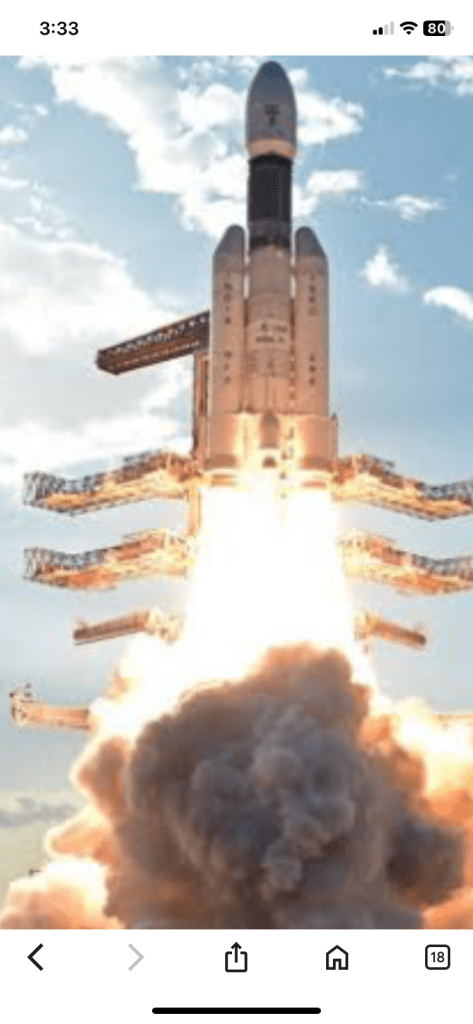
The Indian Space Research Organisation (ISRO) is making significant strides in its launch vehicle capabilities, with plans for its heaviest rocket to date, the Lunar Module Launch Vehicle (LMLV). This new rocket is being developed to support India’s ambitious lunar missions, including the first human mission to the Moon, which is planned for 2040.
LMLV: The New Heavy-Lift Rocket
- Purpose: The LMLV is being built specifically for lunar missions. It will have a much greater payload capacity than ISRO’s current rockets.
- Payload Capacity: The LMLV is designed to carry 80 tonnes to low Earth orbit (LEO) and approximately 27 tonnes to the Moon. This is a substantial increase compared to the current LVM3, which has a LEO payload capacity of about 10 tonnes.
- Specifications: The rocket is planned to be as tall as a 40-storey building and will be a three-stage vehicle. The first two stages will use liquid propellant, while the third stage will utilize cryogenic propellant.
- Timeline: The LMLV is expected to be ready by 2035.
ISRO’s Current Launch Vehicles
ISRO has a family of operational launch vehicles that have been instrumental in its space missions. - Launch Vehicle Mark-3 (LVM3): Previously known as the Geosynchronous Satellite Launch Vehicle Mark III (GSLV Mk III), this is currently ISRO’s heaviest operational rocket. It is a three-stage vehicle capable of placing a 4-tonne class of satellites into Geosynchronous Transfer Orbit (GTO) or about 10 tonnes into LEO. The LVM3 was used for the Chandrayaan-2 and Chandrayaan-3 missions and has been human-rated for the Gaganyaan mission.
- Polar Satellite Launch Vehicle (PSLV): The PSLV is often referred to as ISRO’s “workhorse.” It is a reliable and versatile four-stage vehicle known for launching satellites into Sun-synchronous Polar Orbits, LEO, and GTO. The PSLV has been used for some of India’s most significant missions, including Chandrayaan-1 and the Mars Orbiter Mission (Mangalyaan).
- Geosynchronous Satellite Launch Vehicle (GSLV): This is a fourth-generation, three-stage vehicle designed to launch satellites weighing up to 2 tonnes into GTO.
- Small Satellite Launch Vehicle (SSLV): The SSLV is a new rocket designed for “launch-on-demand” of small satellites (10 to 500 kg) into LEO. It is a three-stage, all-solid propulsion vehicle.
ISRO is also working on a reusable launch vehicle (RLV) demonstrator, which aims to reduce the cost of space travel in the future.
ISRO history

The history of ISRO’s own launch vehicles goes back to 1980, when the space agency successfully launched its first rocket, SLV-3, into space. Since then, ISRO has made much more powerful and efficient rockets such as PSLV and LVM-3.
India had been thinking of rockets even before ISRO was established. On November 21, 1963, it launched the US Nike Apache ‘sounding rocket’ from Thumba, near Thiruvananthapuram. The rocket was taken to the launch site on a bullock cart. Sounding rockets are suborbital rockets that carry experiments to the upper atmosphere of the Earth. They aren’t capable of exiting the planet’s gravity or reaching into space.
The first Indian launch vehicle to arrive there was the SLV-3 in 1980. The mission was led by A P J Abdul Kalam, who had joined ISRO in 1969, and was responsible for designing, developing and launching the vehicle. But the success didn’t come instantly, as the first attempt to send the SLV-3 into space on August 10, 1979, failed.
Scientist Ramabhadran Aravamudan in his book, ISRO: A Personal History, writes about the incident as follows: “The burning of the first stage seemed normal. I was watching Kalam for some sign. Had the rocket performed well? After some time, I saw a blank and fixed expression on his face, followed by disappointment. He turned around and made a thumbs down gesture. Something had gone wrong.”
SLV-3 had gone out of control and splashed into the Bay of Bengal at a distance of 560 km from the coast, about five minutes after take-off from the Sriharikota launch pad.
Kalam and his team learnt quickly from the mistakes. The second attempt for the launch was scheduled for just a year later, on July 18, 1980. There was some tension because Sanjay Gandhi, the Prime Minister’s son, had died in a plane crash about three weeks ago.
“Delhi was in chaos as Indira Gandhi tried to come to terms with the loss. In Trivandrum and SHAR this had a trickledown effect, but we were determined to go ahead with our launch,” Ramabhadran wrote. SLV-3 took off without any glitches, and placed its payload, Rohini 1, a 40 kg experimental satellite, in space. This made India the sixth member of the exclusive club of space-faring nations, and boosted ISRO’s morale to new heights.
The rise of PSLV
SLV-3’s payload capability wasn’t significant. But it provided a learning platform to ISRO, and led to the development of the Augmented Satellite Launch Vehicle (ASLV). This was essentially the SLV-3 rocket, but with additional strap-on boosters, which enabled it to carry a payload of more than 100 kg.
PSLV’s development started in 1982, and its maiden successful launch took place in October 1994. Most significantly, it marked India’s entry into the Big Rockets league, as it could carry a payload of up to 1,000 kg
Isro achievements from 1980 to 2025

The Indian Space Research Organisation (ISRO) is making significant strides in its launch vehicle capabilities, with plans for its heaviest rocket to date, the Lunar Module Launch Vehicle (LMLV). This new rocket is being developed to support India’s ambitious lunar missions, including the first human mission to the Moon, which is planned for 2040.
LMLV: The New Heavy-Lift Rocket
- Purpose: The LMLV is being built specifically for lunar missions. It will have a much greater payload capacity than ISRO’s current rockets.
- Payload Capacity: The LMLV is designed to carry 80 tonnes to low Earth orbit (LEO) and approximately 27 tonnes to the Moon. This is a substantial increase compared to the current LVM3, which has a LEO payload capacity of about 10 tonnes.
- Specifications: The rocket is planned to be as tall as a 40-storey building and will be a three-stage vehicle. The first two stages will use liquid propellant, while the third stage will utilize cryogenic propellant.
- Timeline: The LMLV is expected to be ready by 2035.
ISRO’s Current Launch Vehicles
ISRO has a family of operational launch vehicles that have been instrumental in its space missions. - Launch Vehicle Mark-3 (LVM3): Previously known as the Geosynchronous Satellite Launch Vehicle Mark III (GSLV Mk III), this is currently ISRO’s heaviest operational rocket. It is a three-stage vehicle capable of placing a 4-tonne class of satellites into Geosynchronous Transfer Orbit (GTO) or about 10 tonnes into LEO. The LVM3 was used for the Chandrayaan-2 and Chandrayaan-3 missions and has been human-rated for the Gaganyaan mission.
- Polar Satellite Launch Vehicle (PSLV): The PSLV is often referred to as ISRO’s “workhorse.” It is a reliable and versatile four-stage vehicle known for launching satellites into Sun-synchronous Polar Orbits, LEO, and GTO. The PSLV has been used for some of India’s most significant missions, including Chandrayaan-1 and the Mars Orbiter Mission (Mangalyaan).
- Geosynchronous Satellite Launch Vehicle (GSLV): This is a fourth-generation, three-stage vehicle designed to launch satellites weighing up to 2 tonnes into GTO.
- Small Satellite Launch Vehicle (SSLV): The SSLV is a new rocket designed for “launch-on-demand” of small satellites (10 to 500 kg) into LEO. It is a three-stage, all-solid propulsion vehicle.
ISRO is also working on a reusable launch vehicle (RLV) demonstrator, which aims to reduce the cost of space travel in the future.
Please like subscribe comment your precious comment on universe discoveries
Full article source google
https://www.buymeacoffee.com/Satyam55
https://www.amazon.in/b?_encoding=UTF8&tag=555101-21&link
https://youtube.com/shorts/xuPOBrOSDLw?si=wOpHxsEeDb_znSRV
Watch the interesting video of isro by clicking on above link
 Universe discoveries
🙏🌹
Aum Shanti
LikeLike