

As of September 2025, ISRO is on track to launch the first uncrewed Gaganyaan mission (G1) in December 2025. This mission, featuring the humanoid robot Vyommitra, will be followed by the first crewed flight, which is now targeted for the first quarter of 2027.
Upcoming missions and milestones
- G1 Uncrewed Mission (December 2025):ISRO Chairman V. Narayanan has confirmed the launch of the first uncrewed Gaganyaan test flight for December 2025.
- The mission will carry the half-humanoid robot Vyommitra to simulate human functions and test critical systems.
- This is a crucial step to validate key technologies and safety protocols before the first crewed flight.
- Subsequent Uncrewed Missions (2026):Two more uncrewed missions are planned for 2026 to further test the systems.
- First Crewed Flight (Early 2027): The final crewed mission, which was initially targeted for 2022, was rescheduled to early 2027 to ensure the highest safety standards and conduct comprehensive testing.
- Astronaut Training: The four astronauts selected for the mission are in the final stages of their training. The program has been updated with insights from astronaut Shubhanshu Shukla, who recently flew to the International Space Station (ISS) with Axiom Mission 4.
Recent progress and developments
- Test Vehicle Flights:
- The first Integrated Air Drop Test (IADT-1) was successfully completed in late August 2025.
- The second test vehicle mission (TV-D2) is scheduled for the third quarter of 2025.
- Propulsion System Testing: Successful “hot tests” of the Gaganyaan Service Module Propulsion System (SMPS) were conducted in July 2025.
- Research Milestones: ISRO Chairman V. Narayanan stated in September 2025 that 85% of the research work for the program has been completed.
- International Collaboration: The mission benefits from collaboration with NASA and experience gained from Indian astronauts participating in joint missions.
- Long-Term Goals: The Gaganyaan program is part of a broader Indian space roadmap, which includes establishing the Bharatiya Antariksh Station (BAS) by 2035 and an Indian lunar landing by 2040.
India space station

Name and timeline
- Official Name: The Bharatiya Antariksh Station (BAS).
- First Module Launch: 2028.
- Full Operational Capability: 2035.
- Estimated Crew Capacity: 3–4 (nominal), up to 6 for short durations.
Key recent updates
- Unveiled Model: In August 2025, on National Space Day, the Indian Space Research Organisation (ISRO) unveiled a scale model of the first module (BAS-01) in New Delhi.
- Cabinet Approval: In September 2024, the Indian government approved the development of the BAS’s initial module, committing additional funding as part of the expanded Gaganyaan program.
- Technology Demonstrations:
- Space Docking: The second successful demonstration of space docking and power transfer was completed with the Space Docking Experiment (SpaDeX) mission in January 2025.
- Robotic Arm: A prototype robotic arm, intended to assist in the station’s construction, was successfully operated in space in January 2025.
- International Collaboration: In May 2025, ISRO and the European Space Agency (ESA) signed a Joint Statement of Intent for collaboration on human space exploration, which could lead to European cargo delivery and astronaut visits to the BAS.
Station configuration and technology
- Modular Design: The BAS will be a modular space station, with plans for a total of five modules by 2035.
- First Module (BAS-01):
- Weight and Orbit: 10 tonnes, orbiting at an altitude of 450 km.
- Internal Systems: Includes an indigenous Environmental Control and Life Support System (ECLSS), a docking system, berthing mechanism, and automated hatches.
- Power System: An indigenously developed hydrogen-and-oxygen-based fuel cell system will power the station. A smaller version of this system was successfully tested in 2024.
- Launch Vehicles: Modules will be launched by India’s heavier LVM3 and future Next-Generation Launch Vehicle (NGL) rockets.
Strategic importance and future goals
- Scientific Research: The station will serve as a platform for microgravity research in various scientific fields, from materials and life sciences to medicine.
- Inspiring the Next Generation: Beyond its scientific goals, the BAS is intended to boost India’s space economy, create jobs, and inspire young people to pursue careers in STEM.
- Long-Term Vision: The space station is a key step toward India’s broader ambition of landing an astronaut on the Moon by 2040.
India sucess in space missions from 1947 till now
India’s space program, led by the Indian Space Research Organisation (ISRO), has grown from humble beginnings into a globally respected force known for its cost-effective and innovative missions. From the launch of its first satellite in 1975 to historic lunar landings and interplanetary travel, India has made significant contributions to space exploration.
Foundational era (1960s–1980s)
- 1963: India’s space program began with the launch of its first sounding rocket from Thumba, near Thiruvananthapuram, marking its entry into space research.
- 1969: The Indian Space Research Organisation (ISRO) was formally established to pursue space technology for national development.
- 1975: India’s first satellite, Aryabhata, was launched with a Soviet rocket, proving the country’s capability in satellite design and fabrication.
- 1980: ISRO successfully launched the Rohini satellite using its own Satellite Launch Vehicle (SLV-3), making India the sixth nation to achieve orbital launch capability.
- 1984: Rakesh Sharma became the first Indian to travel to space as part of a joint mission with the Soviet Union.
Era of self-reliance (1990s–2000s)
- 1993: The Polar Satellite Launch Vehicle (PSLV) began its development flights, soon becoming ISRO’s reliable “workhorse” rocket for launching Earth Observation Satellites (EOS) and other payloads.
- 1999: The PSLV launched its first foreign satellites, establishing India as a commercial launch service provider.
- 2001: The Geosynchronous Satellite Launch Vehicle (GSLV) successfully conducted its maiden flight, which was important for launching heavier communication satellites.
- 2008: The Chandrayaan-1 lunar mission was launched. Its instruments detected water molecules and hydroxyl on the lunar surface, a landmark discovery that gained international attention.
Interplanetary exploration (2010s)
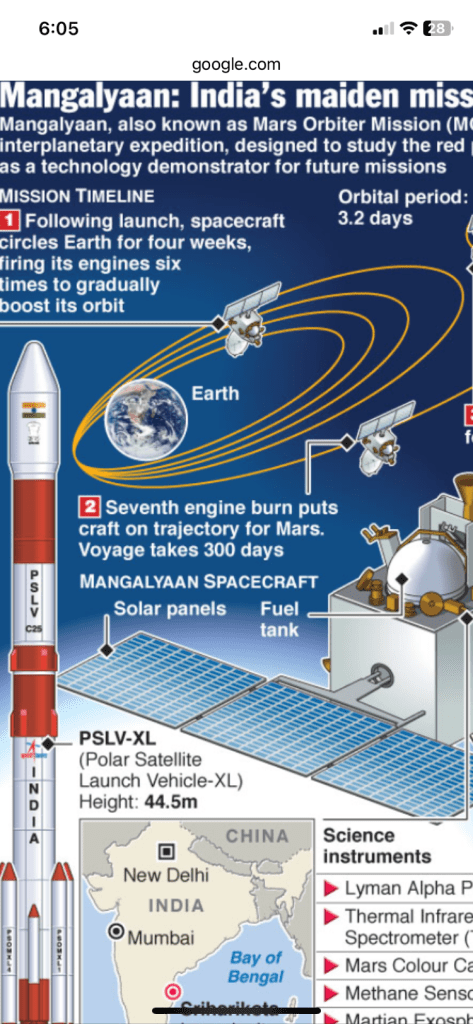
- 2014: The Mars Orbiter Mission (Mangalyaan) made India the first Asian nation to reach Mars orbit and the first country in the world to do so on its first attempt. This highly cost-effective mission cemented India’s reputation in planetary exploration.
- 2017: The PSLV-C37 rocket set a world record by successfully launching 104 satellites into orbit in a single mission.
- 2019: The Chandrayaan-2 lunar mission successfully deployed its orbiter to study the Moon, though the soft landing of its Vikram lander was unsuccessful.
Historic lunar and solar achievements (2020s)
- 2023 (August): The Chandrayaan-3mission achieved a historic soft landing near the Moon’s south pole. This made India the first country to land in this region and the fourth overall to land on the Moon. The lander and rover conducted experiments on the lunar surface, and India declared August 23 as National Space Day to commemorate the event.
- 2023 (September): The Aditya-L1 solar observatory was launched to study the Sun from the Lagrange Point 1. It is India’s first mission dedicated to solar research.
- 2024: India launched XPoSat, its first dedicated mission to study the polarization of cosmic X-rays.
Ongoing and future missions
- Gaganyaan Program: India is actively working on its human spaceflight program, with the first uncrewed mission carrying the humanoid robot Vyommitra scheduled for late 2025. A crewed mission is targeted for 2027.
- Bharatiya Antariksh Station (BAS): The development of India’s first space station, with the first module launch planned for 2028 and completion by 2035.
- Mission to the Moon (2040): India is planning a crewed lunar mission, with the goal of landing an astronaut on the Moon by 2040.
Please like subscribe comment your precious comment on universe discoveries
Full article source google
https://www.buymeacoffee.com/Satyam55
https://www.amazon.in/b?_encoding=UTF8&tag=555101-21&link
https://youtu.be/P1aE1n5Na6w?si=JNMgbItVAJ46E9uL
Click on the above link to watch Gagan yaan video
 Universe discoveries
🙏🌞
Aum Shanti
LikeLike
This is great information to know 👌🏾
LikeLike
This is an excellent and inspiring update on ISRO’s historic journey! 🚀🇮🇳 The detailed overview highlights not only the tremendous progress already made but also the meticulous care being taken to ensure safety and success. The upcoming uncrewed G1 mission with Vyommitra marks a remarkable leap, reflecting India’s ability to blend innovation with responsibility.
LikeLiked by 2 people