

India’s private space startup, Agnikul Cosmos, has announced its plans to develop a fully reusable rocket, similar to SpaceX’s Falcon 9. The announcement was made at the International Astronautical Congress (IAC) 2025 in Sydney, Australia.
Agnikul’s new strategy aims to make space access more affordable and sustainable by ensuring no part of the rocket is expended. The company has already secured patents in the US, Europe, and India for its reusable propulsion systems, semi-cryogenic propellant technology, and a combined launch vehicle-satellite system.
Key Details:
• The Rocket: The company’s flagship rocket, Agnibaan, will be the focus of these reusability efforts.
• Technology: Agnikul is leveraging its expertise in 3D-printed rocket engines and its proprietary autopilot software, which it successfully tested in a previous controlled-ascent flight.
• Cost Reduction: The company claims its additive manufacturing facility in Chennai can cut rocket production costs by as much as 50%.
• Flight Test: Agnikul has stated that it will likely attempt booster recovery in an upcoming flight test of the Agnibaan rocket.
This move positions Agnikul as a key player in the global race to develop cost-effective and environmentally friendly space launch solutions, with support from ISRO and IN-SPACe.
At the heart of Agnikul’s push is a patent for a combined launch vehicle–satellite system along with semi-cryogenic propellant technology, chosen to minimise costs and enable easy refurbishment between flights.
The company has already demonstrated key enablers of this vision, including a successful test of its proprietary autopilot software designed for controlled ascent, marking a major milestone in its journey toward reusable operations.
“We are working on plans for full booster recovery post-launch and also enhancing the life of the upper stage in space. We have consistently designed our vehicles to ensure that affordability and flexibility are never afterthoughts but are built in from day one,” s Srinath Ravichandran, Co-founder and CEO of Agnikul Cosmos ,told IndiaToday.in.
He emphasised the strong support the company has received from ISRO and India’s regulator IN-SPACe, which have opened the doors for experimentation on rocket stage recovery and reuse, a crucial element for commercial viability in space launch.
The effort echoes global trends pioneered by SpaceX’s Falcon 9, which has redefined launch economics through reusability.
What will change after Agnikul reusable rocket in Indian 🇮🇳 space missions
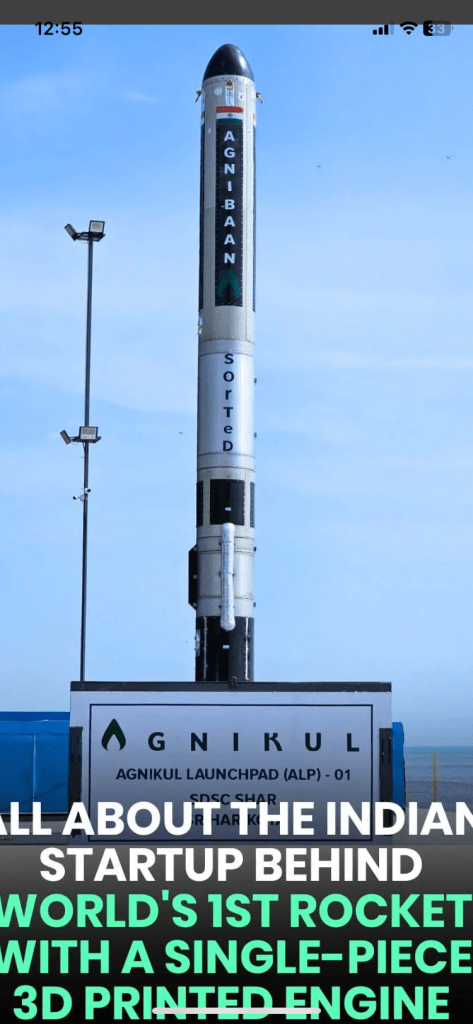
Agnikul’s move towards a reusable rocket will be a major turning point for the Indian space sector, fundamentally changing how missions are conducted. The primary impacts will be in three key areas:
1. Cost and Accessibility
The most significant change will be a drastic reduction in launch costs. Traditionally, rockets are single-use, with each mission requiring a new, expensive vehicle. By reusing a rocket’s components, Agnikul can offer launches at a much lower price point, making space more accessible to a wider range of clients, including small businesses, universities, and research institutions. This will also make India a more competitive player in the global commercial launch market.
2. Launch Frequency and Efficiency
Reusable rockets can significantly increase the frequency of missions. Instead of spending months or years building a new rocket, the company can refurbish and prepare a recovered booster for a new flight in a matter of weeks. This enables a more rapid and responsive launch schedule, allowing for more frequent satellite deployments, technology demonstrations, and scientific experiments.
3. Sustainability and Innovation
By not discarding parts of the rocket after a single use, Agnikul’s approach will also help reduce space debris. This aligns with global efforts to make space exploration more sustainable. Furthermore, the development of these reusable technologies—such as autonomous landing systems and semi-cryogenic propellants—will drive indigenous innovation and strengthen India’s technological capabilities, positioning the country at the forefront of the new space economy.
Please like subscribe comment your precious comments on universe discoveries
Full article source google
 Universe discoveries
🙏🏼🌹
Aum Shanti
LikeLike
Great post! Love how you highlighted sustainability in Agnikul’s reusable rocket journey. Exciting times ahead for India’s space future! 🌍✨
LikeLiked by 1 person