
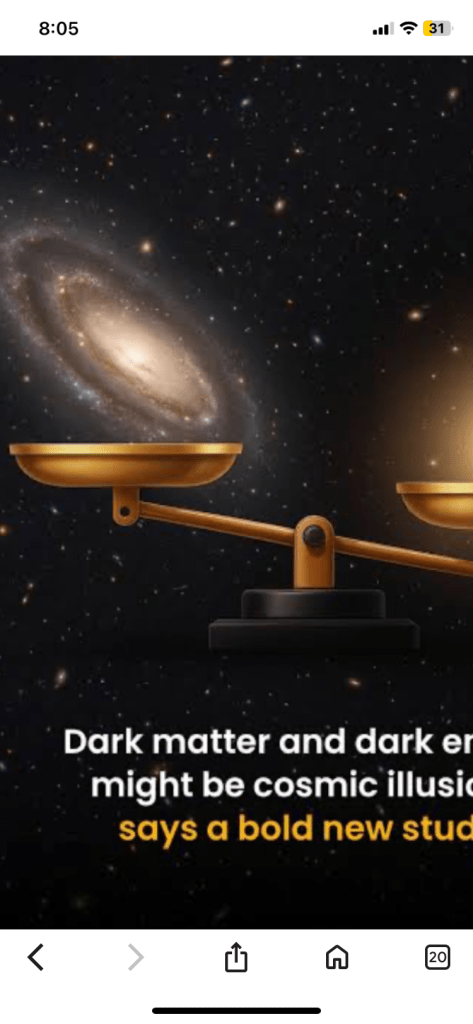
The recent claim that the 95% of the universe composed of dark matter and dark energy might be an illusion was put forward by physicist Rajendra Gupta, an Adjunct Professor at the University of Ottawa.
His research proposes a single, alternative cosmological model that explains both phenomena without resorting to the mysterious components of dark matter and dark energy.
The Alternative Model: Evolving Forces
Dr. Gupta’s hypothesis is based on a modification of the conventional cosmological model, suggesting that the fundamental forces of nature are not constant but slowly weaken as the universe ages.
Explaining Dark Energy (The Illusion of Accelerated Expansion)
• The Problem: Dark energy is thought to be the repulsive force driving the accelerated expansion of the universe, making up about 68% of the cosmos’s total energy content.
• The Alternative: Gupta suggests that as the universe expands, its forces weaken on average. This weakening makes the universe appear to be expanding faster than expected, creating the illusion of a mysterious, accelerating force (dark energy).
Explaining Dark Matter (The Illusion of Extra Gravity)
• The Problem: Dark matter is inferred to exist because its gravity is needed to explain why galaxies and clusters spin so fast without flying apart, accounting for about 27% of the universe’s content.
• The Alternative: The model suggests that the variation of these weakening forces in the gravitationally bound space of galaxies and clusters creates an effect of extra gravity. This effectively mimics the gravitational effects attributed to dark matter.
The Unified Approach
The significance of Gupta’s model is that it attempts to resolve the two major cosmic mysteries—dark matter and dark energy—using a single underlying principle (the slow weakening of fundamental forces) and a single equation, whereas the Standard Model of Cosmology (\LambdaCDM) requires two separate, non-interacting, and yet-to-be-detected entities.
The Consensus View vs. The Illusion
It is important to note that this is a minority viewpoint within the scientific community. The prevailing Standard Model of Cosmology (\LambdaCDM) is supported by a vast body of evidence, including:
While a lack of direct particle detection for dark matter and dark energy keeps the door open for alternative theories, the consensus remains that they are real components necessary to explain the comprehensive set of astrophysical and cosmological observatio
Scientists have long thought that the majority of the universe is invisible. Almost 95% of cosmic material was credited to dark matter and dark energy, which affected cosmic structure and expansion. Physicist Rajendra Gupta now presents a new view that contradicts conventional assumptions regarding the universe
A Single Equation for Cosmic Mysteries
Gupta’s work, as published by LBV Magazine, points out that phenomena in the universe can be explained differently. He is attributing dark matter and dark energy effects to decaying fundamental forces over time. This model employs one variable parameter, α, which varies with the scale of observation. The parameter varies little over enormous cosmic distances but with variation within galaxies in order to account for their distinctive gravitational patterns. Gupta contends that the same equation can be used to describe accelerating expansion as well as galactic rotation without having to invoke unseen particles.
Describing Galaxy Rotation Without Dark Matter
Galaxy rotation curves have been confounding astronomers for decades. Stars on the peripheries of galaxies rotate faster than visible matter can account for. Conventional wisdom attributed this to unknown haloes of dark matter extending around galaxies. Gupta’s theory suggests that fluctuations in α, based on the arrangement of normal matter, produce gravitational effects that masquerade as dark matter. Denser areas remain unaltered, while less dense areas produce more gravity, duplicating observed galactic rotation curves without missing mass.
A second implication of Gupta’s theory is for the age of the universe. There are observations indicating galaxies and supermassive black holes emerging ahead of cosmic formation time as predicted by present theory. With a constant diminution of forces, the model is able to extend cosmic time, allowing structures sufficient time to grow organically. This obviates dark energy-accelerated expansion or the introduction of exotic matter to account for early cosmic development. Gupta propounds that thoroughly documented physical laws can explain these phenomena without invoking untested entities.
Implications for Cosmology
Although still in early stages, Gupta’s proposal invites rethinking of modern cosmology. If correct, dark matter and dark energy may be conceptual tools rather than physical substances. As Gupta concludes, “Perhaps the universe’s greatest secrets are just tricks played by nature’s evolving constants.” Future research will determine whether this approach can stand up to observation and analysis, potentially reshaping our understanding of the cosmos.
Please like subscribe comment your precious comment on universe discoveries
Full article source google
 Universe discoveries
🙏🌹
Aum Shanti
LikeLike
This is a fascinating and thought-provoking post! 🌌✨
Your summary of Rajendra Gupta’s alternative cosmological model is both clear and engaging. I appreciate how you outlined the core idea—that the apparent effects of dark matter and dark energy could emerge from the slow weakening of fundamental forces—without oversimplifying the complex physics involved. The explanations of galaxy rotation curves, accelerating expansion, and the unified single-equation approach are particularly compelling, highlighting how a single principle might reconcile two of the most profound mysteries in modern cosmology.
LikeLiked by 1 person
Thanks sir it’s fascinating 🎸
LikeLiked by 1 person